Downy Emerald
Daily sighting probability <5% · Rare
at Hamburg

In 3 days ~10% in a week ~30%

8 Verified sightings at Hamburg
64 In all 7 parks From 2019 to 2026
May Best month
☀️ Diurnal When it's spotted

About the Downy Emerald

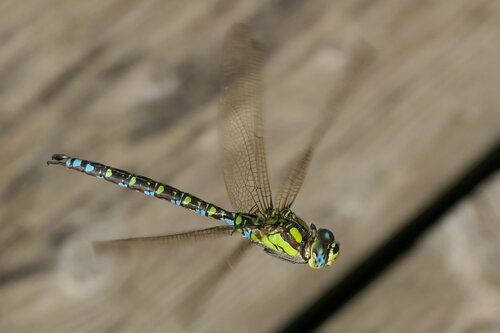
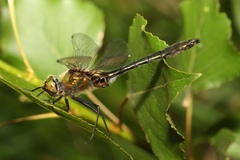
The downy emerald (Cordulia aenea) is a species of dragonfly. It is metallic green and bronze in color, and its thorax is coated with fine hairs, hence its name. Like most other emeralds, the downy emerald has bright shiny green eyes. Adults are around 5 cm (2.0 in) in length, and are in flight from May through July each year.

This species lives in woodlands near lakes and ponds; like other dragonflies, it lays eggs in water and its larvae are aquatic. It is distributed throughout most of Europe. Although it has been eliminated from some of its historic native area in Great Britain due to habitat loss, dense populations of the downy emerald can still be found there in spots where its ideal habitat remains.

After the downy emerald young emerge from their eggs, they live for three years at various larval and nymphal stages. They are fully grown adults for only two months, during which this time they mate and the females deposit their eggs back into the water. Female individuals of the Cordulia aenea (C. aenea) species have panoistic ovaries that produce female sex cells, or oocytes. The nucleus of the panoistic oocyte likely contains all the necessary genetic material to develop the oocyte on its own, form the C. aenea egg yolk, and develop the C. aenea embryo. Wikipedia →

Global Distribution

Parks Where Found

# Park Country Daily sighting probability
1 Plitvice Lakes National Park 🇭🇷 Croatia
~30%
2 Biebrza National Park 🇵🇱 Poland
~20%
3 Mercantour National Park 🇫🇷 France
~10%
4 Triglav National Park 🇸🇮 Slovenia
~10%
5 Bavarian Forest National Park 🇩🇪 Germany
<5%
6 Pyrénées National Park 🇫🇷 France
<5%
7 Wadden Sea National Park 🇩🇪 Germany
<5%

Cities Where Found

# City Country Daily sighting probability
1 Vienna 🇦🇹 Austria
~10%
2 Stockholm 🇸🇪 Sweden
~10%
3 Brussels 🇧🇪 Belgium
~10%
4 Moscow 🇷🇺 Russia
<5%
5 Kyiv 🇺🇦 Ukraine
<5%
6 Hamburg 🇩🇪 Germany
<5%
7 Copenhagen 🇩🇰 Denmark
<5%
8 Paris 🇫🇷 France
<5%
9 Nizhny Novgorod 🇷🇺 Russia
<5%
10 Helsinki 🇫🇮 Finland
<5%

Before you go

What are the chances of seeing a Downy Emerald in Hamburg?

Rare

Under 5% of wildlife watchers report a Downy Emerald sighting in Hamburg on a given day, based on 8 verified sightings from GBIF citizen-science data. It is the 265th most-seen of the 423 insects we can rate there. Over three days the chance rises to about 10%, and over a week to about 30%, if each day is a fresh chance.

When is the best time to see a Downy Emerald in Hamburg?

May and June

In those months about 10% of wildlife watchers report a Downy Emerald in Hamburg on a given day, against under 5% in July to April, the lowest months.

What time of day is best to see a Downy Emerald?

Between 10 am and 1 pm

Across all the parks we cover, that three-hour window holds the most Downy Emerald sightings with a recorded time, and nearly all of them come between 6 am and 6 pm: it is a daytime animal.

Is Hamburg the best place to see a Downy Emerald?

6th of 12

Of the 12 cities where we can rate Downy Emerald sightings, Hamburg ranks 6th at under 5%. The best odds are in Vienna (Austria, about 10%), Stockholm (Sweden, about 10%) and Brussels (Belgium, about 10%).

Which relatives of the Downy Emerald live in Hamburg?

Same order: Odonata

The closest relatives of the Downy Emerald that you can see in Hamburg (order Odonata, Dragonflies and Damselflies) are Azure Damselfly (about 10%), Large Red Damselfly (about 10%) and Black-Tailed Skimmer (about 10%), with each one's daily chance of a sighting.

Where does the Downy Emerald sighting chance come from?

GBIF citizen-science records

It is estimated from how often the Downy Emerald is recorded against all the insects logged in Hamburg (8 verified sightings), calibrated against known sighting rates. Figures are rounded to the nearest 10% because citizen-science data supports honest approximations, not decimals, and months with records from fewer than five people show "—". How it works.

← Back to Hamburg