Striped Blue Crow

Striped Blue Crow

Euploea mulciber

Daily sighting probability ~20% · Possible
at Hanoi

In 3 days ~40% in a week ~70%

5 Verified sightings at Hanoi
119 In all 9 parks From 2019 to 2026
November Best month
☀️ Diurnal When it's spotted

About the Striped Blue Crow

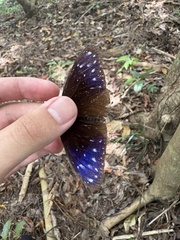
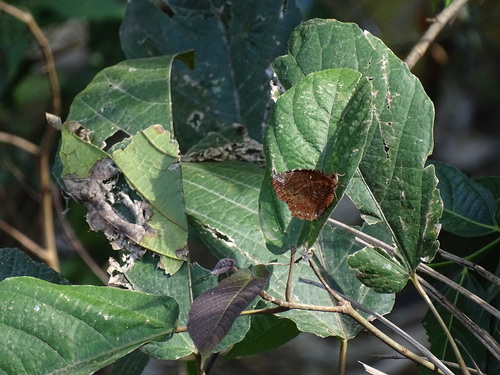
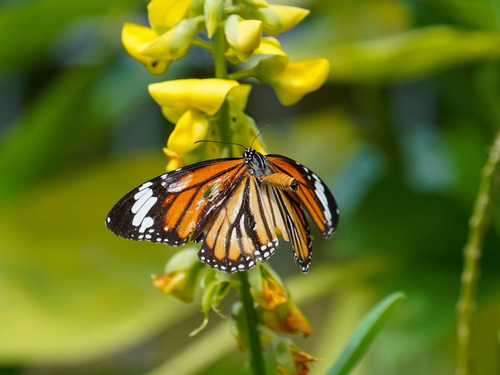
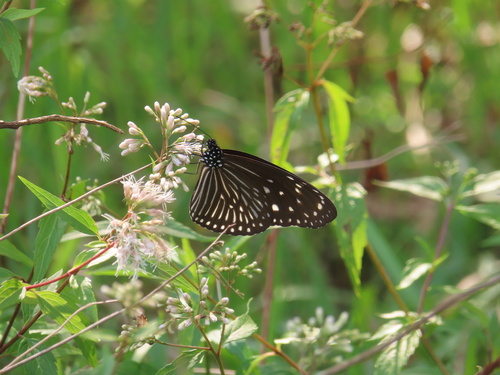
Euploea mulciber, the striped blue crow, is a butterfly found in India and Southeast Asia that belongs to the crows and tigers, that is, the danaid group of the brush-footed butterflies family. Hindwing ovate. Upperside: in the male dark brown entirely glossed with brilliant blue; the following violescent white spots—a spot in apex of cell, a much curved series of five or six discal spots, a subterminal sinuous row of larger spots and an incomplete terminal series of dots. Hindwing uniform, unmarked except for a large patch of light-brown, densely set hair-like scales on the outer upper third of the wing. The female is a lighter brown, the forewing only glossed with blue on the disc; spots white, and more or less similar to those on the forewing of the male, but larger and pure white; in addition a streak in cell and another curved streak in interspace 1 showing through faintly from the underside. Hindwing: narrow white streaks in cell and in the interspaces beyond and a terminal row of slightly elongate white spots.

Underside similar to the upperside in each, but the markings broader, larger and more distinct; in the male there are besides a small white spot in apex... Wikipedia →

Global Distribution

Parks Where Found

# Park Country Daily sighting probability
1 Cuc Phuong National Park 🇻🇳 Vietnam
~40%
2 Royal Manas National Park 🇧🇹 Bhutan
~40%
3 Namdapha National Park 🇮🇳 India
~40%
4 Cat Tien National Park 🇻🇳 Vietnam
~20%
5 Taroko National Park 🇹🇼 Taiwan
~10%
6 Kaeng Krachan National Park 🇹🇭 Thailand
~10%
7 Khao Yai National Park 🇹🇭 Thailand
~10%
8 Gunung Leuser National Park 🇮🇩 Indonesia
~10%
9 Kinabalu Park 🇲🇾 Malaysia
~10%

Cities Where Found

# City Country Daily sighting probability
1 Naha 🇯🇵 Japan
~20%
2 Hanoi 🇻🇳 Vietnam
~20%
3 Jakarta 🇮🇩 Indonesia
~10%
4 Bandung 🇮🇩 Indonesia
~10%
5 Dehradun 🇮🇳 India
~10%
6 Taipei 🇹🇼 Taiwan
~10%
7 Tasikmalaya 🇮🇩 Indonesia
~10%
8 Taichung 🇹🇼 Taiwan
~10%
9 Singapore 🇸🇬 Singapore
~10%
10 Guangzhou 🇨🇳 China
<5%

Before you go

What are the chances of seeing a Striped Blue Crow in Hanoi?

Possible

About 20% of wildlife watchers report a Striped Blue Crow sighting in Hanoi on a given day, based on 5 verified sightings from GBIF citizen-science data. It is the 33rd most-seen of the 36 insects we can rate there. Over three days the chance rises to about 40%, and over a week to about 70%, if each day is a fresh chance.

When is the best time to see a Striped Blue Crow in Hanoi?

November

In that month about 40% of wildlife watchers report a Striped Blue Crow in Hanoi on a given day, against under 5% in February to October, the lowest months. That is one of Hanoi's driest months, with about 50 mm of rain against 320 mm in August.

What time of day is best to see a Striped Blue Crow?

Between 8 and 11 am

Across all the parks we cover, that three-hour window holds the most Striped Blue Crow sightings with a recorded time, and about 9 in 10 of them come between 6 am and 6 pm: it is a daytime animal.

Is Hanoi the best place to see a Striped Blue Crow?

Among the best

Of the 11 cities where we can rate Striped Blue Crow sightings, Hanoi ranks 2nd at about 20%, level with the leaders once rounded. The best odds are in Naha (Japan, about 20%).

Which relatives of the Striped Blue Crow live in Hanoi?

Same family: Nymphalidae

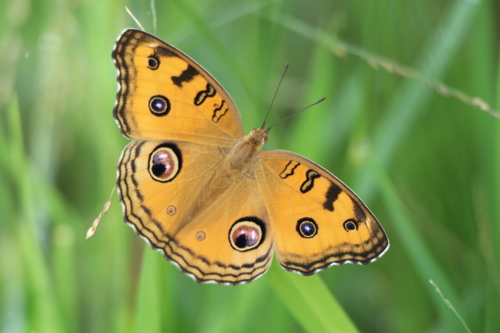
The closest relatives of the Striped Blue Crow that you can see in Hanoi (family Nymphalidae, Brush-footed Butterflies) are Common Palmfly (about 40%), Great Eggfly (about 40%) and Peacock Pansy (about 30%), with each one's daily chance of a sighting.

Where does the Striped Blue Crow sighting chance come from?

GBIF citizen-science records

It is estimated from how often the Striped Blue Crow is recorded against all the insects logged in Hanoi (5 verified sightings), calibrated against known sighting rates. Figures are rounded to the nearest 10% because citizen-science data supports honest approximations, not decimals, and months with records from fewer than five people show "—". How it works.
← Back to Hanoi