Orangebreast

Orangebreast

Amandava subflava

Silhouette: Sheatherius · PhyloPic

LCLeast ConcernNTVUENCR
Daily sighting probability ~10% · With luck
at Harare

In 3 days ~20% in a week ~40%

45 Verified sightings at Harare
114 In all 5 parks From 2019 to 2026
May Best month
☀️ Diurnal When it's spotted

About the Orangebreast

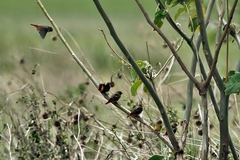
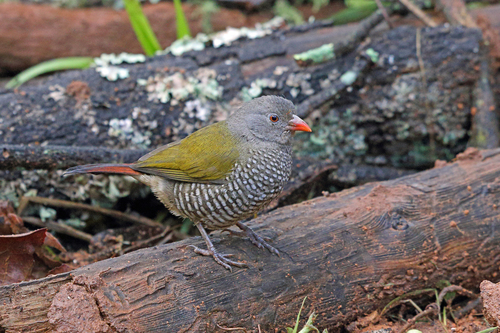
The orange-breasted waxbill (Amandava subflava), also known as the zebra waxbill, is a small (approximately 9 cm long) sparrow-like bird with a reddish iris, orange breast, red bill and dark olive-green plumage. The male has a red rump, dark bars on the whitish flank and a scarlet eyebrow stripe. The female is duller and smaller than male; it also lacks the male's red eyebrow.

The orange-breasted waxbill is found in grassland and savannahs south of the Sahara in Africa. It has an estimated global extent of occurrence of 10,000,000 km2. This species is also introduced to other countries, e.g., Kuwait. Its diet consists mainly of seeds, insects and shoots. The female usually lays between four and six eggs in an oval-shaped nest made from grass. These nests are often the old nests of red-collared widowbirds.

Widespread and common throughout its large range, the orange-breasted waxbill is evaluated to be of least concern on the IUCN Red List of Threatened Species. It is listed on Appendix III of CITES in Ghana. BirdLife International species factsheet

Species text in The Atlas of Southern African Birds Wikipedia →

Sounds

Call0:19

Zambia · 2024

© Dries Van de Loock · XC872300 · CC BY-NC-ND 4.0

Recording0:14

South Africa · 2012

© Nature sounds by Simply Birding · XC649902 · CC BY-NC-ND 4.0

Call0:19

Senegal · 2020

© Bram Piot · XC528267 · CC BY-NC-SA 4.0

Global Distribution

Parks Where Found

# Park Country Daily sighting probability
1 Mikumi National Park 🇹🇿 Tanzania
~10%
2 Nairobi National Park 🇰🇪 Kenya
<5%
3 Kruger National Park 🇿🇦 South Africa
<5%
4 Queen Elizabeth National Park 🇺🇬 Uganda
<5%
5 Ngorongoro Conservation Area 🇹🇿 Tanzania
<5%

Cities Where Found

# City Country Daily sighting probability
1 Harare 🇿🇼 Zimbabwe
~10%

Zoos & Centres Where Found

# Zoo / Centre Country
1 Wilhelma 🇩🇪 Germany In captivity
2 Halls Gap Zoo 🇦🇺 Australia In captivity
3 Cambridge Butterfly Conservatory 🇨🇦 Canada In captivity
4 Birdworld Kuranda 🇦🇺 Australia In captivity
5 Key West Butterfly and Nature Conservatory 🇺🇸 United States In captivity
6 Kuranda Koala Gardens 🇦🇺 Australia In captivity

Before you go

What are the chances of seeing an Orangebreast in Harare?

With luck

About 10% of wildlife watchers report an Orangebreast sighting in Harare on a given day, based on 45 verified sightings from GBIF citizen-science data. It is the 96th most-seen of the 213 birds we can rate there. Over three days the chance rises to about 20%, and over a week to about 40%, if each day is a fresh chance.

When is the best time to see an Orangebreast in Harare?

May

In that month about 20% of wildlife watchers report an Orangebreast in Harare on a given day, against under 5% in February, September–October and December, the lowest months. That is one of Harare's driest months, with about 5 mm of rain against 200 mm in December.

What time of day is best to see an Orangebreast?

Between 7 and 10 am

Across all the parks we cover, that three-hour window holds the most Orangebreast sightings with a recorded time, and about 9 in 10 of them come between 6 am and 6 pm: it is a daytime animal.

Where else can you see an Orangebreast?

Only Harare, in our data

Harare is the only city on Wallace's Line with enough records to rate Orangebreast sightings: about 10% of wildlife watchers there report one on a given day.

Where does the Orangebreast sighting chance come from?

GBIF citizen-science records

It is estimated from how often the Orangebreast is recorded against all the birds logged in Harare (45 verified sightings), calibrated against known sighting rates. Figures are rounded to the nearest 10% because citizen-science data supports honest approximations, not decimals, and months with records from fewer than five people show "—". How it works.

← Back to Harare