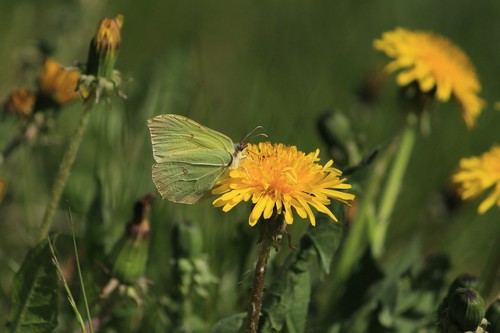
Coxcomb Prominent

Coxcomb Prominent

Ptilodon capucina

Daily sighting probability <5% · Rare
at Helsinki

In 3 days ~10% in a week ~20%

5 Verified sightings at Helsinki
133 In all 5 parks From 2019 to 2026
June Best month
☀️🌙 Day & Night When it's spotted

About the Coxcomb Prominent

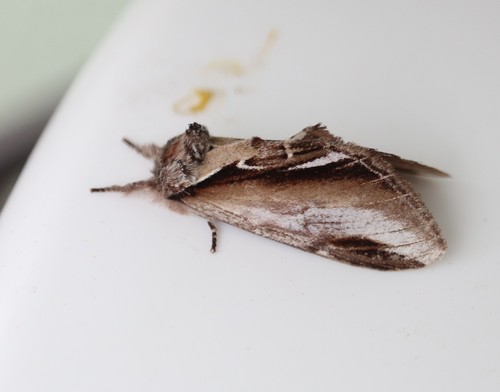
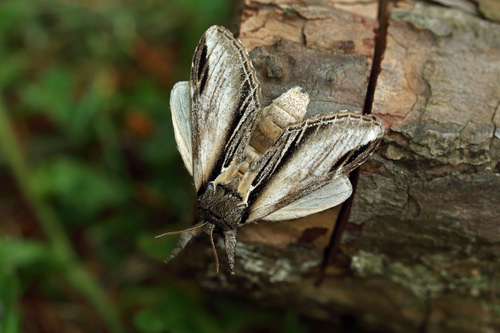
The coxcomb prominent (Ptilodon capucina) is a moth of the family Notodontidae. It is a common species throughout the Palearctic realm from Ireland to Japan. It was first described by Carl Linnaeus in his 1758 10th edition of Systema Naturae.

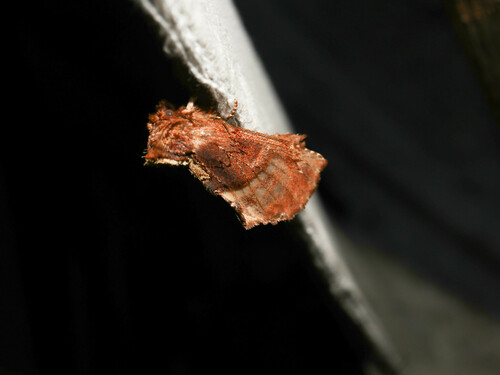
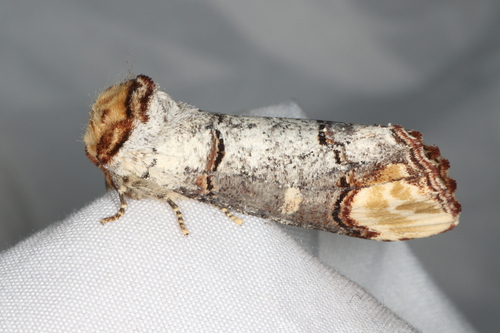
This species has brown forewings, varying considerably in tone, with indistinct darker markings. The hindwings are buffish with a black spot at the tornus. At rest, the species has a very distinctive profile with tufts of hairs protruding upwards from the thorax and the hind edge of the forewings (this latter feature shared with other prominents). The margins of the forewings are also wavy. This rather "lumpy" appearance has led to the rather fanciful comparison to the comb on a cock's head.

Seitz - Thorax and forewing reddish grey, the ground lighter or darker, the two transverse bands narrow, black and very sharply dentate, strongly approximated at the tooth of scales of the hind margin; beyond the postdiscal band a whitish submarginal band, often but feebly indicated.Hindwing paler, yellowish brown or greyish brown, with black anal spot traversed by a transverse whitish line, and with a slightly indicated pale postdiscal band. Distributed from Northern Spain and Central Italy throughout Europe, northward to Scotland and Scandinavia, eastward throughout Siberia to Corea and Japan. —giraffina Hbn.[ aberration] is a dark form with the ground-colour of the forewing red-brown to blackish; it occurs throughout the distribution-area of camelina [ capucina ], being rare in the West, but commoner in Japan. — Egg strongly globose, whitish.Larva at first green with glossy black head and numerous deep black dots which bear long hairs. Fullfed greenish to pale brown-red; on abdominal segment 8 two dark red pointed tubercles. Stigmata black, behind each a red spot. May—September on various deciduous trees, particularly Birch and Lime, at first gregarious.At rest the head is raised in Sphinx-shape. Pupa dark red-brown, the pointed anal end with several thin spines; at the foot of trees in a cell in the ground. Moth in 2 broods in the South, April-—May and July–August; from Central Germany northward one brood only, April to June. One of the commonest Prominents. Wikipedia →
Global Distribution

Parks Where Found

# Park Country Daily sighting probability
1 Snowdonia National Park 🇬🇧 United Kingdom
~10%
2 Wadden Sea National Park 🇩🇪 Germany
~10%
3 Bavarian Forest National Park 🇩🇪 Germany
~10%
4 Cairngorms National Park 🇬🇧 United Kingdom
~10%
5 Pyrénées National Park 🇫🇷 France
~10%

Cities Where Found

# City Country Daily sighting probability
1 Manchester 🇬🇧 United Kingdom
<5%
2 Helsinki 🇫🇮 Finland
<5%

Before you go

What are the chances of seeing a Coxcomb Prominent in Helsinki?

Rare

Under 5% of wildlife watchers report a Coxcomb Prominent sighting in Helsinki on a given day, based on 5 verified sightings from GBIF citizen-science data. It is the 732nd most-seen of the 838 insects we can rate there. Over three days the chance rises to about 10%, and over a week to about 20%, if each day is a fresh chance.

When is the best time to see a Coxcomb Prominent in Helsinki?

Any time of year

In every month with enough records, under 5% of wildlife watchers report a Coxcomb Prominent in Helsinki on a given day, so our monthly data shows no clear season.

What time of day is best to see a Coxcomb Prominent?

Between 11 pm and 2 am

Across all the parks we cover, that three-hour window holds the most Coxcomb Prominent sightings with a recorded time, and about half of them come between 6 pm and 6 am: it is seen both by day and at night.

Is Helsinki the best place to see a Coxcomb Prominent?

Among the best

Of the 2 cities where we can rate Coxcomb Prominent sightings, Helsinki ranks 2nd at under 5%, level with the leaders once rounded. The best odds are in Manchester (United Kingdom, under 5%).

Where does the Coxcomb Prominent sighting chance come from?

GBIF citizen-science records

It is estimated from how often the Coxcomb Prominent is recorded against all the insects logged in Helsinki (5 verified sightings), calibrated against known sighting rates. Figures are rounded to the nearest 10% because citizen-science data supports honest approximations, not decimals, and months with records from fewer than five people show "—". How it works.

← Back to Helsinki