Metallic Coolskink

Metallic Coolskink

Carinascincus metallicus

Silhouette: David Orr · PhyloPic

LCLeast ConcernNTVUENCR Endemic
Daily sighting probability ~10% · With luck
at Hobart

In 3 days ~40% in a week ~60%

14 Verified sightings at Hobart
305 In all 4 parks From 2019 to 2026
February Best month
☀️ Diurnal When it's spotted

About the Metallic Coolskink

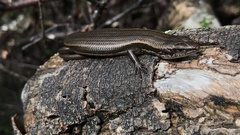
"Metallic skink" may also refer to the garden skink (Lampropholis delicata). Carinascincus metallicus, the metallic cool-skink or metallic skink is a species of skink in the family Scincidae. It is endemic to Australia, found in southern Victoria, as well as in Tasmania where it is the most widespread and common lizard, occurring on many offshore islands in Bass Strait as well as the mainland. It gives birth to live young. It is highly variable in colour and pattern, and may be a complex of closely related species.

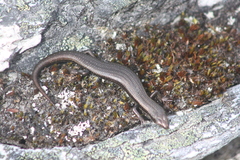
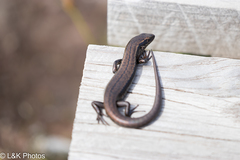
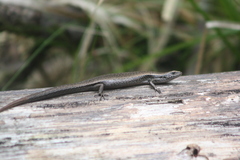
The Metallic Skink exhibits a range of colour variations depending on its habitat. It is typically brown with pale or dark streaks, sometimes forming distinct longitudinal stripes along its body. The dorsal scales have a metallic sheen, which gives the species its name. The underside is usually grey or white with dark spots on the throat, chest, and tail, while the belly and lower tail often have an orange or pink hue.

This species has 24–28 rows of keeled (ridged) scales at mid-body. It has dark eyes, a movable lower eyelid with a transparent disc, and an ear opening of similar size. Adult skinks can grow up to 63 mm in length.... Wikipedia →

Global Distribution

Parks Where Found

# Park Country Daily sighting probability
1 Cradle Mountain-Lake St Clair National Park 🇦🇺 Australia
~80%
2 Maria Island National Park 🇦🇺 Australia
~30%
3 Freycinet National Park 🇦🇺 Australia
~30%
4 Wilsons Promontory National Park 🇦🇺 Australia
~30%

Cities Where Found

# City Country Daily sighting probability
1 Hobart 🇦🇺 Australia
~10%

Before you go

What are the chances of seeing a Metallic Coolskink in Hobart?

With luck

About 10% of wildlife watchers report a Metallic Coolskink sighting in Hobart on a given day, based on 14 verified sightings from GBIF citizen-science data. Over three days the chance rises to about 40%, and over a week to about 60%, if each day is a fresh chance.

When is the best time to see a Metallic Coolskink in Hobart?

February–March, May and August–September

In those months about 20% of wildlife watchers report a Metallic Coolskink in Hobart on a given day, against under 5% in June and July, the lowest months.

What time of day is best to see a Metallic Coolskink?

Between 1 and 4 pm

Across all the parks we cover, that three-hour window holds the most Metallic Coolskink sightings with a recorded time, and about 9 in 10 of them come between 6 am and 6 pm: it is a daytime animal.

Where else can you see a Metallic Coolskink?

Only Hobart, in our data

Hobart is the only city on Wallace's Line with enough records to rate Metallic Coolskink sightings: about 10% of wildlife watchers there report one on a given day.

Which relatives of the Metallic Coolskink live in Hobart?

Same family: Scincidae

The closest relatives of the Metallic Coolskink that you can see in Hobart (family Scincidae, Skinks) are Blotched Bluetongue (about 10%) and White's Rock-skink (about 10%), with each one's daily chance of a sighting.

Where does the Metallic Coolskink sighting chance come from?

GBIF citizen-science records

It is estimated from how often the Metallic Coolskink is recorded against all the reptiles logged in Hobart (14 verified sightings), calibrated against known sighting rates. Figures are rounded to the nearest 10% because citizen-science data supports honest approximations, not decimals, and months with records from fewer than five people show "—". How it works.

← Back to Hobart