Common Bronzeback Tree Snake

Common Bronzeback Tree Snake

Dendrelaphis tristis

Silhouette: Alex Slavenko · PhyloPic

LCLeast ConcernNTVUENCR
Daily sighting probability ~10% · With luck
at Hyderabad

In 3 days ~30% in a week ~60%

21 Verified sightings at Hyderabad
12 In all 2 parks From 2019 to 2026
April Best month
☀️ Diurnal When it's spotted

About the Common Bronzeback Tree Snake

Dendrelaphis tristis (Common bronzeback or Daudin's bronzeback) is a species of colubrid tree-snake found in South Asia. It is not venomous, and harmless to humans. Dendrelaphis tristis belongs to the genus Dendrelaphis, which contains 48 other described species.

Dendrelaphis is one of five genera belonging to the vine snake subfamily Ahaetuliinae, of which Dendrelaphis is most closely related to Chrysopelea, as shown in the cladogram below: Dendrelaphis tristis is found in Sri Lanka, India, Bangladesh, Nepal, Myanmar, Pakistan, and Bhutan, although its presence is uncertain in Myanmar, Bhutan, and Pakistan. It is diurnal and fully arboreal. It lives in various types of forests, from dry deciduous to semi-evergreen, and has even been reported in urban gardens and parks.

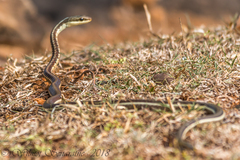
Dendrelaphis tristis is a long, slender snake with a pointed head and a bronze-coloured line running right down its back. It is camouflaged among the leaves because of its uniform ruddy brown skin. Its diet includes geckos, garden lizards, frogs, and small birds. It is not venomous, and harmless to humans.

The snake has oviparous... Wikipedia →

Global Distribution

Parks Where Found

# Park Country Daily sighting probability
1 Wilpattu National Park 🇱🇰 Sri Lanka
~20%
2 Minneriya National Park 🇱🇰 Sri Lanka
~20%

Cities Where Found

# City Country Daily sighting probability
1 Jabalpur 🇮🇳 India
~40%
2 Visakhapatnam 🇮🇳 India
~40%
3 Hyderabad 🇮🇳 India
~10%
4 Kolkata 🇮🇳 India
~10%
5 Chennai 🇮🇳 India
~10%

Zoos & Centres Where Found

# Zoo / Centre Country
1 Nehru Zoological Park 🇮🇳 India In captivity

Before you go

What are the chances of seeing a Common Bronzeback Tree Snake in Hyderabad?

With luck

About 10% of wildlife watchers report a Common Bronzeback Tree Snake sighting in Hyderabad on a given day, based on 21 verified sightings from GBIF citizen-science data. It is the 10th most-seen of the 23 reptiles we can rate there. Over three days the chance rises to about 30%, and over a week to about 60%, if each day is a fresh chance.

When is the best time to see a Common Bronzeback Tree Snake in Hyderabad?

April and July

In those months about 20% of wildlife watchers report a Common Bronzeback Tree Snake in Hyderabad on a given day, against under 5% in March, June, October and December–January, the lowest months. Those are among Hyderabad's wettest months, with about 95 mm of rain a month against almost none in December.

What time of day is best to see a Common Bronzeback Tree Snake?

Between 5 and 8 am

Across all the parks we cover, that three-hour window holds the most Common Bronzeback Tree Snake sightings with a recorded time, and about 8 in 10 of them come between 6 am and 6 pm: it is a daytime animal.

Is Hyderabad the best place to see a Common Bronzeback Tree Snake?

3rd of 5

Of the 5 cities where we can rate Common Bronzeback Tree Snake sightings, Hyderabad ranks 3rd at about 10%. The best odds are in Jabalpur (India, about 40%) and Visakhapatnam (India, about 40%).

Which relatives of the Common Bronzeback Tree Snake live in Hyderabad?

Same family: Colubridae

The closest relatives of the Common Bronzeback Tree Snake that you can see in Hyderabad (family Colubridae, Colubrid Snakes) are Chequered Keelback (about 20%), Dhaman (about 20%) and Ahaetulla oxyrhyncha (about 10%), with each one's daily chance of a sighting.

Where does the Common Bronzeback Tree Snake sighting chance come from?

GBIF citizen-science records

It is estimated from how often the Common Bronzeback Tree Snake is recorded against all the reptiles logged in Hyderabad (21 verified sightings), calibrated against known sighting rates. Figures are rounded to the nearest 10% because citizen-science data supports honest approximations, not decimals, and months with records from fewer than five people show "—". How it works.

← Back to Hyderabad