Blue-capped Rock-Thrush

Blue-capped Rock-Thrush

Monticola cinclorhynchus

Silhouette: Martin Bulla, based on François Desbordes' illustration · PhyloPic

Daily sighting probability ~10% · With luck
at Jabalpur

In 3 days ~30% in a week ~60%

100 Verified sightings at Jabalpur
571 In all 9 parks From 2019 to 2026
April Best month
☀️ Diurnal When it's spotted

About the Blue-capped Rock-Thrush

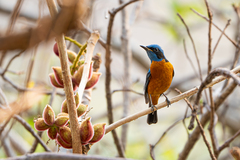
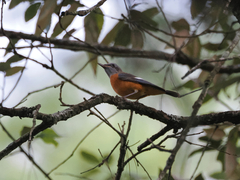
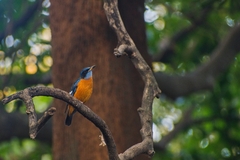
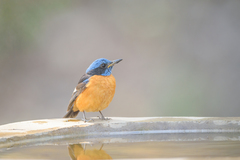
The blue-capped rock thrush (Monticola cinclorhyncha) is a species of bird in the family Muscicapidae. The male has a blue head, chin and throat. The upper parts are blue and black. The rump and underparts are chestnut brown. There is a white patch on the wing that is visible during flight. The female bird is brown with a brown and white underside.

The blue-capped rock thrush breeds in dense forests in the Himalayas and winters in the lowlands of southern India. During winter it is found primarily in the Western Ghats and Eastern Ghats of southern India. Like thrushes, they fly up into trees and sit motionless when they are disturbed. It is a summer visitor in parts of Afghanistan and along the Himalayas from Pakistan to Arunachal Pradesh. In summer it is found in pine forests and hill slopes. In winter it is found in dense canopied forests. Wikipedia →

Sounds

Recording0:12

India · 2023

© dbeadle · iNaturalist · CC BY-NC 4.0

Global Distribution

Parks Where Found

# Park Country Daily sighting probability
1 Royal Manas National Park 🇧🇹 Bhutan
~30%
2 Eravikulam National Park 🇮🇳 India
~10%
3 Langtang National Park 🇳🇵 Nepal
<5%
4 Nagarhole National Park 🇮🇳 India
<5%
5 Bandhavgarh National Park 🇮🇳 India
<5%
6 Kanha National Park 🇮🇳 India
<5%
7 Jim Corbett National Park 🇮🇳 India
<5%
8 Satpura National Park 🇮🇳 India
<5%
9 Periyar National Park 🇮🇳 India
<5%

Cities Where Found

# City Country Daily sighting probability
1 Jabalpur 🇮🇳 India
~10%
2 Srinagar 🇮🇳 India
<5%
3 Bengaluru 🇮🇳 India
<5%
4 Kathmandu 🇳🇵 Nepal
<5%
5 Lucknow 🇮🇳 India
<5%
6 Kolkata 🇮🇳 India
<5%
7 Visakhapatnam 🇮🇳 India
<5%
8 Dehradun 🇮🇳 India
<5%
9 Hyderabad 🇮🇳 India
<5%
10 Pune 🇮🇳 India
<5%

Before you go

What are the chances of seeing a Blue-capped Rock-Thrush in Jabalpur?

With luck

About 10% of wildlife watchers report a Blue-capped Rock-Thrush sighting in Jabalpur on a given day, based on 100 verified sightings from GBIF citizen-science data. It is the 65th most-seen of the 185 birds we can rate there. Over three days the chance rises to about 30%, and over a week to about 60%, if each day is a fresh chance.

When is the best time to see a Blue-capped Rock-Thrush in Jabalpur?

April

In that month about 40% of wildlife watchers report a Blue-capped Rock-Thrush in Jabalpur on a given day, against under 5% in May–September and November–February, the lowest months. That is one of Jabalpur's driest months, with about 10 mm of rain against 410 mm in July.

What time of day is best to see a Blue-capped Rock-Thrush?

Between 7 and 10 am

Across all the parks we cover, that three-hour window holds the most Blue-capped Rock-Thrush sightings with a recorded time, and about 9 in 10 of them come between 6 am and 6 pm: it is a daytime animal.

Is Jabalpur the best place to see a Blue-capped Rock-Thrush?

Yes

Of the 10 cities where we can rate Blue-capped Rock-Thrush sightings, Jabalpur has the highest daily chance: about 10%. Next come Srinagar (India, under 5%) and Bengaluru (India, under 5%).

Where does the Blue-capped Rock-Thrush sighting chance come from?

GBIF citizen-science records

It is estimated from how often the Blue-capped Rock-Thrush is recorded against all the birds logged in Jabalpur (100 verified sightings), calibrated against known sighting rates. Figures are rounded to the nearest 10% because citizen-science data supports honest approximations, not decimals, and months with records from fewer than five people show "—". How it works.

← Back to Jabalpur