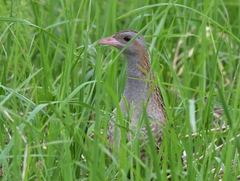
Corn Crake

Corn Crake

Crex crex

Silhouette: Michael Day · PhyloPic

LCLeast ConcernNTVUENCR
Daily sighting probability <5% · Rare
at Jerusalem

In 3 days <5%

8 Verified sightings at Jerusalem
533 In all 9 parks From 2019 to 2026
October Best month
☀️🌙 Day & Night When it's spotted

About the Corn Crake

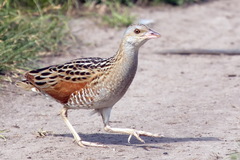
The corn crake, corncrake or landrail (Crex crex) is a bird in the rail family. It breeds in Europe and Asia as far east as western China, and migrates to Africa for the Northern Hemisphere's winter. It is a medium-sized crake with buff- or grey-streaked brownish-black upperparts, chestnut markings on the wings, and blue-grey underparts with rust-coloured and white bars on the flanks and undertail. The strong bill is flesh-toned, the iris is pale brown, and the legs and feet are pale grey. Juveniles are similar in plumage to adults, and downy chicks are black, as with all rails. There are no subspecies, although individuals from the east of the breeding range tend to be slightly paler than their western counterparts. The male's call is a loud krek krek, from which the scientific name is derived. The corn crake is larger than its closest relative, the African crake, which shares its wintering range; that species is also darker-plumaged, and has a plainer face.

The corn crake's breeding habitat is grassland, particularly hayfields, and it uses similar environments on the wintering grounds. This secretive species builds a nest of grass leaves in a hollow in the ground and lays 6–14 cream-coloured eggs which are covered with rufous blotches. These hatch in 19–20 days, and the black precocial chicks fledge after about five weeks. This crake is in steep decline across much of its former breeding range because modern farming practices often destroy nests before breeding is completed. The corn crake is omnivorous but mainly feeds on invertebrates, the occasional small frog or mammal, and plant material including grass seed and cereal grain. Threats include dogs, cats, other introduced and feral mammals, large birds, various parasites and diseases.

Although numbers have declined steeply in western Europe, this bird is classed as least concern on the IUCN Red List because of its huge range and large, apparently stable, populations in Russia and Kazakhstan. Numbers in western China are more significant than previously thought, and conservation measures have facilitated an increased population in some countries which had suffered the greatest losses. Despite its elusive nature, the loud call has ensured the corn crake has been noted in literature, and garnered a range of local and dialect names. Wikipedia →

Sounds

Song0:39

Poland · 2026

© Krzysztof J. · XC1139509 · CC BY-NC-SA 4.0

Call0:16

France · 2025

© Ryan Boswarthick · XC1006948 · CC BY-NC-SA 4.0

Duet1:11

Sweden · 2024

© Dag Österlund · XC921308 · CC BY-NC-SA 4.0

Global Distribution

Parks Where Found

# Park Country Daily sighting probability
1 Białowieża National Park 🇵🇱 Poland
~20%
2 Biebrza National Park 🇵🇱 Poland
~20%
3 Fertő-Hanság National Park 🇭🇺 Hungary
<5%
4 Tatra National Park 🇸🇰 Slovakia
<5%
5 Tsavo West National Park 🇰🇪 Kenya
<5%
6 Gauja National Park 🇱🇻 Latvia
<5%
7 Samburu National Reserve 🇰🇪 Kenya
<5%
8 Masai Mara National Reserve 🇰🇪 Kenya
<5%
9 Kruger National Park 🇿🇦 South Africa
<5%

Cities Where Found

# City Country Daily sighting probability
1 Yekaterinburg 🇷🇺 Russia
<5%
2 Moscow 🇷🇺 Russia
<5%
3 Minsk 🇧🇾 Belarus
<5%
4 Warsaw 🇵🇱 Poland
<5%
5 Tel Aviv 🇮🇱 Israel
<5%
6 Saint Petersburg 🇷🇺 Russia
<5%
7 Helsinki 🇫🇮 Finland
<5%
8 Jerusalem 🇮🇱 Israel
<5%
9 Istanbul 🇹🇷 Turkey
<5%

Zoos & Centres Where Found

# Zoo / Centre Country
1 Dresden Zoo 🇩🇪 Germany In captivity
2 Zoo Pilsen 🇨🇿 Czechia In captivity

Before you go

What are the chances of seeing a Corn Crake in Jerusalem?

Rare

Under 5% of wildlife watchers report a Corn Crake sighting in Jerusalem on a given day, based on 8 verified sightings from GBIF citizen-science data. It is the 177th most-seen of the 192 birds we can rate there. Over three days the chance rises to under 5%, if each day is a fresh chance.

When is the best time to see a Corn Crake in Jerusalem?

Any time of year

In every month with enough records, under 5% of wildlife watchers report a Corn Crake in Jerusalem on a given day, so our monthly data shows no clear season.

What time of day is best to see a Corn Crake?

Between 9 am and noon

Across all the parks we cover, that three-hour window holds the most Corn Crake sightings with a recorded time, and about 6 in 10 of them come between 6 am and 6 pm: it is seen both by day and at night.

Is Jerusalem the best place to see a Corn Crake?

Among the best

Of the 9 cities where we can rate Corn Crake sightings, Jerusalem ranks 8th at under 5%, level with the leaders once rounded. The best odds are in Yekaterinburg (Russia, under 5%), Moscow (Russia, under 5%) and Minsk (Belarus, under 5%).

Which relatives of the Corn Crake live in Jerusalem?

Same family: Rallidae

The closest relatives of the Corn Crake that you can see in Jerusalem (family Rallidae, Rails, Gallinules, and Coots) are Common Moorhen (about 30%) and Eurasian Coot (about 20%), with each one's daily chance of a sighting.

Where does the Corn Crake sighting chance come from?

GBIF citizen-science records

It is estimated from how often the Corn Crake is recorded against all the birds logged in Jerusalem (8 verified sightings), calibrated against known sighting rates. Figures are rounded to the nearest 10% because citizen-science data supports honest approximations, not decimals, and months with records from fewer than five people show "—". How it works.

← Back to Jerusalem