Cape Terrapin

Cape Terrapin

Pelomedusa galeata

Silhouette: Day & Haghe · PhyloPic

LCLeast ConcernNTVUENCR
Daily sighting probability ~10% · With luck
at Johannesburg

In 3 days ~30% in a week ~60%

23 Verified sightings at Johannesburg
283 In all 6 parks From 2019 to 2026
October Best month
☀️ Diurnal When it's spotted

About the Cape Terrapin

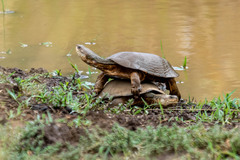
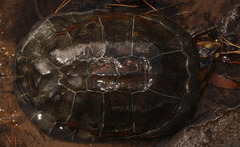
Pelomedusa galeata, commonly known as the South African helmeted terrapin and the cape terrapin, is a species of side-necked terrapin in the family Pelomedusidae. It is endemic to South Africa, Eswatini and southern Mozambique.

The cape terrapin is found in all South African provinces, Eswatini and southern Mozambique. It is absent from the Bushmanland bioregion in the Northern Cape. Adults average 26 cm (10 in) in straight carapace length; and up to 32.5 cm (12.8 in) in exceptional cases.

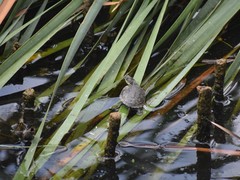
The cape terrapin is found in fresh and stagnant water bodies, but not in mountainous or forested terrain. Mating of the cape terrapin occurs during spring. Nesting occurs from late spring to autumn. Up to 30 eggs are laid in an 18 by 9 cm (7.1 by 3.5 in) chamber close to the water. Incubation is roughly three months.

As of 2017, the cape terrapin has been assessed as least concern due to its widespread occurrence. The population group in western South Africa could be a candidate species. Media related to Pelomedusa galeata at Wikimedia Commons Wikipedia →

Global Distribution

Parks Where Found

# Park Country Daily sighting probability
1 uMkhuze Game Reserve 🇿🇦 South Africa
~70%
2 Hluhluwe-Imfolozi Park 🇿🇦 South Africa
~40%
3 Addo Elephant National Park 🇿🇦 South Africa
~20%
4 Pilanesberg National Park 🇿🇦 South Africa
~10%
5 Table Mountain National Park 🇿🇦 South Africa
~10%
6 Garden Route National Park 🇿🇦 South Africa
~10%

Cities Where Found

# City Country Daily sighting probability
1 Johannesburg 🇿🇦 South Africa
~10%
2 Cape Town 🇿🇦 South Africa
~10%
3 Pretoria 🇿🇦 South Africa
~10%
4 Durban 🇿🇦 South Africa
~10%

Zoos & Centres Where Found

# Zoo / Centre Country
1 Omaha’s Henry Doorly Zoo and Aquarium 🇺🇸 United States In captivity
2 National Zoological Garden of South Africa 🇿🇦 South Africa In captivity
3 Espace zoologique de Saint-Martin-la-Plaine 🇫🇷 France In captivity
4 World of Birds Wildlife Sanctuary and Monkey Park 🇿🇦 South Africa In captivity
5 East London Aquarium 🇿🇦 South Africa In captivity

Closest Relatives at Johannesburg

No species of the same family or order lives in Johannesburg, so these are its closest relatives here: other reptiles.

Before you go

What are the chances of seeing a Cape Terrapin in Johannesburg?

With luck

About 10% of wildlife watchers report a Cape Terrapin sighting in Johannesburg on a given day, based on 23 verified sightings from GBIF citizen-science data. It is the 8th most-seen of the 15 reptiles we can rate there. Over three days the chance rises to about 30%, and over a week to about 60%, if each day is a fresh chance.

When is the best time to see a Cape Terrapin in Johannesburg?

February and October–December

In those months about 20% of wildlife watchers report a Cape Terrapin in Johannesburg on a given day, against under 5% in June and August, the lowest months. Those are among Johannesburg's wettest months, with about 90 mm of rain a month against almost none in July.

What time of day is best to see a Cape Terrapin?

Between 11 am and 2 pm

Across all the parks we cover, that three-hour window holds the most Cape Terrapin sightings with a recorded time, and about 9 in 10 of them come between 6 am and 6 pm: it is a daytime animal.

Is Johannesburg the best place to see a Cape Terrapin?

Yes

Of the 4 cities where we can rate Cape Terrapin sightings, Johannesburg has the highest daily chance: about 10%. Next come Cape Town (South Africa, about 10%) and Pretoria (South Africa, about 10%).

Where does the Cape Terrapin sighting chance come from?

GBIF citizen-science records

It is estimated from how often the Cape Terrapin is recorded against all the reptiles logged in Johannesburg (23 verified sightings), calibrated against known sighting rates. Figures are rounded to the nearest 10% because citizen-science data supports honest approximations, not decimals, and months with records from fewer than five people show "—". How it works.

← Back to Johannesburg