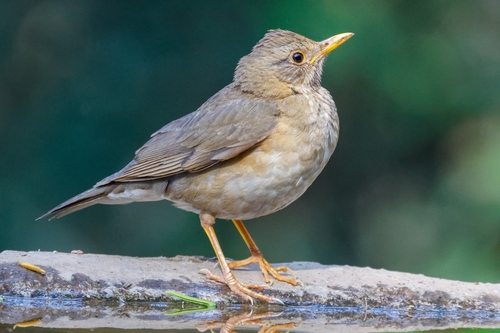
Black-throated Thrush

Black-throated Thrush

Turdus atrogularis

Silhouette: Sharon Wegner-Larsen · PhyloPic

LCLeast ConcernNTVUENCR
Daily sighting probability <5% · Rare
at Kathmandu

In 3 days ~10% in a week ~20%

190 Verified sightings at Kathmandu
157 In all 5 parks From 2019 to 2026
March Best month
☀️ Diurnal When it's spotted

About the Black-throated Thrush

The black-throated thrush (Turdus atrogularis) is a passerine bird in the thrush family. It is sometimes regarded as one subspecies of a polytypic species, "dark-throated thrush", red-throated thrush then being the other subspecies. More recent treatments regard the two as separate species.

The black-throated thrush is a migratory Eastern Palearctic species. Its range overlaps with the more easterly-breeding red-throated thrush. This is a large and distinctive thrush. The male has black from the chin to the breast with a greyish black tail. The upperparts are grey and the underparts are whitish with orange-red underwing coverts. Females and immatures are similar but the black on the throat and breast is replaced with dusky streaking.

Black-throated thrushes breed along the edges of clearings in coniferous or mixed deciduous forest, often in the undergrowth of Siberian Pine Pinus sibirica or mixed spruce fir forest, especially along watercourses or in swampy areas.

Black-throated thrushes breed solitarily or in loose aggregations of pairs in late May through to late July. The nest is made of grasses and thin twigs bound with earth and lined... Wikipedia →

Sounds

Call0:22

Nepal · 2012

© Marc Anderson · XC666431 · CC BY-NC-ND 4.0

Alarm call0:22

Netherlands · 2021

© Peter de Rouw · XC614272 · CC BY-NC-SA 4.0

Call0:35

India · 2019

© Andrew Spencer · XC547778 · CC BY-NC-ND 4.0

Global Distribution

Parks Where Found

# Park Country Daily sighting probability
1 Langtang National Park 🇳🇵 Nepal
<5%
2 Manas National Park 🇮🇳 India
<5%
3 Jim Corbett National Park 🇮🇳 India
<5%
4 Royal Manas National Park 🇧🇹 Bhutan
<5%
5 Chitwan National Park 🇳🇵 Nepal
<5%

Cities Where Found

# City Country Daily sighting probability
1 Dushanbe 🇹🇯 Tajikistan
~30%
2 Tashkent 🇺🇿 Uzbekistan
~30%
3 Almaty 🇰🇿 Kazakhstan
~20%
4 Ürümqi 🇨🇳 China
~10%
5 Bishkek 🇰🇬 Kyrgyzstan
~10%
6 Tehran 🇮🇷 Iran
~10%
7 Mashhad 🇮🇷 Iran
~10%
8 Yekaterinburg 🇷🇺 Russia
~10%
9 Kathmandu 🇳🇵 Nepal
<5%
10 Srinagar 🇮🇳 India
<5%

Before you go

What are the chances of seeing a Black-throated Thrush in Kathmandu?

Rare

Under 5% of wildlife watchers report a Black-throated Thrush sighting in Kathmandu on a given day, based on 190 verified sightings from GBIF citizen-science data. It is the 110th most-seen of the 312 birds we can rate there. Over three days the chance rises to about 10%, and over a week to about 20%, if each day is a fresh chance.

When is the best time to see a Black-throated Thrush in Kathmandu?

March

In that month about 20% of wildlife watchers report a Black-throated Thrush in Kathmandu on a given day, against under 5% in April to December, the lowest months. That is one of Kathmandu's driest months, with about 20 mm of rain against 280 mm in July.

What time of day is best to see a Black-throated Thrush?

Between 10 am and 1 pm

Across all the parks we cover, that three-hour window holds the most Black-throated Thrush sightings with a recorded time, and about 8 in 10 of them come between 6 am and 6 pm: it is a daytime animal.

Is Kathmandu the best place to see a Black-throated Thrush?

9th of 15

Of the 15 cities where we can rate Black-throated Thrush sightings, Kathmandu ranks 9th at under 5%. The best odds are in Dushanbe (Tajikistan, about 30%), Tashkent (Uzbekistan, about 30%) and Almaty (Kazakhstan, about 20%).

Where does the Black-throated Thrush sighting chance come from?

GBIF citizen-science records

It is estimated from how often the Black-throated Thrush is recorded against all the birds logged in Kathmandu (190 verified sightings), calibrated against known sighting rates. Figures are rounded to the nearest 10% because citizen-science data supports honest approximations, not decimals, and months with records from fewer than five people show "—". How it works.

← Back to Kathmandu