Chubb's Cisticola

Chubb's Cisticola

Cisticola chubbi

Silhouette: Sheatherius · PhyloPic

LCLeast ConcernNTVUENCR
Daily sighting probability ~10% · With luck
at Kigali

In 3 days ~30% in a week ~50%

112 Verified sightings at Kigali
2,855 In all 7 parks From 2019 to 2026
January Best month
☀️ Diurnal When it's spotted

About the Chubb's Cisticola

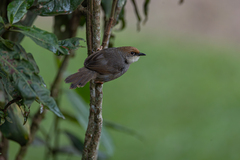
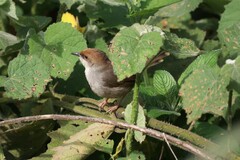
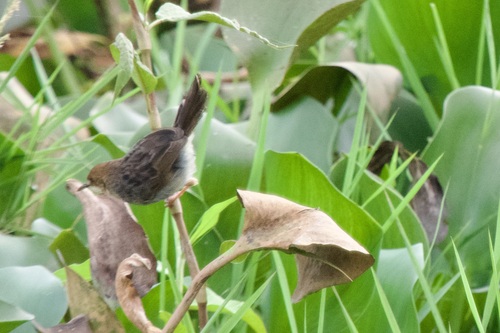
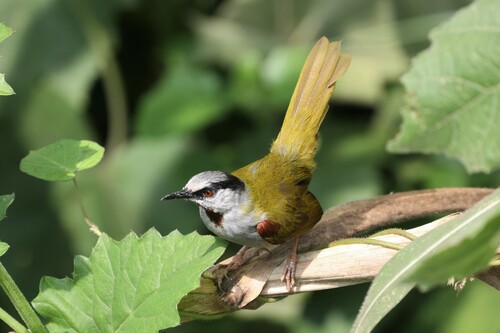
Chubb's cisticola (Cisticola chubbi) is a species of bird in the family Cisticolidae. It is native to the Western High Plateau, the Albertine Rift montane forests and the East African montane forests. There are four subspecies:

It is territorial. It spends most of its time in dense vegetation. In duets, males trill and females whistle. Females produce longer and lower-pitched notes. Chubb's cisticolas also sometimes sing in choruses of up to five; this is most common at the end of breeding season. Solo singing is very rare.

Duets and choruses are likely primarily for the purpose of territorial defense. They are always done while in sight of the other participating bird(s)—less than 1 meter apart. They perform dance-like movements such as moving their tails and flapping their wings to make snapping noises.

They sing from elevated places. Wikipedia →

Sounds

Song0:36

Uganda · 2022

© Peter Boesman · XC739564 · CC BY-NC-ND 4.0

Duet0:33

Uganda · 2015

© Martin St-Michel · XC234731 · CC BY-NC-SA 4.0

Call0:35

Uganda · 2005

© András Schmidt · XC704484 · CC BY-NC-SA 4.0

Global Distribution

Parks Where Found

# Park Country Daily sighting probability
1 Volcanoes National Park 🇷🇼 Rwanda
~80%
2 Nyungwe National Park 🇷🇼 Rwanda
~70%
3 Bwindi Impenetrable National Park 🇺🇬 Uganda
~50%
4 Virunga National Park 🇨🇩 Democratic Republic of the Congo
~30%
5 Akagera National Park 🇷🇼 Rwanda
<5%
6 Kibale National Park 🇺🇬 Uganda
<5%
7 Queen Elizabeth National Park 🇺🇬 Uganda
<5%

Cities Where Found

# City Country Daily sighting probability
1 Kigali 🇷🇼 Rwanda
~10%

Before you go

What are the chances of seeing a Chubb's Cisticola in Kigali?

With luck

About 10% of wildlife watchers report a Chubb's Cisticola sighting in Kigali on a given day, based on 112 verified sightings from GBIF citizen-science data. It is the 93rd most-seen of the 244 birds we can rate there. Over three days the chance rises to about 30%, and over a week to about 50%, if each day is a fresh chance.

When is the best time to see a Chubb's Cisticola in Kigali?

December and January

In those months about 20% of wildlife watchers report a Chubb's Cisticola in Kigali on a given day, against under 5% in May and July–August, the lowest months.

What time of day is best to see a Chubb's Cisticola?

Between 8 and 11 am

Across all the parks we cover, that three-hour window holds the most Chubb's Cisticola sightings with a recorded time, and about 8 in 10 of them come between 6 am and 6 pm: it is a daytime animal.

Where else can you see a Chubb's Cisticola?

Only Kigali, in our data

Kigali is the only city on Wallace's Line with enough records to rate Chubb's Cisticola sightings: about 10% of wildlife watchers there report one on a given day.

Which relatives of the Chubb's Cisticola live in Kigali?

Same genus: Cisticola

The closest relatives of the Chubb's Cisticola that you can see in Kigali (genus Cisticola, Cisticolas) are Winding Cisticola (about 40%), Red-faced Cisticola (about 10%) and Trilling Cisticola (about 10%), with each one's daily chance of a sighting.

Where does the Chubb's Cisticola sighting chance come from?

GBIF citizen-science records

It is estimated from how often the Chubb's Cisticola is recorded against all the birds logged in Kigali (112 verified sightings), calibrated against known sighting rates. Figures are rounded to the nearest 10% because citizen-science data supports honest approximations, not decimals, and months with records from fewer than five people show "—". How it works.

← Back to Kigali