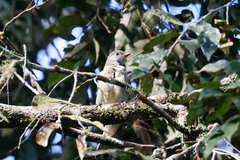
Scaly-throated Honeyguide

Scaly-throated Honeyguide

Indicator variegatus

Silhouette: Sheatherius · PhyloPic

LCLeast ConcernNTVUENCR
Daily sighting probability <5% · Rare
at Kigali

In 3 days <5% in a week ~10%

11 Verified sightings at Kigali
291 In all 12 parks From 2019 to 2026
August Best month
☀️ Diurnal When it's spotted

About the Scaly-throated Honeyguide

The scaly-throated honeyguide (Indicator variegatus) is a species of bird in the family Indicatoridae. They have a mutualistic relationship with humans in which they attract beekeepers towards bees' nests and then feeding on the remains, especially larvae.

The scaly-throated honeyguide is closely related to the spotted honeyguide (Indicator maculatus), of which it shares part of its range. The two species are sympatric in South Sudan and Southwest Uganda. Scaly-throated honeyguides from Southern Somalia to Northeast Tanzania were previously regarded as a separate race (jubaensis). However, the species is currently regarded as monotypic, with no subspecies.

Mature scaly-throated honeyguides range between 18 and 19 centimetres (7.1 and 7.5 in) and typically weigh around 34 to 55 grams (0.075 to 0.121 lb), occasionally reaching up to 61 grams (0.134 lb). Males are larger than females, with recorded weights of males ranging from 50 to 56 grams (0.110 to 0.123 lb) and weights of females generally ranging from 36.6 to 55 grams (0.081 to 0.121 lb). However, male birds in Uganda have been reported to weigh as low as 31 grams (0.068 lb) and females, up to 60... Wikipedia →

Sounds

Song0:52

Zambia · 2022

© Dries Van de Loock · XC758587 · CC BY-NC-ND 4.0

Song0:56

Kenya · 2020

© James Bradley · XC536485 · CC BY-NC-SA 4.0

Song0:24

Zambia · 2016

© Peter Boesman · XC339224 · CC BY-NC-ND 4.0

Global Distribution

Parks Where Found

# Park Country Daily sighting probability
1 uMkhuze Game Reserve 🇿🇦 South Africa
~10%
2 Lake Nakuru National Park 🇰🇪 Kenya
<5%
3 Garden Route National Park 🇿🇦 South Africa
<5%
4 iSimangaliso Wetland Park 🇿🇦 South Africa
<5%
5 Arusha National Park 🇹🇿 Tanzania
<5%
6 Ngorongoro Conservation Area 🇹🇿 Tanzania
<5%
7 Lake Mburo National Park 🇺🇬 Uganda
<5%
8 Kibale National Park 🇺🇬 Uganda
<5%
9 Bwindi Impenetrable National Park 🇺🇬 Uganda
<5%
10 Masai Mara National Reserve 🇰🇪 Kenya
<5%
11 Serengeti National Park 🇹🇿 Tanzania
<5%
12 Kruger National Park 🇿🇦 South Africa
<5%

Cities Where Found

# City Country Daily sighting probability
1 Kigali 🇷🇼 Rwanda
<5%
2 Durban 🇿🇦 South Africa
<5%

Before you go

What are the chances of seeing a Scaly-throated Honeyguide in Kigali?

Rare

Under 5% of wildlife watchers report a Scaly-throated Honeyguide sighting in Kigali on a given day, based on 11 verified sightings from GBIF citizen-science data. It is the 201st most-seen of the 244 birds we can rate there. Over three days the chance rises to under 5%, and over a week to about 10%, if each day is a fresh chance.

When is the best time to see a Scaly-throated Honeyguide in Kigali?

August

In that month about 10% of wildlife watchers report a Scaly-throated Honeyguide in Kigali on a given day, against under 5% in September to July, the lowest months. That is one of Kigali's driest months, with about 55 mm of rain against 180 mm in April.

What time of day is best to see a Scaly-throated Honeyguide?

Between 8 and 11 am

Across all the parks we cover, that three-hour window holds the most Scaly-throated Honeyguide sightings with a recorded time, and about 9 in 10 of them come between 6 am and 6 pm: it is a daytime animal.

Is Kigali the best place to see a Scaly-throated Honeyguide?

Yes

Of the 2 cities where we can rate Scaly-throated Honeyguide sightings, Kigali has the highest daily chance: under 5%. Next come Durban (South Africa, under 5%).

Where does the Scaly-throated Honeyguide sighting chance come from?

GBIF citizen-science records

It is estimated from how often the Scaly-throated Honeyguide is recorded against all the birds logged in Kigali (11 verified sightings), calibrated against known sighting rates. Figures are rounded to the nearest 10% because citizen-science data supports honest approximations, not decimals, and months with records from fewer than five people show "—". How it works.

← Back to Kigali