Black-headed Bunting

Black-headed Bunting

Emberiza melanocephala

Silhouette: L. Shyamal · PhyloPic

LCLeast ConcernNTVUENCR
Daily sighting probability <5% · Rare
at Kolkata

In 3 days <5% in a week ~10%

150 Verified sightings at Kolkata
13 In all 2 parks From 2019 to 2026
December Best month
☀️ Diurnal When it's spotted

About the Black-headed Bunting

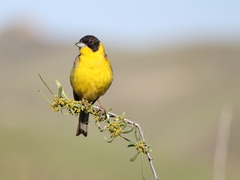
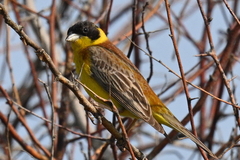
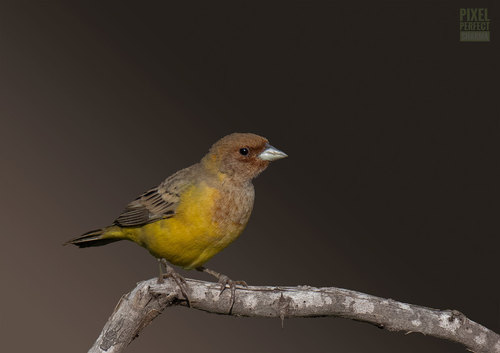
The black-headed bunting (Emberiza melanocephala) is a passerine bird in the bunting family Emberizidae. It breeds in south-east Europe east to Iran and migrates in winter mainly to India, with some individuals moving further into south-east Asia. Like others in its family, it is found in open grassland habitats where they fly in flocks in search of grains and seed. Adult males are well marked with yellow underparts, chestnut back and a black head. Adult females in breeding plumage look like duller males. In other plumages, they can be hard to separate from the closely related red-headed bunting and natural hybridization occurs between the two species in the zone of overlap of their breeding ranges in northern Iran.

The black-headed bunting was formally described in 1769 by the Austrian naturalist Giovanni Antonio Scopoli under the binomial name Emberiza melanocephala. The type locality is Carniola in Slovenia. The species is monotypic: no subspecies are recognised. The genus name Emberiza is from Old German Embritz, a bunting, and the specific melanocephala combines the Ancient Greek melas meaning "black", and kephale meaning "head".

This bird is 15... Wikipedia →

Sounds

Alarm call1:29

Croatia · 2025

© Domagoj Tomičić · XC1007714 · CC BY-NC-SA 4.0

Song0:24

France · 2022

© Antoine Salmon · XC951772 · CC BY-NC-SA 4.0

Call0:14

Bulgaria · 2022

© Agris Celmins · XC741114 · CC BY-NC-ND 4.0

Global Distribution

Parks Where Found

# Park Country Daily sighting probability
1 Chitwan National Park 🇳🇵 Nepal
<5%
2 Kanha National Park 🇮🇳 India
<5%

Cities Where Found

# City Country Daily sighting probability
1 Karaj 🇮🇷 Iran
~10%
2 Vasai-Virar 🇮🇳 India
<5%
3 Kolkata 🇮🇳 India
<5%
4 Istanbul 🇹🇷 Turkey
<5%
5 Kathmandu 🇳🇵 Nepal
<5%
6 Phnom Penh 🇰🇭 Cambodia
<5%
7 Antalya 🇹🇷 Turkey
<5%
8 Nagpur 🇮🇳 India
<5%
9 Indore 🇮🇳 India
<5%
10 Kalyan-Dombivli 🇮🇳 India
<5%

Before you go

What are the chances of seeing a Black-headed Bunting in Kolkata?

Rare

Under 5% of wildlife watchers report a Black-headed Bunting sighting in Kolkata on a given day, based on 150 verified sightings from GBIF citizen-science data. It is the 136th most-seen of the 247 birds we can rate there. Over three days the chance rises to under 5%, and over a week to about 10%, if each day is a fresh chance.

When is the best time to see a Black-headed Bunting in Kolkata?

November and December

In those months about 10% of wildlife watchers report a Black-headed Bunting in Kolkata on a given day, against under 5% in January to October, the lowest months. Those are among Kolkata's driest months, with about 15 mm of rain a month against 330 mm in July.

What time of day is best to see a Black-headed Bunting?

Between 9 am and noon

Across all the parks we cover, that three-hour window holds the most Black-headed Bunting sightings with a recorded time, and about 8 in 10 of them come between 6 am and 6 pm: it is a daytime animal.

Is Kolkata the best place to see a Black-headed Bunting?

3rd of 14

Of the 14 cities where we can rate Black-headed Bunting sightings, Kolkata ranks 3rd at under 5%. The best odds are in Karaj (Iran, about 10%) and Vasai-Virar (India, under 5%).

Where does the Black-headed Bunting sighting chance come from?

GBIF citizen-science records

It is estimated from how often the Black-headed Bunting is recorded against all the birds logged in Kolkata (150 verified sightings), calibrated against known sighting rates. Figures are rounded to the nearest 10% because citizen-science data supports honest approximations, not decimals, and months with records from fewer than five people show "—". How it works.

← Back to Kolkata