Indian Chat

Indian Chat

Oenanthe fusca

Silhouette: PhyloPic

LCLeast ConcernNTVUENCR
Daily sighting probability ~20% · Possible
at Kota

In 3 days ~50% in a week ~80%

59 Verified sightings at Kota
1,178 In all 7 parks From 2019 to 2026
September Best month
🌅 Crepuscular When it's spotted

About the Indian Chat

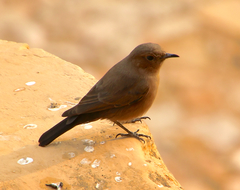
The brown rock chat (Oenanthe fusca) or Indian chat is a bird species of the family Muscicapidae. It is found mainly in northern and central India. It is often found in old buildings and rocky areas. It resembles a female Indian robin but lacks the reddish vent and differs in posture and behaviour apart from being larger. In flight it bears some resemblance to thrushes and redstarts. It feeds on insects, captured mainly on the ground. It was formerly placed as the sole species in the genus Cercomela but is now included with the wheatears in the genus Oenanthe.

In central India, the local name of Shama has been noted. The brown rock chat is about 17 cm long, larger than the somewhat similar-looking Indian robin. It is uniformly rufous brown with the wings and tail of a slightly darker shade. The brown on the undersides grades into a dark grey-brown vent. The beak is slender and is slightly curved at the tip. The second primary is the longest and the tail is rounded. In flight it resembles a female blue rock thrush. The sexes are indistinguishable in the field.

The species is nearly endemic to India, distributed north of the Narmada,... Wikipedia →

Sounds

Song0:15

India · 2021

© Sreekumar Chirukandoth · XC632705 · CC BY-NC-SA 4.0

Subsong0:14

India · 2021

© Suniti Bhushan Datta · XC627657 · CC BY-NC-SA 4.0

Uncertain0:46

India · 2021

© Virag Sharma · XC621904 · CC BY-NC-SA 4.0

Global Distribution

Parks Where Found

# Park Country Daily sighting probability
1 Ranthambore National Park 🇮🇳 India
~20%
2 Keoladeo National Park 🇮🇳 India
~10%
3 Satpura National Park 🇮🇳 India
~10%
4 Jim Corbett National Park 🇮🇳 India
~10%
5 Royal Bardia National Park 🇳🇵 Nepal
~10%
6 Bandhavgarh National Park 🇮🇳 India
<5%
7 Kanha National Park 🇮🇳 India
<5%

Cities Where Found

# City Country Daily sighting probability
1 Jalandhar 🇮🇳 India
~80%
2 Kanpur 🇮🇳 India
~60%
3 Islamabad 🇵🇰 Pakistan
~50%
4 Aligarh 🇮🇳 India
~40%
5 Jodhpur 🇮🇳 India
~40%
6 Prayagraj 🇮🇳 India
~30%
7 Bareilly 🇮🇳 India
~30%
8 Jammu 🇮🇳 India
~30%
9 Dehradun 🇮🇳 India
~30%
10 Lahore 🇵🇰 Pakistan
~30%

Before you go

What are the chances of seeing an Indian Chat in Kota?

Possible

About 20% of wildlife watchers report an Indian Chat sighting in Kota on a given day, based on 59 verified sightings from GBIF citizen-science data. It is the 36th most-seen of the 123 birds we can rate there. Over three days the chance rises to about 50%, and over a week to about 80%, if each day is a fresh chance.

When is the best time to see an Indian Chat in Kota?

April, June and September

In those months about 30% of wildlife watchers report an Indian Chat in Kota on a given day, against about 10% in May and December, the lowest months.

What time of day is best to see an Indian Chat?

Between 3 and 6 am

Across all the parks we cover, that three-hour window holds the most Indian Chat sightings with a recorded time, and about half of them come between 6 am and 6 pm: it is most active around dawn and dusk.

Is Kota the best place to see an Indian Chat?

16th of 35

Of the 35 cities where we can rate Indian Chat sightings, Kota ranks 16th at about 20%. The best odds are in Jalandhar (India, about 80%), Kanpur (India, about 60%) and Islamabad (Pakistan, about 50%).

Which relatives of the Indian Chat live in Kota?

Same family: Muscicapidae

The closest relatives of the Indian Chat that you can see in Kota (family Muscicapidae, Old World Flycatchers, Robins, and Chats) are Indian Robin (about 40%) and Oriental Magpie-Robin (about 30%), with each one's daily chance of a sighting.

Where does the Indian Chat sighting chance come from?

GBIF citizen-science records

It is estimated from how often the Indian Chat is recorded against all the birds logged in Kota (59 verified sightings), calibrated against known sighting rates. Figures are rounded to the nearest 10% because citizen-science data supports honest approximations, not decimals, and months with records from fewer than five people show "—". How it works.

← Back to Kota