White-eared Bulbul

White-eared Bulbul

Pycnonotus leucotis

Silhouette: Andy Wilson · PhyloPic

LCLeast ConcernNTVUENCR
Daily sighting probability <5% · Rare
at Kota

In 3 days ~10% in a week ~30%

10 Verified sightings at Kota
2,011 In all 2 parks From 2019 to 2026
February Best month
☀️ Diurnal When it's spotted

About the White-eared Bulbul

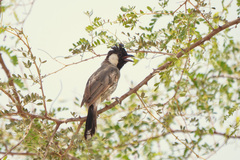
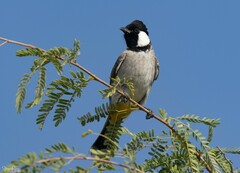
The white-eared bulbul (Pycnonotus leucotis) is a member of the bulbul family. It is found in south-western Asia from India to the Arabian peninsula. The white-eared bulbul was originally described in the genus Ixos. The white-eared bulbul is considered to belong to a superspecies along with the Himalayan bulbul, white-spectacled bulbul, African red-eyed bulbul, Cape bulbul, and the common bulbul. Formerly, some authorities considered the white-eared bulbul to be a subspecies of the Himalayan Bulbul.

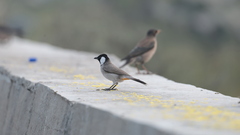
The white-eared bulbul is rotund in appearance, and has a brownish-grey body. The tail of this bird is relatively long, tapering outwards. Starting off black, the tail feathers end in white tips. The head of the white-eared bulbul is black, with the area around its cheeks bearing a large white spot. The eye rings of the bulbul are... Wikipedia →

Sounds

Subsong0:04

Iran · 2019

© Ding Li Yong · XC863417 · CC BY-NC-ND 4.0

Song0:33

Oman · 2023

© Peter Boesman · XC781393 · CC BY-NC-ND 4.0

Call0:36

India · 2012

© Jelle Scharringa · XC630861 · CC BY-NC-SA 4.0

Global Distribution

Parks Where Found

# Park Country Daily sighting probability
1 Keoladeo National Park 🇮🇳 India
~70%
2 Ranthambore National Park 🇮🇳 India
<5%

Cities Where Found

# City Country Daily sighting probability
1 Doha 🇶🇦 Qatar
>90%
2 Abu Dhabi 🇦🇪 United Arab Emirates
>90%
3 Dubai 🇦🇪 United Arab Emirates
~90%
4 Tehran 🇮🇷 Iran
~90%
5 Riyadh 🇸🇦 Saudi Arabia
~90%
6 Kuwait City 🇰🇼 Kuwait
~90%
7 Mashhad 🇮🇷 Iran
~80%
8 Karaj 🇮🇷 Iran
~70%
9 Jodhpur 🇮🇳 India
~60%
10 Manama 🇧🇭 Bahrain
~40%

Zoos & Centres Where Found

# Zoo / Centre Country
1 Zoo Miami 🇺🇸 United States In captivity
2 San Antonio Zoo 🇺🇸 United States In captivity
3 Bird Paradise 🇸🇬 Singapore In captivity
4 Rainforest Wild Asia 🇸🇬 Singapore In captivity
5 National Zoological Gardens of Sri Lanka 🇱🇰 Sri Lanka In captivity
6 Bird Kingdom 🇨🇦 Canada In captivity

Before you go

What are the chances of seeing a White-eared Bulbul in Kota?

Rare

Under 5% of wildlife watchers report a White-eared Bulbul sighting in Kota on a given day, based on 10 verified sightings from GBIF citizen-science data. It is the 91st most-seen of the 123 birds we can rate there. Over three days the chance rises to about 10%, and over a week to about 30%, if each day is a fresh chance.

When is the best time to see a White-eared Bulbul in Kota?

February

In that month about 20% of wildlife watchers report a White-eared Bulbul in Kota on a given day, against under 5% in April–August and October–December, the lowest months. That is one of Kota's driest months, with about 10 mm of rain against 260 mm in August.

What time of day is best to see a White-eared Bulbul?

Between 6 and 9 am

Across all the parks we cover, that three-hour window holds the most White-eared Bulbul sightings with a recorded time, and about 8 in 10 of them come between 6 am and 6 pm: it is a daytime animal.

Is Kota the best place to see a White-eared Bulbul?

21st of 25

Of the 25 cities where we can rate White-eared Bulbul sightings, Kota ranks 21st at under 5%. The best odds are in Doha (Qatar, over 90%), Abu Dhabi (United Arab Emirates, over 90%) and Dubai (United Arab Emirates, about 90%).

Which relatives of the White-eared Bulbul live in Kota?

Same order: Passeriformes

The closest relatives of the White-eared Bulbul that you can see in Kota (order Passeriformes, Perching Birds) are Black Drongo (about 70%), House Sparrow (about 60%) and Purple Sunbird (about 40%), with each one's daily chance of a sighting.

Where does the White-eared Bulbul sighting chance come from?

GBIF citizen-science records

It is estimated from how often the White-eared Bulbul is recorded against all the birds logged in Kota (10 verified sightings), calibrated against known sighting rates. Figures are rounded to the nearest 10% because citizen-science data supports honest approximations, not decimals, and months with records from fewer than five people show "—". How it works.

← Back to Kota