Black-throated Munia

Black-throated Munia

Lonchura kelaarti

Silhouette: Ferran Sayol · PhyloPic

LCLeast ConcernNTVUENCR
Daily sighting probability <5% · Rare
at Kozhikode

In 3 days ~10% in a week ~20%

57 Verified sightings at Kozhikode
618 In all 7 parks From 2019 to 2026
January Best month
☀️ Diurnal When it's spotted

About the Black-throated Munia

The black-throated munia or Jerdon's mannikin (Lonchura kelaarti) is a small passerine bird. This estrildid finch is a resident breeding bird in the hills of southwest India, the Western Ghats, Eastern Ghats and Sri Lanka.

The black-throated munia is a small gregarious bird which feeds mainly on seeds. It frequents open hill woodland and cultivation. The nest is a large domed grass structure in a tree or creepers on a house into which 3-8 white eggs are laid in India, and usually five in Sri Lanka.

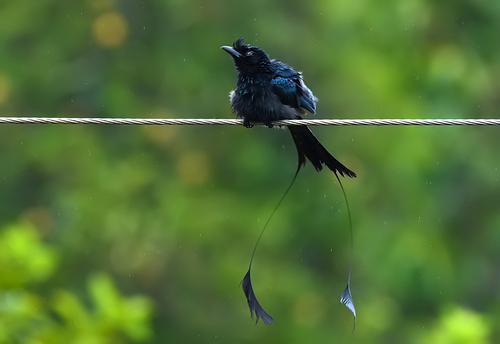
The black-throated munia is 12cm in length with a long black tail. The adult of the southwest Indian population, L. k. jerdoni, has a stubby grey bill, dark brown upperparts with pale shaft streaks; a blackish face and bib; and pinkish brown underparts with scaly marking towards the vent. The Eastern Ghats form vernayi has paler pinkish underparts. The nominate form L. k. kelaarti of Sri Lanka has scaly patterning on the underparts and vent with the pale almost whitish shaft streaks contrasting on the darker back. The sexes are similar in all populations, but immatures lack the darker face and have more uniform underparts.

The binomial... Wikipedia →

Sounds

Call0:08

India · 2014

© Mandar Bhagat · XC194105 · CC BY-NC-ND 4.0

Call0:07

India · 2014

© vir joshi · XC178301 · CC BY-NC-SA 4.0

Call0:04

Sri Lanka · 2016

© Peter Boesman · XC311344 · CC BY-NC-ND 4.0

Global Distribution

Parks Where Found

# Park Country Daily sighting probability
1 Mudumalai National Park 🇮🇳 India
~10%
2 Sinharaja Forest Reserve 🇱🇰 Sri Lanka
~10%
3 Periyar National Park 🇮🇳 India
~10%
4 Horton Plains National Park 🇱🇰 Sri Lanka
~10%
5 Eravikulam National Park 🇮🇳 India
<5%
6 Nagarhole National Park 🇮🇳 India
<5%
7 Bandipur National Park 🇮🇳 India
<5%

Cities Where Found

# City Country Daily sighting probability
1 Kozhikode 🇮🇳 India
<5%
2 Thrissur 🇮🇳 India
<5%

Before you go

What are the chances of seeing a Black-throated Munia in Kozhikode?

Rare

Under 5% of wildlife watchers report a Black-throated Munia sighting in Kozhikode on a given day, based on 57 verified sightings from GBIF citizen-science data. It is the 124th most-seen of the 229 birds we can rate there. Over three days the chance rises to about 10%, and over a week to about 20%, if each day is a fresh chance.

When is the best time to see a Black-throated Munia in Kozhikode?

January and October

In those months about 10% of wildlife watchers report a Black-throated Munia in Kozhikode on a given day, against under 5% in February–September and November–December, the lowest months.

What time of day is best to see a Black-throated Munia?

Between 8 and 11 am

Across all the parks we cover, that three-hour window holds the most Black-throated Munia sightings with a recorded time, and about 9 in 10 of them come between 6 am and 6 pm: it is a daytime animal.

Is Kozhikode the best place to see a Black-throated Munia?

Yes

Of the 2 cities where we can rate Black-throated Munia sightings, Kozhikode has the highest daily chance: under 5%. Next come Thrissur (India, under 5%).

Which relatives of the Black-throated Munia live in Kozhikode?

Same genus: Lonchura

The closest relatives of the Black-throated Munia that you can see in Kozhikode (genus Lonchura, Typical Munias and Mannikins) are White-rumped Munia (about 10%) and Nutmeg Mannikin (about 10%), with each one's daily chance of a sighting.

Where does the Black-throated Munia sighting chance come from?

GBIF citizen-science records

It is estimated from how often the Black-throated Munia is recorded against all the birds logged in Kozhikode (57 verified sightings), calibrated against known sighting rates. Figures are rounded to the nearest 10% because citizen-science data supports honest approximations, not decimals, and months with records from fewer than five people show "—". How it works.

← Back to Kozhikode