
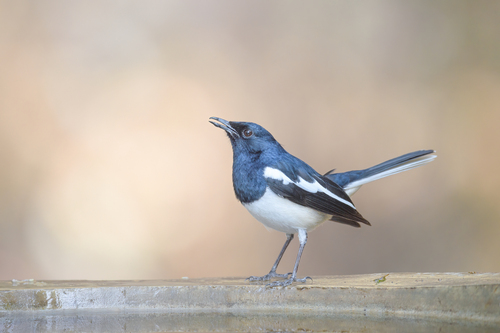
Black-collared Starling

Black-collared Starling

Gracupica nigricollis

Silhouette: Rafael Maia · PhyloPic

LCLeast ConcernNTVUENCR
Daily sighting probability <5% · Rare
at Kuala Lumpur

In 3 days <5%

19 Verified sightings at Kuala Lumpur
213 In all 3 parks From 2019 to 2026
April Best month
🌅 Crepuscular When it's spotted

About the Black-collared Starling

The black-collared starling (Gracupica nigricollis) is a species of starling with black and white plumage and a black collar. It is found in southern China and most of mainland Southeast Asia, and has been introduced to Taiwan, Malaysia and Singapore. Its habitats include grassland, dry forest and human settlements. The International Union for Conservation of Nature (IUCN) has assessed it as being of least concern.

This species was described as Gracula nigricollis by Gustaf von Paykull in 1807. Formerly placed in the genus Sturnus, it and the Siamese pied myna (Gracupica floweri) were separated to the genus Gracupica when Sturnus was split, following phylogenetic studies in 2008. In the past it had also been placed in Sturnopastor, Acridotheres and Graculipica.

The black-collared starling is 26–30 cm (10–12 in) long. The head is white, with a yellow patch of bare skin around the eye, and a black collar around the neck. The mantle, back and wings are dark brown, appearing almost black. The underparts are white, often with a grey-brown tinge. The tail and most of the covert and flight feathers are tipped white, with the primary coverts completely white... Wikipedia →

Sounds

Song0:15

China · 2026

© Bo Shunqi 薄顺奇 · XC1172789 · CC BY-NC-SA 4.0

Call0:20

China · 2025

© Lim Ying Hien 林勇贤 · XC1053311 · CC BY-NC-ND 4.0

Call0:46

China · 2025

© Ding Li Yong · XC1052462 · CC BY-NC-ND 4.0

Global Distribution

Parks Where Found

# Park Country Daily sighting probability
1 Doi Inthanon National Park 🇹🇭 Thailand
~10%
2 Khao Yai National Park 🇹🇭 Thailand
<5%
3 Cat Tien National Park 🇻🇳 Vietnam
<5%

Cities Where Found

# City Country Daily sighting probability
1 Tuen Mun 🇨🇳 China
~70%
2 Taipei 🇹🇼 Taiwan
~70%
3 Hong Kong 🇨🇳 China
~70%
4 Xiuying District 🇨🇳 China
~60%
5 Xiamen City 🇨🇳 China
~50%
6 Quanzhou 🇨🇳 China
~50%
7 Guangzhou 🇨🇳 China
~50%
8 Bangkok 🇹🇭 Thailand
~40%
9 Nanchang 🇨🇳 China
~40%
10 Fuzhou 🇨🇳 China
~40%

Zoos & Centres Where Found

# Zoo / Centre Country
1 Disney's Animal Kingdom 🇺🇸 United States In captivity
2 San Diego Zoo 🇺🇸 United States In captivity
3 Zoo Miami 🇺🇸 United States In captivity
4 Kadoorie Farm and Botanic Garden 🇭🇰 Hong Kong SAR China In captivity
5 Saigon Zoo and Botanical Gardens 🇻🇳 Vietnam In captivity
6 Green World Ecological Farm 🇹🇼 Taiwan In captivity
7 Penang Bird Park 🇲🇾 Malaysia In captivity
8 Melaka Bird Park 🇲🇾 Malaysia In captivity

Before you go

What are the chances of seeing a Black-collared Starling in Kuala Lumpur?

Rare

Under 5% of wildlife watchers report a Black-collared Starling sighting in Kuala Lumpur on a given day, based on 19 verified sightings from GBIF citizen-science data. It is the 185th most-seen of the 228 birds we can rate there. Over three days the chance rises to under 5%, if each day is a fresh chance.

When is the best time to see a Black-collared Starling in Kuala Lumpur?

Any time of year

In every month with enough records, under 5% of wildlife watchers report a Black-collared Starling in Kuala Lumpur on a given day, so our monthly data shows no clear season.

What time of day is best to see a Black-collared Starling?

Between 10 am and 1 pm

Across all the parks we cover, that three-hour window holds the most Black-collared Starling sightings with a recorded time, and about 6 in 10 of them come between 6 am and 6 pm: it is most active around dawn and dusk.

Is Kuala Lumpur the best place to see a Black-collared Starling?

26th of 26

Of the 26 cities where we can rate Black-collared Starling sightings, Kuala Lumpur ranks 26th at under 5%. The best odds are in Tuen Mun (China, about 70%), Taipei (Taiwan, about 70%) and Hong Kong (China, about 70%).

Where does the Black-collared Starling sighting chance come from?

GBIF citizen-science records

It is estimated from how often the Black-collared Starling is recorded against all the birds logged in Kuala Lumpur (19 verified sightings), calibrated against known sighting rates. Figures are rounded to the nearest 10% because citizen-science data supports honest approximations, not decimals, and months with records from fewer than five people show "—". How it works.

← Back to Kuala Lumpur