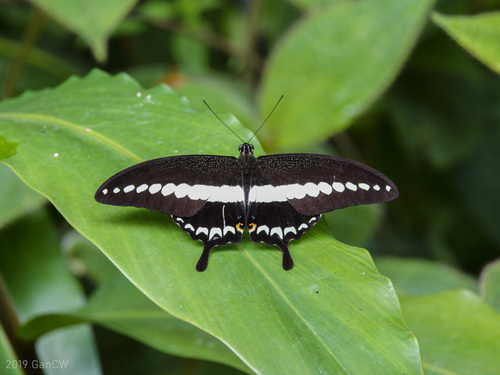
Five-Bar Swordtail
Daily sighting probability ~10% · With luck
at Kuala Lumpur

In 3 days ~20% in a week ~40%

14 Verified sightings at Kuala Lumpur
128 In all 8 parks From 2019 to 2026
April Best month
☀️ Diurnal When it's spotted

About the Five-Bar Swordtail

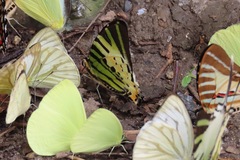
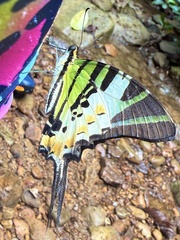
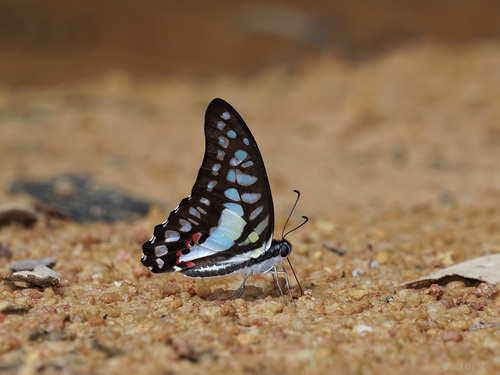
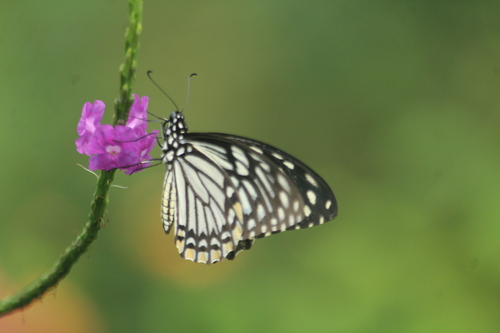
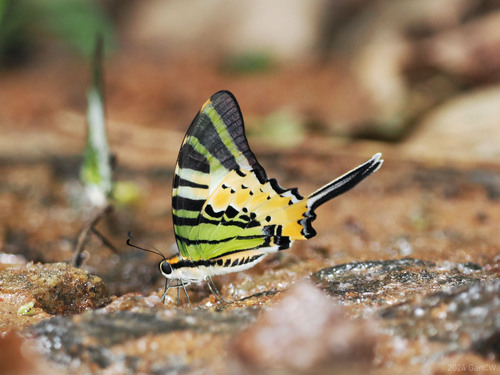
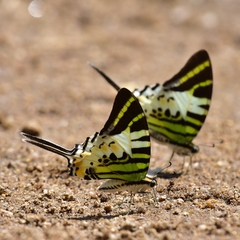
Graphium antiphates, The Five-bar swordtail is a species of papilionid butterfly found in South and Southeast Asia. The species was first described by Pieter Cramer in 1775. The ground colour of the upperside of both males and females is white. The forewing has the cell crossed by five short black bands, of which the basal extends to the dorsum, the sub-basal into interspace 1, the medial and pre-apical up to the median vein, and the apical or fifth along the discocellulars; this last band extends broadly on both sides of the veinlets and terminates at the lower apex of the cell; beyond these are broad postdiscal and terminal black transverse bands from costa to tornal angle; the two bands coalesce below vein 4 and terminate in a point at the tornus; the white portions of the cell anteriorly overlaid with pale green; short broken glossy green bands between the black cellular apical band and the discal band and anteriorly between the latter and the terminal band.

The upperside of the hindwing has the basal three-fourths uniformly white, with black markings on the underside that show through; the terminal fourth dark grey traversed by a curved irregular subterminal... Wikipedia →

Global Distribution

Parks Where Found

# Park Country Daily sighting probability
1 Cuc Phuong National Park 🇻🇳 Vietnam
~30%
2 Kaeng Krachan National Park 🇹🇭 Thailand
~20%
3 Sinharaja Forest Reserve 🇱🇰 Sri Lanka
~20%
4 Cat Tien National Park 🇻🇳 Vietnam
~20%
5 Gunung Leuser National Park 🇮🇩 Indonesia
~20%
6 Taman Negara National Park 🇲🇾 Malaysia
~20%
7 Khao Sok National Park 🇹🇭 Thailand
~10%
8 Khao Yai National Park 🇹🇭 Thailand
~10%

Cities Where Found

# City Country Daily sighting probability
1 Hong Kong 🇨🇳 China
~10%
2 Kuala Lumpur 🇲🇾 Malaysia
~10%
3 Tuen Mun 🇨🇳 China
~10%
4 Singapore 🇸🇬 Singapore
~10%
5 Guangzhou 🇨🇳 China
<5%

Before you go

What are the chances of seeing a Five-Bar Swordtail in Kuala Lumpur?

With luck

About 10% of wildlife watchers report a Five-Bar Swordtail sighting in Kuala Lumpur on a given day, based on 14 verified sightings from GBIF citizen-science data. It is the 116th most-seen of the 323 insects we can rate there. Over three days the chance rises to about 20%, and over a week to about 40%, if each day is a fresh chance.

When is the best time to see a Five-Bar Swordtail in Kuala Lumpur?

April–July, September–October and December–February

In those months about 10% of wildlife watchers report a Five-Bar Swordtail in Kuala Lumpur on a given day, against under 5% in March, August and November, the lowest months.

What time of day is best to see a Five-Bar Swordtail?

Between 10 am and 1 pm

Across all the parks we cover, that three-hour window holds the most Five-Bar Swordtail sightings with a recorded time, and about 9 in 10 of them come between 6 am and 6 pm: it is a daytime animal.

Is Kuala Lumpur the best place to see a Five-Bar Swordtail?

Among the best

Of the 5 cities where we can rate Five-Bar Swordtail sightings, Kuala Lumpur ranks 2nd at about 10%, level with the leaders once rounded. The best odds are in Hong Kong (China, about 10%).

Which relatives of the Five-Bar Swordtail live in Kuala Lumpur?

Same genus: Graphium

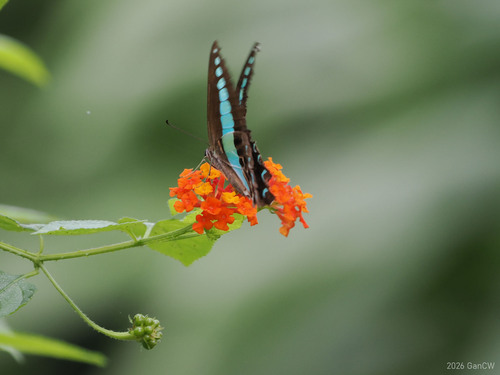
The closest relatives of the Five-Bar Swordtail that you can see in Kuala Lumpur (genus Graphium, Swordtails, Jays, Bluebottles and allies) are Tailed Jay (about 10%), Common Bluebottle (about 10%) and Lesser Jay (about 10%), with each one's daily chance of a sighting.

Where does the Five-Bar Swordtail sighting chance come from?

GBIF citizen-science records

It is estimated from how often the Five-Bar Swordtail is recorded against all the insects logged in Kuala Lumpur (14 verified sightings), calibrated against known sighting rates. Figures are rounded to the nearest 10% because citizen-science data supports honest approximations, not decimals, and months with records from fewer than five people show "—". How it works.
← Back to Kuala Lumpur