Purple-collared Woodstar

Purple-collared Woodstar

Myrtis fanny

Silhouette: Ferran Sayol · PhyloPic

LCLeast ConcernNTVUENCR
Daily sighting probability <5% · Rare
at Lima

In 3 days ~10% in a week ~20%

194 Verified sightings at Lima
9 In 1 park From 2019 to 2026
February Best month
☀️ Diurnal When it's spotted

About the Purple-collared Woodstar

The purple-collared woodstar (Myrtis fanny) is a species of hummingbird in tribe Mellisugini of subfamily Trochilinae, the "bee hummingbirds". It is found in Ecuador and Peru. The exact relationships within the "bee hummingbirds" are uncertain, but the purple-collared woodstar appears to be closely related to the amethyst woodstar (Calliphlox amethystina).

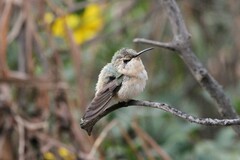
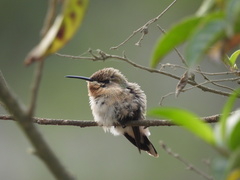
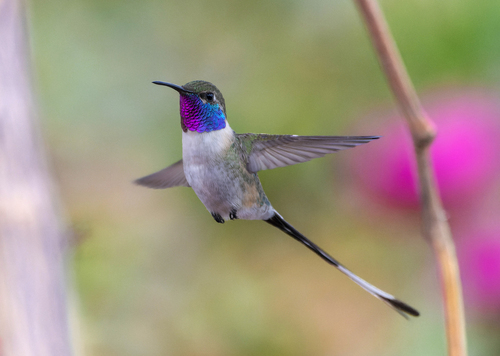
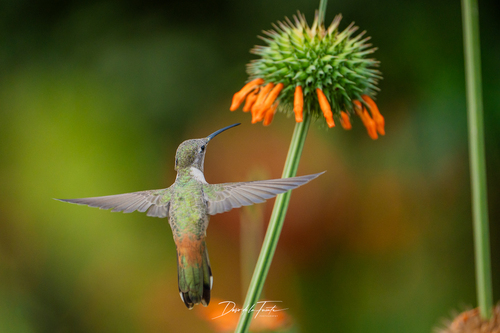
The purple-collared woodstar is 7.5 to 8 cm (3.0 to 3.1 in) long and weighs 2.3 to 2.5 g (0.081 to 0.088 oz). Both sexes have a short, decurved, black bill. Their upperparts are bronze-green. Males have an iridescent aquamarine gorget with a shiny violet band below it. The rest of the underparts are dirty white. The long forked tail is dusky brown glossed with light green. The female's underparts are buff, with a bit of white on the throat and belly. Its tail is short and rounded; the central pair of feathers are blue-green, the next pair blue-green with black tips, and the rest black with white tips. The two subspecies are alike but for M. f. megalura's longer tail. Wikipedia →

Sounds

Call0:14

Ecuador · 2025

© Manuel Sánchez-Nivicela · XC1162558 · CC BY-NC-ND 4.0

Recording0:04

Ecuador · 2022

© Belén Álvaro · XC701960 · CC BY-NC-SA 4.0

Flight song0:13

Ecuador · 2006

© Niels Krabbe · XC251237 · CC BY-SA 4.0

Global Distribution

Parks Where Found

# Park Country Daily sighting probability
1 Podocarpus National Park 🇪🇨 Ecuador
<5%

More parks will be added in future updates.

Cities Where Found

# City Country Daily sighting probability
1 Arequipa 🇵🇪 Peru
~20%
2 Lima 🇵🇪 Peru
<5%
3 Quito 🇪🇨 Ecuador
<5%

Before you go

What are the chances of seeing a Purple-collared Woodstar in Lima?

Rare

Under 5% of wildlife watchers report a Purple-collared Woodstar sighting in Lima on a given day, based on 194 verified sightings from GBIF citizen-science data. It is the 106th most-seen of the 171 birds we can rate there. Over three days the chance rises to about 10%, and over a week to about 20%, if each day is a fresh chance.

When is the best time to see a Purple-collared Woodstar in Lima?

January and February

In those months about 10% of wildlife watchers report a Purple-collared Woodstar in Lima on a given day, against under 5% in March to December, the lowest months.

What time of day is best to see a Purple-collared Woodstar?

Between 8 and 11 am

Across all the parks we cover, that three-hour window holds the most Purple-collared Woodstar sightings with a recorded time, and about 9 in 10 of them come between 6 am and 6 pm: it is a daytime animal.

Is Lima the best place to see a Purple-collared Woodstar?

2nd of 3

Of the 3 cities where we can rate Purple-collared Woodstar sightings, Lima ranks 2nd at under 5%. The best odds are in Arequipa (Peru, about 20%).

Which relatives of the Purple-collared Woodstar live in Lima?

Same family: Trochilidae

The closest relatives of the Purple-collared Woodstar that you can see in Lima (family Trochilidae, Hummingbirds) are Emerald Hummingbird (about 70%) and Peruvian Sheartail (about 10%), with each one's daily chance of a sighting.

Where does the Purple-collared Woodstar sighting chance come from?

GBIF citizen-science records

It is estimated from how often the Purple-collared Woodstar is recorded against all the birds logged in Lima (194 verified sightings), calibrated against known sighting rates. Figures are rounded to the nearest 10% because citizen-science data supports honest approximations, not decimals, and months with records from fewer than five people show "—". How it works.

← Back to Lima