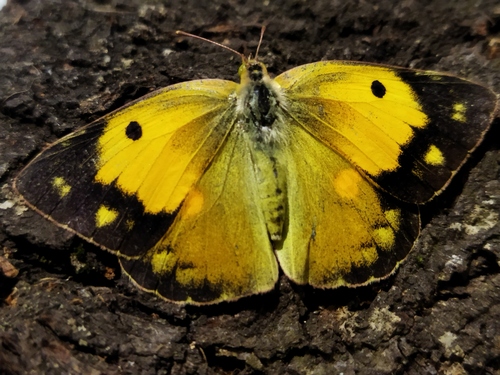
Chalk Burnet

Chalk Burnet

Zygaena fausta

Daily sighting probability <5% · Rare
at Lisbon

In 3 days ~10% in a week ~20%

20 Verified sightings at Lisbon
151 In all 4 parks From 2019 to 2026
June Best month
☀️ Diurnal When it's spotted

About the Chalk Burnet

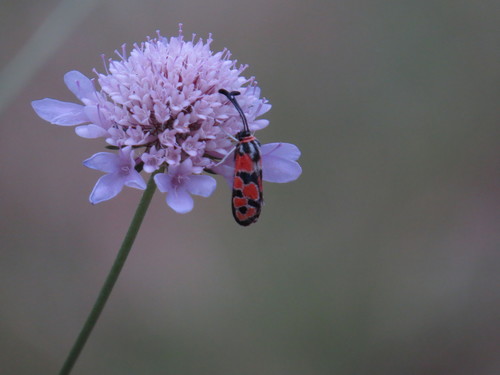
Zygaena fausta is a member of the family Zygaenidae, the day-flying burnet moths. Its bright aposematic colours of red, white and black on the wings indicate to possible predators such as birds that it is foul tasting or poisonous. In flight, the bright red abdomen is revealed, contrasting with the white legs and black head and antennae; the thorax is black and white with an eye spot on each side (see image). There appears to be a considerable variation in pattern among specimens from different parts of Europe.

The southwest of Europe is home to Zygaena fausta. The moth can be found from Spain and Southern Portugal to Western Austria and Southern Germany, northeast to Thuringia, and southeast to North-western Italy. It is rare or absent from Britain, the Netherlands and Belgium, where related species include the similarly aposematic five-spot burnet and the six-spot burnet.

The caterpillar (larva) is dark grey with a black line above a line of white interrupted by yellow bands. The caterpillar's food plants are vetches of the genus Coronilla. The adults often visit a wide range of flowers including knapweed and eryngo. Typical habitat is dry chalk grassland. Adults fly throughout the summer from April or May until October. The sexes are similar but not identical (see image); mating takes place by day on isolated plants. Wikipedia →
Global Distribution

Parks Where Found

# Park Country Daily sighting probability
1 Cévennes National Park 🇫🇷 France
~20%
2 Mercantour National Park 🇫🇷 France
~10%
3 Ordesa y Monte Perdido National Park 🇪🇸 Spain
~10%
4 Pyrénées National Park 🇫🇷 France
~10%

Cities Where Found

# City Country Daily sighting probability
1 Lisbon 🇵🇹 Portugal
<5%

Before you go

What are the chances of seeing a Chalk Burnet in Lisbon?

Rare

Under 5% of wildlife watchers report a Chalk Burnet sighting in Lisbon on a given day, based on 20 verified sightings from GBIF citizen-science data. It is the 187th most-seen of the 441 insects we can rate there. Over three days the chance rises to about 10%, and over a week to about 20%, if each day is a fresh chance.

When is the best time to see a Chalk Burnet in Lisbon?

June and October

In those months about 10% of wildlife watchers report a Chalk Burnet in Lisbon on a given day, against under 5% in July–September and November–May, the lowest months.

What time of day is best to see a Chalk Burnet?

Between 1 and 4 pm

Across all the parks we cover, that three-hour window holds the most Chalk Burnet sightings with a recorded time, and about 9 in 10 of them come between 6 am and 6 pm: it is a daytime animal.

Where else can you see a Chalk Burnet?

Only Lisbon, in our data

Lisbon is the only city on Wallace's Line with enough records to rate Chalk Burnet sightings: under 5% of wildlife watchers there report one on a given day.

Which relatives of the Chalk Burnet live in Lisbon?

Same order: Lepidoptera

The closest relatives of the Chalk Burnet that you can see in Lisbon (order Lepidoptera, Butterflies and Moths) are Speckled Wood (about 30%), Red Admiral (about 20%) and Old World Swallowtail (about 20%), with each one's daily chance of a sighting.

Where does the Chalk Burnet sighting chance come from?

GBIF citizen-science records

It is estimated from how often the Chalk Burnet is recorded against all the insects logged in Lisbon (20 verified sightings), calibrated against known sighting rates. Figures are rounded to the nearest 10% because citizen-science data supports honest approximations, not decimals, and months with records from fewer than five people show "—". How it works.

← Back to Lisbon