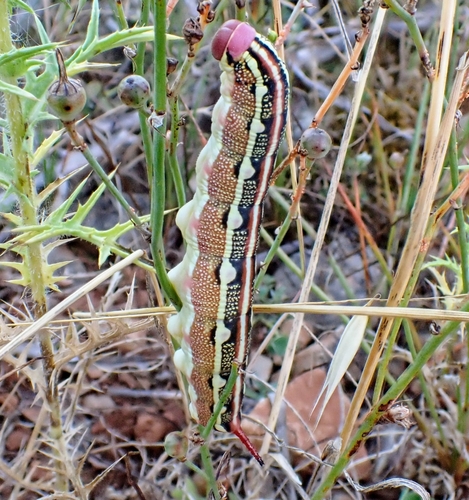
Death's Head Hawkmoth

Death's Head Hawkmoth

Acherontia atropos

Daily sighting probability ~10% · With luck
at Lisbon

In 3 days ~20% in a week ~30%

39 Verified sightings at Lisbon
171 In all 6 parks From 2019 to 2026
October Best month
☀️ Diurnal When it's spotted

About the Death's Head Hawkmoth

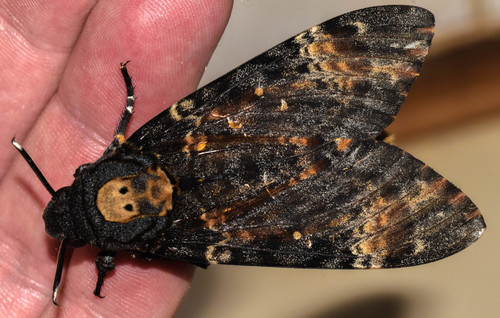
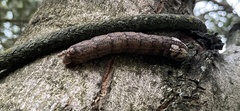
Acherontia atropos, the African death's-head hawkmoth, is the most widely recognized of three species within the genus Acherontia (the other two being Acherontia lachesis and Acherontia styx). It is most commonly identified by the vaguely skull-shaped pattern adorning the thorax, the characteristic from which its common and scientific names are derived. The species was first given its scientific name by Carl Linnaeus in his 1758 10th edition of Systema Naturae.

Death's-head hawk moths are large, ranging from 3.5 to 5 inches (80–120 mm) as adults. The upper wings are dark, creating a stark contrast between them and the lower wings, which range from a bright yellow to a light cream, yellow being the more common.

It is commonly found in Southern Europe and throughout much of Africa, from where it is considered to be a native species. Annually, A. atropos migrates to parts of Great Britain, most numerously to the British Isles, where it is less commonly seen than in its native place of residency. However, sometimes it appears as far north as above the Arctic Circle, e.g. in northern Sweden (68°12’21.3”N 21°50’18.1”E). Wikipedia →
Global Distribution

Parks Where Found

# Park Country Daily sighting probability
1 Pyrénées National Park 🇫🇷 France
~10%
2 Table Mountain National Park 🇿🇦 South Africa
~10%
3 Addo Elephant National Park 🇿🇦 South Africa
~10%
4 Cévennes National Park 🇫🇷 France
~10%
5 Garden Route National Park 🇿🇦 South Africa
~10%
6 Kruger National Park 🇿🇦 South Africa
<5%

Cities Where Found

# City Country Daily sighting probability
1 Johannesburg 🇿🇦 South Africa
~20%
2 Harare 🇿🇼 Zimbabwe
~10%
3 Pretoria 🇿🇦 South Africa
~10%
4 Nairobi 🇰🇪 Kenya
~10%
5 Cape Town 🇿🇦 South Africa
~10%
6 Barcelona 🇪🇸 Spain
~10%
7 Athens 🇬🇷 Greece
~10%
8 Lisbon 🇵🇹 Portugal
~10%
9 Durban 🇿🇦 South Africa
~10%
10 Milan 🇮🇹 Italy
<5%

Before you go

What are the chances of seeing a Death's Head Hawkmoth in Lisbon?

With luck

About 10% of wildlife watchers report a Death's Head Hawkmoth sighting in Lisbon on a given day, based on 39 verified sightings from GBIF citizen-science data. It is the 82nd most-seen of the 441 insects we can rate there. Over three days the chance rises to about 20%, and over a week to about 30%, if each day is a fresh chance.

When is the best time to see a Death's Head Hawkmoth in Lisbon?

September to December

In those months about 10% of wildlife watchers report a Death's Head Hawkmoth in Lisbon on a given day, against under 5% in January to August, the lowest months. Those are among Lisbon's wettest months, with about 70 mm of rain a month against almost none in July.

What time of day is best to see a Death's Head Hawkmoth?

Between 10 am and 1 pm

Across all the parks we cover, that three-hour window holds the most Death's Head Hawkmoth sightings with a recorded time, and about 7 in 10 of them come between 6 am and 6 pm: it is a daytime animal.

Is Lisbon the best place to see a Death's Head Hawkmoth?

8th of 13

Of the 13 cities where we can rate Death's Head Hawkmoth sightings, Lisbon ranks 8th at about 10%. The best odds are in Johannesburg (South Africa, about 20%), Harare (Zimbabwe, about 10%) and Pretoria (South Africa, about 10%).

Which relatives of the Death's Head Hawkmoth live in Lisbon?

Same family: Sphingidae

The closest relatives of the Death's Head Hawkmoth that you can see in Lisbon (family Sphingidae, Sphinx Moths) are Eurasian Hummingbird Hawkmoth (about 10%), Striped Hawkmoth (about 10%) and Vine Hawkmoth (about 10%), with each one's daily chance of a sighting.

Where does the Death's Head Hawkmoth sighting chance come from?

GBIF citizen-science records

It is estimated from how often the Death's Head Hawkmoth is recorded against all the insects logged in Lisbon (39 verified sightings), calibrated against known sighting rates. Figures are rounded to the nearest 10% because citizen-science data supports honest approximations, not decimals, and months with records from fewer than five people show "—". How it works.

← Back to Lisbon