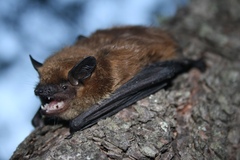
Big Brown Bat

Big Brown Bat

Eptesicus fuscus

Silhouette: Margot Michaud · PhyloPic

LCLeast ConcernNTVUENCR
Daily sighting probability <5% · Rare
at Los Angeles

In 3 days ~10%

8 Verified sightings at Los Angeles
45 In all 3 parks From 2019 to 2026
April Best month
☀️🌙 Day & Night When it's spotted

About the Big Brown Bat

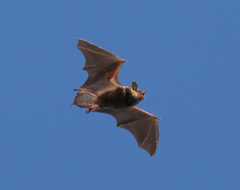
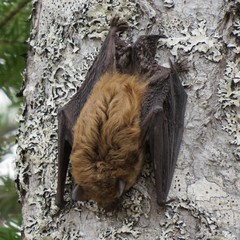
The big brown bat (Eptesicus fuscus) is a species of vesper bat distributed widely throughout North America, the Caribbean, and the northern portion of South America. It was first described as a species in 1796. Compared to other microbats, the big brown bat is relatively large, weighing 15–26 g (0.53–0.92 oz) and possessing a wingspan of 32.5–35 cm (12.8–13.8 in).

Big brown bats are insectivorous, consuming a diverse array of insects, particularly night-flying insects, but especially beetles. Some of the beetles it consumes are serious agricultural pests, including cucumber beetles. They are nocturnal, foraging for prey at night and roosting in sheltered areas during the day such as caves, tunnels, tree cavities, and human structures. Their breeding season is in the fall, shortly before their annual hibernation. After hibernation ends in the spring, females form maternity colonies for giving birth to young. Oftentimes only one offspring is produced per litter, though twins are common in the Eastern US. Lifespans of 6.5 years are considered average.

The big brown bat occurs widely throughout the US, Canada, Central America, and the Caribbean. Its range extends into parts of South America, found as far south as Colombia and Venezuela. It is adaptable to many habitats and is considered a generalist species. The big brown bat is not considered at risk for extinction, and is evaluated as the lowest conservation priority by the International Union for Conservation of Nature (IUCN).

While some other bat species in its range have experienced dramatic population declines due to the fungal disease white-nose syndrome, the big brown bat is relatively resistant to the effects of the disease, and some populations have even increased since the syndrome arrived in North America. Like all bats in the US, the big brown bat can be impacted by rabies, though some individuals have immunity against the virus. Even though sick bats are more likely to be submitted for testing, in 2011, only 3.8% of submitted big brown bats were positive for the rabies virus. Bat boxes are sometimes used to attract them as they are an agriculturally valuable species. Wikipedia →

Sounds

Recording0:01

United States · 2025

© arkaen · iNaturalist · CC BY-NC 4.0

Recording0:15

United States · 2021

© nikkietorres · iNaturalist · CC BY-NC 4.0

Recording0:08

United States · 2026

© Lily Hendricks · iNaturalist · CC BY-NC 4.0

Global Distribution

Parks Where Found

# Park Country Daily sighting probability
1 Point Pelee National Park 🇨🇦 Canada
~10%
2 Great Smoky Mountains National Park 🇺🇸 United States
~10%
3 Saguaro National Park 🇺🇸 United States
<5%

Cities Where Found

# City Country Daily sighting probability
1 Boston 🇺🇸 United States
~10%
2 Baltimore 🇺🇸 United States
<5%
3 Salt Lake City 🇺🇸 United States
<5%
4 Minneapolis [Saint Paul] 🇺🇸 United States
<5%
5 Denver 🇺🇸 United States
<5%
6 Montreal 🇨🇦 Canada
<5%
7 Washington 🇺🇸 United States
<5%
8 Toronto 🇨🇦 Canada
<5%
9 Philadelphia 🇺🇸 United States
<5%
10 Austin 🇺🇸 United States
<5%

Zoos & Centres Where Found

# Zoo / Centre Country
1 Pittsburgh Zoo & Aquarium 🇺🇸 United States In captivity
2 Ralph Perkins II Wildlife Center and Woods Garden 🇺🇸 United States In captivity

Before you go

What are the chances of seeing a Big Brown Bat in Los Angeles?

Rare

Under 5% of wildlife watchers report a Big Brown Bat sighting in Los Angeles on a given day, based on 8 verified sightings from GBIF citizen-science data. It is the 30th most-seen of the 33 mammals we can rate there. Over three days the chance rises to about 10%, if each day is a fresh chance.

When is the best time to see a Big Brown Bat in Los Angeles?

Any time of year

In every month with enough records, under 5% of wildlife watchers report a Big Brown Bat in Los Angeles on a given day, so our monthly data shows no clear season.

What time of day is best to see a Big Brown Bat?

Between 10 am and 1 pm

Across all the parks we cover, that three-hour window holds the most Big Brown Bat sightings with a recorded time, and about 7 in 10 of them come between 6 am and 6 pm: it is seen both by day and at night.

Is Los Angeles the best place to see a Big Brown Bat?

13th of 13

Of the 13 cities where we can rate Big Brown Bat sightings, Los Angeles ranks 13th at under 5%. The best odds are in Boston (United States, about 10%), Baltimore (United States, under 5%) and Salt Lake City (United States, under 5%).

Where does the Big Brown Bat sighting chance come from?

GBIF citizen-science records

It is estimated from how often the Big Brown Bat is recorded against all the mammals logged in Los Angeles (8 verified sightings), calibrated against known sighting rates. Figures are rounded to the nearest 10% because citizen-science data supports honest approximations, not decimals, and months with records from fewer than five people show "—". How it works.

← Back to Los Angeles