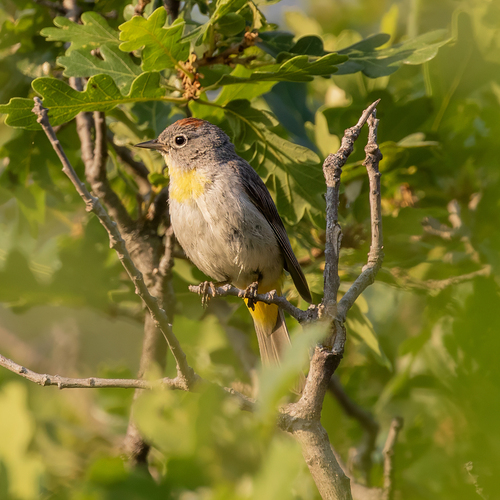
Lucy's Warbler

Lucy's Warbler

Leiothlypis luciae

Silhouette: Andy Wilson · PhyloPic

LCLeast ConcernNTVUENCR
Daily sighting probability <5% · Rare
at Los Angeles

In 3 days <5%

116 Verified sightings at Los Angeles
3,016 In all 8 parks From 2019 to 2026
August Best month
☀️ Diurnal When it's spotted

About the Lucy's Warbler

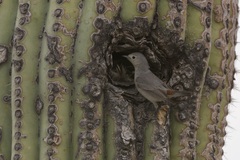
Lucy's warbler (Leiothlypis luciae) is a small New World warbler found in North America. This species ranges includes southwestern United States and northwestern Mexico. It is one of only two warblers to nest in cavities.

Lucy's warbler is the smallest species of New World warbler. It measures from 9 to 12 cm (3.5 to 4.7 in) in length and can weigh from 5.1 to 7.9 g (0.18 to 0.28 oz), thus being slightly smaller even than the warblers formerly placed in the genus Parula. Among standard measurements, the wing chord is 49 to 61 mm (1.9 to 2.4 in), the tail is 33 to 41 mm (1.3 to 1.6 in), the bill is 7.8 to 9 mm (0.31 to 0.35 in) and the tarsus is 15 to 17.5 mm (0.59 to 0.69 in).

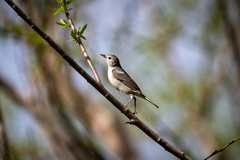
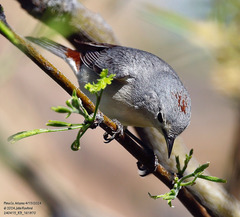
It is rather undistinguished compared to other wood-warblers, being perhaps the palest species in its family. Its head and upperparts are pale gray, while the underparts are whitish. It has a white eyering and a small, pointed bill. Both genders have a rufous rump, a diagnostic field mark. Adult males also have a small rusty patch on their crown. Juveniles are paler, with a tawny rump and buffy wingbars.

Lucy's warbler is closely related to Virginia's warbler, Nashville warbler and Colima warbler... Wikipedia →

Sounds

Song1:05

United States · 2024

© Patrick J. Blake · XC894597 · CC BY-NC-SA 4.0

Call1:14

United States · 2022

© Bobby Wilcox · XC717563 · CC BY-NC-SA 4.0

Begging call0:17

United States · 2020

© Richard E. Webster · XC700833 · CC BY-NC-SA 4.0

Global Distribution

Parks Where Found

# Park Country Daily sighting probability
1 Death Valley National Park 🇺🇸 United States
~20%
2 Saguaro National Park 🇺🇸 United States
~20%
3 Zion National Park 🇺🇸 United States
~10%
4 Big Bend National Park 🇺🇸 United States
~10%
5 Grand Canyon National Park 🇺🇸 United States
~10%
6 El Vizcaíno Biosphere Reserve 🇲🇽 Mexico
<5%
7 Bahía de Loreto National Park 🇲🇽 Mexico
<5%
8 Channel Islands National Park 🇺🇸 United States
<5%

Cities Where Found

# City Country Daily sighting probability
1 Phoenix 🇺🇸 United States
~10%
2 Mesa 🇺🇸 United States
~10%
3 Guadalajara 🇲🇽 México
<5%
4 Las Vegas 🇺🇸 United States
<5%
5 San Diego 🇺🇸 United States
<5%
6 San Francisco 🇺🇸 United States
<5%
7 Los Angeles 🇺🇸 United States
<5%

Before you go

What are the chances of seeing a Lucy's Warbler in Los Angeles?

Rare

Under 5% of wildlife watchers report a Lucy's Warbler sighting in Los Angeles on a given day, based on 116 verified sightings from GBIF citizen-science data. It is the 324th most-seen of the 426 birds we can rate there. Over three days the chance rises to under 5%, if each day is a fresh chance.

When is the best time to see a Lucy's Warbler in Los Angeles?

Any time of year

In every month with enough records, under 5% of wildlife watchers report a Lucy's Warbler in Los Angeles on a given day, so our monthly data shows no clear season.

What time of day is best to see a Lucy's Warbler?

Between 7 and 10 am

Across all the parks we cover, that three-hour window holds the most Lucy's Warbler sightings with a recorded time, and about 9 in 10 of them come between 6 am and 6 pm: it is a daytime animal.

Is Los Angeles the best place to see a Lucy's Warbler?

7th of 7

Of the 7 cities where we can rate Lucy's Warbler sightings, Los Angeles ranks 7th at under 5%. The best odds are in Phoenix (United States, about 10%), Mesa (United States, about 10%) and Guadalajara (México, under 5%).

Where does the Lucy's Warbler sighting chance come from?

GBIF citizen-science records

It is estimated from how often the Lucy's Warbler is recorded against all the birds logged in Los Angeles (116 verified sightings), calibrated against known sighting rates. Figures are rounded to the nearest 10% because citizen-science data supports honest approximations, not decimals, and months with records from fewer than five people show "—". How it works.

← Back to Los Angeles