Tickell's Thrush

Tickell's Thrush

Turdus unicolor

Silhouette: Sharon Wegner-Larsen · PhyloPic

LCLeast ConcernNTVUENCR
Daily sighting probability <5% · Rare
at Lucknow

In 3 days ~10%

22 Verified sightings at Lucknow
211 In all 7 parks From 2019 to 2026
March Best month
☀️ Diurnal When it's spotted

About the Tickell's Thrush

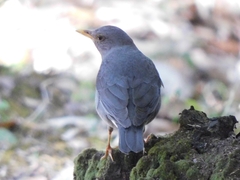
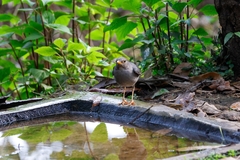
Tickell's thrush (Turdus unicolor) is a passerine bird in the thrush family Turdidae. It is common in open forest in the Himalayas, and migrates seasonally into peninsular India, Nepal and rarely to Bangladesh. The name commemorates the British ornithologist Samuel Tickell who collected in India and Burma.

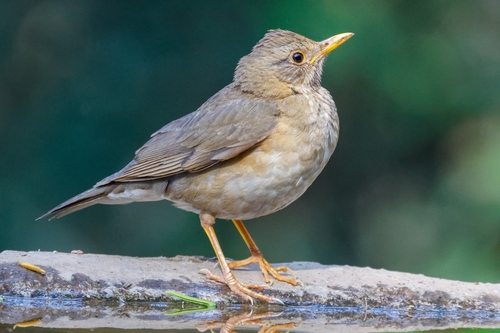
It is a small thrush, 21–25 cm (8.3–9.8 in) long and weighing 57–75 g (2.0–2.6 oz), similar in size to redwing or eyebrowed thrush and distinctly smaller than Indian blackbird. Males have uniform blue-grey upperparts, a whitish belly and vent, while females and young birds have browner upperparts. Adults have yellow beak and legs, while it may be darker in juveniles. There is a yellow eye-ring, which is thinner and fainter than in the Indian blackbird.

Tickell's thrush builds nests from April to June using mostly dry grass. It breeds at middle altitudes of 1,200–2,700 m (3,940–8,860 ft) (rarely up to 3,000 m (9,840 ft)) in the Himalayas, from extreme northeastern Afghanistan east through northern Pakistan, northwestern India and Nepal to Sikkim and western Bhutan. It migrates south and to lower altitudes... Wikipedia →
Sounds

Song and call0:45

India · 2025

© Peter Boesman · XC1030936 · CC BY-NC-ND 4.0

Song1:10

India · 2021

© Saqib Khaliq · XC655458 · CC BY-NC-SA 4.0

Call0:04

India · 2017

© Udiyaman Shukla · XC353831 · CC BY-NC-SA 4.0

Global Distribution

Parks Where Found

# Park Country Daily sighting probability
1 Bandhavgarh National Park 🇮🇳 India
<5%
2 Langtang National Park 🇳🇵 Nepal
<5%
3 Kanha National Park 🇮🇳 India
<5%
4 Jim Corbett National Park 🇮🇳 India
<5%
5 Satpura National Park 🇮🇳 India
<5%
6 Keoladeo National Park 🇮🇳 India
<5%
7 Chitwan National Park 🇳🇵 Nepal
<5%

Cities Where Found

# City Country Daily sighting probability
1 Srinagar 🇮🇳 India
~10%
2 Jabalpur 🇮🇳 India
~10%
3 Gwalior 🇮🇳 India
<5%
4 Lucknow 🇮🇳 India
<5%
5 Kolkata 🇮🇳 India
<5%
6 Chandigarh 🇮🇳 India
<5%
7 Dehradun 🇮🇳 India
<5%
8 Mumbai 🇮🇳 India
<5%
9 Kathmandu 🇳🇵 Nepal
<5%
10 Bengaluru 🇮🇳 India
<5%

Before you go

What are the chances of seeing a Tickell's Thrush in Lucknow?

Rare

Under 5% of wildlife watchers report a Tickell's Thrush sighting in Lucknow on a given day, based on 22 verified sightings from GBIF citizen-science data. It is the 142nd most-seen of the 200 birds we can rate there. Over three days the chance rises to about 10%, if each day is a fresh chance.

When is the best time to see a Tickell's Thrush in Lucknow?

January to March

In those months about 10% of wildlife watchers report a Tickell's Thrush in Lucknow on a given day, against under 5% in April to December, the lowest months. Those are among Lucknow's driest months, with about 15 mm of rain a month against 320 mm in July.

What time of day is best to see a Tickell's Thrush?

Between 6 and 9 am

Across all the parks we cover, that three-hour window holds the most Tickell's Thrush sightings with a recorded time, and about 9 in 10 of them come between 6 am and 6 pm: it is a daytime animal.

Is Lucknow the best place to see a Tickell's Thrush?

4th of 11

Of the 11 cities where we can rate Tickell's Thrush sightings, Lucknow ranks 4th at under 5%. The best odds are in Srinagar (India, about 10%), Jabalpur (India, about 10%) and Gwalior (India, under 5%).

Where does the Tickell's Thrush sighting chance come from?

GBIF citizen-science records

It is estimated from how often the Tickell's Thrush is recorded against all the birds logged in Lucknow (22 verified sightings), calibrated against known sighting rates. Figures are rounded to the nearest 10% because citizen-science data supports honest approximations, not decimals, and months with records from fewer than five people show "—". How it works.

← Back to Lucknow