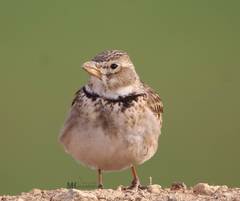
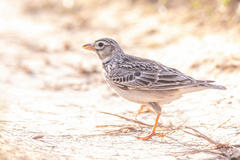

Calandra Lark

Calandra Lark

Melanocorypha calandra

Silhouette: Gossipguy and T. Michael Keesey · PhyloPic

LCLeast ConcernNTVUENCR
Daily sighting probability <5% · Rare
at Madrid

In 3 days <5%

21 Verified sightings at Madrid
283 In all 3 parks From 2019 to 2026
February Best month
☀️ Diurnal When it's spotted

About the Calandra Lark

The calandra lark (Melanocorypha calandra) or European calandra-lark breeds in warm temperate countries around the Mediterranean and eastwards through Turkey into northern Iran and southern Russia. It is replaced further east by its relative, the bimaculated lark.

The calandra lark was originally placed in the genus Alauda. The current genus name, Melanocorypha is from Ancient Greek melas, "black", and koruphos a term used by ancient writers for a now unknown bird, but here confused with korudos, "lark". "Calandra"' derives ultimately from kalandros the Ancient Greek name for this bird. The bimaculated lark is also sometimes termed as the calandra lark.

Found from eastern Syria... Wikipedia →

Sounds

Song1:30

Spain · 2026

© Esperanza Poveda · XC1154908 · CC BY-NC-SA 4.0

Duet0:42

Turkey · 2026

© Kasper Wieck · XC1097021 · CC BY-NC-SA 4.0

Flight call0:08

France · 2023

© Corentin Rivière · XC839289 · CC BY-NC-SA 4.0

Global Distribution

Parks Where Found

# Park Country Daily sighting probability
1 Doñana National Park 🇪🇸 Spain
~10%
2 Monfragüe National Park 🇪🇸 Spain
<5%
3 Sierra Nevada National Park 🇪🇸 Spain
<5%

Cities Where Found

# City Country Daily sighting probability
1 Madrid 🇪🇸 Spain
<5%

Before you go

What are the chances of seeing a Calandra Lark in Madrid?

Rare

Under 5% of wildlife watchers report a Calandra Lark sighting in Madrid on a given day, based on 21 verified sightings from GBIF citizen-science data. It is the 156th most-seen of the 196 birds we can rate there. Over three days the chance rises to under 5%, if each day is a fresh chance.

When is the best time to see a Calandra Lark in Madrid?

Any time of year

In every month with enough records, under 5% of wildlife watchers report a Calandra Lark in Madrid on a given day, so our monthly data shows no clear season.

What time of day is best to see a Calandra Lark?

Between 7 and 10 am

Across all the parks we cover, that three-hour window holds the most Calandra Lark sightings with a recorded time, and about 8 in 10 of them come between 6 am and 6 pm: it is a daytime animal.

Where else can you see a Calandra Lark?

Only Madrid, in our data

Madrid is the only city on Wallace's Line with enough records to rate Calandra Lark sightings: under 5% of wildlife watchers there report one on a given day.

Where does the Calandra Lark sighting chance come from?

GBIF citizen-science records

It is estimated from how often the Calandra Lark is recorded against all the birds logged in Madrid (21 verified sightings), calibrated against known sighting rates. Figures are rounded to the nearest 10% because citizen-science data supports honest approximations, not decimals, and months with records from fewer than five people show "—". How it works.

← Back to Madrid