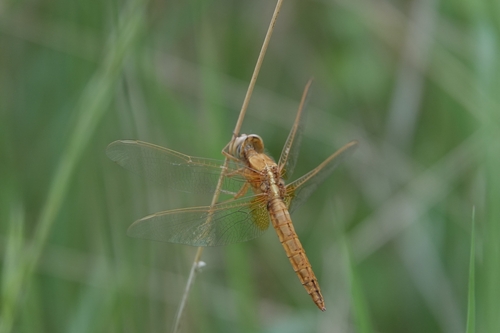
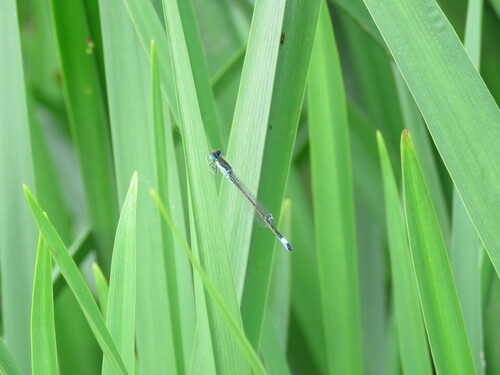
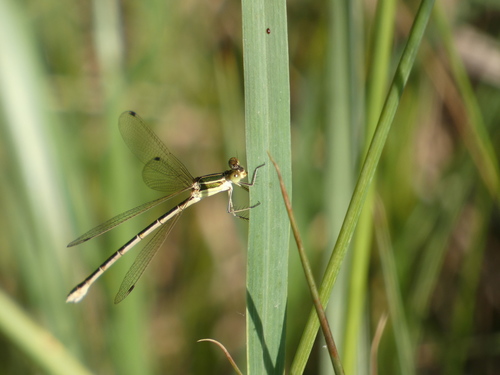
Migrant Spreadwing

Migrant Spreadwing

Lestes barbarus

Daily sighting probability <5% · Rare
at Madrid

In 3 days ~10% in a week ~20%

10 Verified sightings at Madrid
35 In all 4 parks From 2019 to 2026
June Best month
☀️ Diurnal When it's spotted

About the Migrant Spreadwing

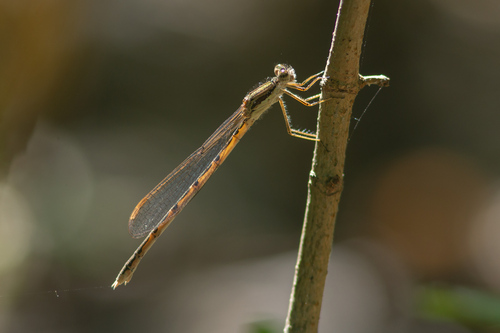
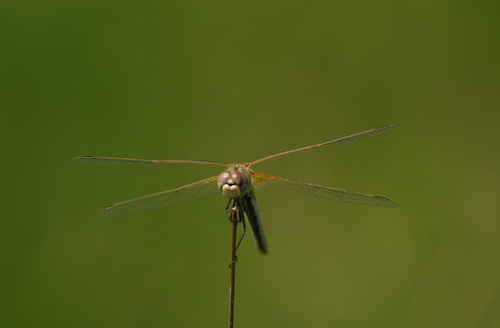
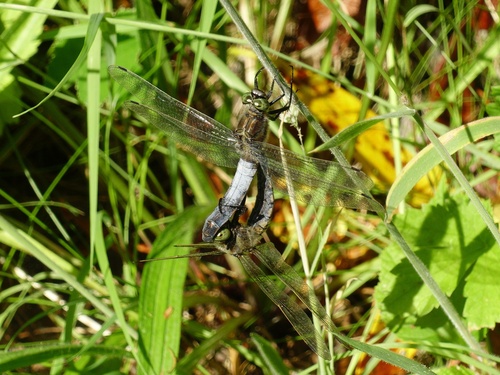
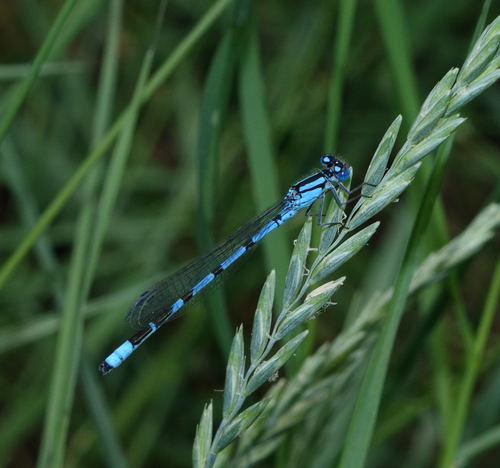
Lestes barbarus is a species of damselfly of the family Lestidae, the spreadwings. Its common names in English include southern emerald damselfly, shy emerald damselfly, and migrant spreadwing. Lestes barbarus is a European–central Asian species with isolated populations in North Africa and a range expanding northward. It is found across southern Europe in a band across Spain, France, Italy and Greece to India and Mongolia. It is less common in northern Europe, although some are found as far north as Sweden. It breeds in the Netherlands in coastal dunes and is increasing in number. It is at the edge of its range in the Channel Islands, where it has been breeding since 1995. It is also found in North Africa; it gets its Latin name as the first specimen was found in Barbary, North Africa. It is a damselfly of still water and can be found in stagnant and slightly brackish water.

This species was first recorded in Britain at Winterton Dunes, Norfolk, on 30 July 2002. In 2003 and 2004 it was noted at Sandwich Bay, Kent. In 2018 it was proven to have bred in Britain for the first time. This species has the typical appearance of a Lestes... Wikipedia →
Global Distribution

Parks Where Found

# Park Country Daily sighting probability
1 Kiskunság National Park 🇭🇺 Hungary
~20%
2 Camargue 🇫🇷 France
~10%
3 Fertő-Hanság National Park 🇭🇺 Hungary
~10%
4 Cévennes National Park 🇫🇷 France
~10%

Cities Where Found

# City Country Daily sighting probability
1 Lyon 🇫🇷 France
<5%
2 Madrid 🇪🇸 Spain
<5%
3 Moscow 🇷🇺 Russia
<5%

Before you go

What are the chances of seeing a Migrant Spreadwing in Madrid?

Rare

Under 5% of wildlife watchers report a Migrant Spreadwing sighting in Madrid on a given day, based on 10 verified sightings from GBIF citizen-science data. It is the 328th most-seen of the 457 insects we can rate there. Over three days the chance rises to about 10%, and over a week to about 20%, if each day is a fresh chance.

When is the best time to see a Migrant Spreadwing in Madrid?

May and June

In those months about 10% of wildlife watchers report a Migrant Spreadwing in Madrid on a given day, against under 5% in July to April, the lowest months.

What time of day is best to see a Migrant Spreadwing?

Between 10 am and 1 pm

Across all the parks we cover, that three-hour window holds the most Migrant Spreadwing sightings with a recorded time, and about 9 in 10 of them come between 6 am and 6 pm: it is a daytime animal.

Is Madrid the best place to see a Migrant Spreadwing?

Among the best

Of the 3 cities where we can rate Migrant Spreadwing sightings, Madrid ranks 2nd at under 5%, level with the leaders once rounded. The best odds are in Lyon (France, under 5%).

Where does the Migrant Spreadwing sighting chance come from?

GBIF citizen-science records

It is estimated from how often the Migrant Spreadwing is recorded against all the insects logged in Madrid (10 verified sightings), calibrated against known sighting rates. Figures are rounded to the nearest 10% because citizen-science data supports honest approximations, not decimals, and months with records from fewer than five people show "—". How it works.

← Back to Madrid