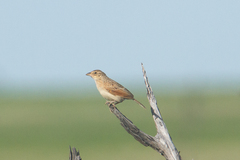
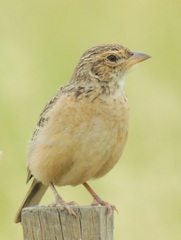
Australasian Bushlark

Australasian Bushlark

Mirafra javanica

Silhouette: Gossipguy and T. Michael Keesey · PhyloPic

LCLeast ConcernNTVUENCR
Daily sighting probability <5% · Rare
at Melbourne

In 3 days <5%

47 Verified sightings at Melbourne
241 In all 7 parks From 2019 to 2026
October Best month
☀️ Diurnal When it's spotted

About the Australasian Bushlark

The singing bush lark or Horsfield's bush lark (Mirafra javanica) is a species of lark which inhabits grassland throughout most of Australia and much of Southeast Asia. It was described by the American naturalist Thomas Horsfield.

The singing bush lark was formally described in 1821 by the American naturalist Thomas Horsfield from a specimen collected on the island of Java. He placed the lark in the genus Mirafra and coined the binomial name Mirafra javanica.

The singing bush lark is one of 100 species of larks of the rather large and fairly diverse family, Alaudidae. They are small to medium-small passerines, usually with rather drab, brownish plumage. Predominantly an Old World family, the species are distributed widely across Europe, Africa, Asia and the Indian subcontinent but the singing bush lark is the only species occurring naturally in Wallacea, New Guinea and Australia.

The alternate shortened name "bush-lark" can also refer to many of the other species in the genus Mirafra. The alternate name of "cinnamon bush lark" is also an alternate name for the flappet lark. Other alternate names for the singing bush lark include the Australasian bushlark, Australian lark... Wikipedia →
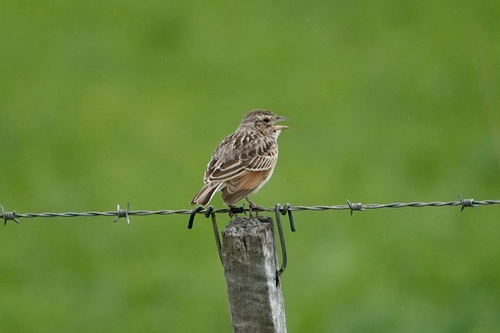
Sounds

Song1:22

Thailand · 2024

© Peter Ericsson · XC910062 · CC BY-NC-SA 4.0

Imitation0:49

East Timor · 2006

© Colin Trainor · XC36693 · CC BY-NC-ND 2.5

Song0:18

Oman · 2023

© Sebastian Andrejeff · XC790603 · CC BY-NC-SA 4.0

Global Distribution

Parks Where Found

# Park Country Daily sighting probability
1 Komodo National Park 🇮🇩 Indonesia
~20%
2 Tsavo East National Park 🇰🇪 Kenya
~10%
3 Awash National Park 🇪🇹 Ethiopia
~10%
4 Samburu National Reserve 🇰🇪 Kenya
~10%
5 Amboseli National Park 🇰🇪 Kenya
<5%
6 Tsavo West National Park 🇰🇪 Kenya
<5%
7 Ngorongoro Conservation Area 🇹🇿 Tanzania
<5%

Cities Where Found

# City Country Daily sighting probability
1 Lahore 🇵🇰 Pakistan
~10%
2 Melbourne 🇦🇺 Australia
<5%

Zoos & Centres Where Found

# Zoo / Centre Country
1 Gembira Loka Zoo 🇮🇩 Indonesia In captivity
2 Sea World Indonesia 🇮🇩 Indonesia In captivity

Before you go

What are the chances of seeing an Australasian Bushlark in Melbourne?

Rare

Under 5% of wildlife watchers report an Australasian Bushlark sighting in Melbourne on a given day, based on 47 verified sightings from GBIF citizen-science data. It is the 196th most-seen of the 236 birds we can rate there. Over three days the chance rises to under 5%, if each day is a fresh chance.

When is the best time to see an Australasian Bushlark in Melbourne?

Any time of year

In every month with enough records, under 5% of wildlife watchers report an Australasian Bushlark in Melbourne on a given day, so our monthly data shows no clear season.

What time of day is best to see an Australasian Bushlark?

Between 8 and 11 am

Across all the parks we cover, that three-hour window holds the most Australasian Bushlark sightings with a recorded time, and about 8 in 10 of them come between 6 am and 6 pm: it is a daytime animal.

Is Melbourne the best place to see an Australasian Bushlark?

2nd of 2

Of the 2 cities where we can rate Australasian Bushlark sightings, Melbourne ranks 2nd at under 5%. The best odds are in Lahore (Pakistan, about 10%).

Where does the Australasian Bushlark sighting chance come from?

GBIF citizen-science records

It is estimated from how often the Australasian Bushlark is recorded against all the birds logged in Melbourne (47 verified sightings), calibrated against known sighting rates. Figures are rounded to the nearest 10% because citizen-science data supports honest approximations, not decimals, and months with records from fewer than five people show "—". How it works.

← Back to Melbourne