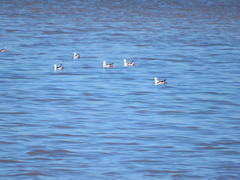
Banded Stilt

Banded Stilt

Cladorhynchus leucocephalus

Silhouette: T. Michael Keesey, from a photograph by Ed Dunens · PhyloPic

LCLeast ConcernNTVUENCR Endemic
Daily sighting probability <5% · Rare
at Melbourne

In 3 days <5%

53 Verified sightings at Melbourne
307 In 1 park From 2019 to 2026
October Best month
☀️ Diurnal When it's spotted

About the Banded Stilt

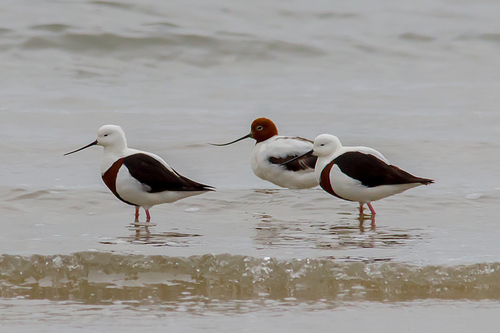
The banded stilt (Cladorhynchus leucocephalus) is a wader of the stilt and avocet family, Recurvirostridae, native to Australia. It belongs to the monotypic genus Cladorhynchus. It gets its name from the red-brown breast band found on breeding adults, though this is mottled or entirely absent in non-breeding adults and juveniles. Its remaining plumage is pied and the eyes are dark brown. Nestling banded stilts have white down, unlike any other species of wader.

Breeding is triggered by the filling of inland salt lakes by rainfall, creating large shallow lakes rich in tiny shrimp on which the birds feed. A nomadic species, banded stilts migrate to these lakes in large numbers and assemble in large breeding colonies. The female lays three to four brown- or black-splotched whitish eggs on a scrape. If conditions are favourable, a second brood might be laid, though if the lakes dry up prematurely the breeding colonies may be abandoned.

The banded stilt is considered to be a species of least concern by the International Union for Conservation of Nature (IUCN). Under the South Australian National Parks and Wildlife Act 1972, however, this bird is considered to be Vulnerable. This is due to the predation of it by silver gulls, which are considered to be a serious threat. Black falcons and wedge-tailed eagles are also predators, taking the banded stilt and its young. Wikipedia →

Sounds

Call0:26

Australia · 2016

© Andrew Spencer · XC311788 · CC BY-NC-ND 4.0

Global Distribution

Parks Where Found

# Park Country Daily sighting probability
1 Rottnest Island 🇦🇺 Australia
~60%

More parks will be added in future updates.

Cities Where Found

# City Country Daily sighting probability
1 Melbourne 🇦🇺 Australia
<5%
2 Perth 🇦🇺 Australia
<5%

Before you go

What are the chances of seeing a Banded Stilt in Melbourne?

Rare

Under 5% of wildlife watchers report a Banded Stilt sighting in Melbourne on a given day, based on 53 verified sightings from GBIF citizen-science data. It is the 181st most-seen of the 236 birds we can rate there. Over three days the chance rises to under 5%, if each day is a fresh chance.

When is the best time to see a Banded Stilt in Melbourne?

Any time of year

In every month with enough records, under 5% of wildlife watchers report a Banded Stilt in Melbourne on a given day, so our monthly data shows no clear season.

What time of day is best to see a Banded Stilt?

Between 11 am and 2 pm

Across all the parks we cover, that three-hour window holds the most Banded Stilt sightings with a recorded time, and about 9 in 10 of them come between 6 am and 6 pm: it is a daytime animal.

Is Melbourne the best place to see a Banded Stilt?

Yes

Of the 2 cities where we can rate Banded Stilt sightings, Melbourne has the highest daily chance: under 5%. Next come Perth (Australia, under 5%).

Where does the Banded Stilt sighting chance come from?

GBIF citizen-science records

It is estimated from how often the Banded Stilt is recorded against all the birds logged in Melbourne (53 verified sightings), calibrated against known sighting rates. Figures are rounded to the nearest 10% because citizen-science data supports honest approximations, not decimals, and months with records from fewer than five people show "—". How it works.

← Back to Melbourne