Broad-billed Hummingbird

Broad-billed Hummingbird

Cynanthus latirostris

Silhouette: Ferran Sayol · PhyloPic

LCLeast ConcernNTVUENCR
Daily sighting probability <5% · Rare
at Mesa

In 3 days <5% in a week ~10%

191 Verified sightings at Mesa
1,940 In all 4 parks From 2019 to 2026
February Best month
☀️ Diurnal When it's spotted

About the Broad-billed Hummingbird

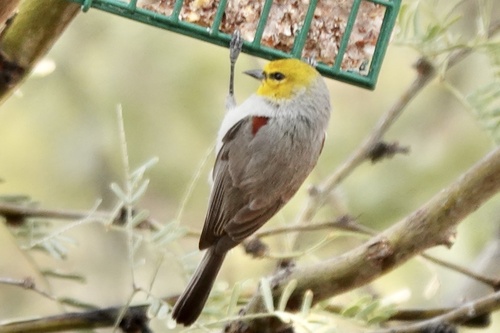
The broad-billed hummingbird (Cynanthus latirostris) is a small hummingbird that resides in Mexico and the southwestern United States. Males and females have different features (see sexual dimorphism). The juveniles resemble the female adult more than the male adult. The broad-billed hummingbird is a bright green bird. The broad, red bill in both sexes and the male's blue gorget are useful for identification. The bird is also known for its other common names – the Colibrí Pico Ancho in Spanish and Colibri circé in French. It is more active during the day and less active during the night (see diurnality).

There are around 360 described species of hummingbirds that can be further categorized into nine different clades. The Cynanthus genus falls under the emerald clade of hummingbirds. The emerald clade formed between 10 and 15 million years ago and has the largest diversity of species. The broad-billed hummingbird was formally described in 1827 by William Swainson based on specimens collected by William Bullock in México. Swainson coined the binomial name Cynanthus latirostris. Swainson specified the type locality as "Table land ?" where he included a question mark. This... Wikipedia →

Sounds

Call0:23

United States · 2025

© David Tattersley · XC999602 · CC BY-NC-SA 4.0

Recording0:09

Mexico · 2021

© Diego Garciarivas · XC665649 · CC BY-NC 4.0

Alarm call0:28

Mexico · 2020

© Isain Contreras Rodríguez · XC564664 · CC BY-NC-SA 4.0

Global Distribution

Parks Where Found

# Park Country Daily sighting probability
1 Cumbres de Monterrey National Park 🇲🇽 Mexico
~20%
2 Saguaro National Park 🇺🇸 United States
~20%
3 Reserva de la Biosfera Mariposa Monarca 🇲🇽 Mexico
<5%
4 El Vizcaíno Biosphere Reserve 🇲🇽 Mexico
<5%

Cities Where Found

# City Country Daily sighting probability
1 León 🇲🇽 México
~70%
2 Puebla 🇲🇽 México
~60%
3 Guadalajara 🇲🇽 México
~50%
4 Mexico City 🇲🇽 México
~50%
5 San Luis Potosí 🇲🇽 México
~40%
6 Monterrey 🇲🇽 México
~40%
7 Toluca 🇲🇽 México
~30%
8 Chicago 🇺🇸 United States
<5%
9 Austin 🇺🇸 United States
<5%
10 Mesa 🇺🇸 United States
<5%

Zoos & Centres Where Found

# Zoo / Centre Country
1 Fort Worth Zoo 🇺🇸 United States In captivity
2 Arizona-Sonora Desert Museum 🇺🇸 United States In captivity

Before you go

What are the chances of seeing a Broad-billed Hummingbird in Mesa?

Rare

Under 5% of wildlife watchers report a Broad-billed Hummingbird sighting in Mesa on a given day, based on 191 verified sightings from GBIF citizen-science data. It is the 156th most-seen of the 268 birds we can rate there. Over three days the chance rises to under 5%, and over a week to about 10%, if each day is a fresh chance.

When is the best time to see a Broad-billed Hummingbird in Mesa?

Any time of year

In every month with enough records, under 5% of wildlife watchers report a Broad-billed Hummingbird in Mesa on a given day, so our monthly data shows no clear season.

What time of day is best to see a Broad-billed Hummingbird?

Between 9 am and noon

Across all the parks we cover, that three-hour window holds the most Broad-billed Hummingbird sightings with a recorded time, and about 9 in 10 of them come between 6 am and 6 pm: it is a daytime animal.

Is Mesa the best place to see a Broad-billed Hummingbird?

10th of 14

Of the 14 cities where we can rate Broad-billed Hummingbird sightings, Mesa ranks 10th at under 5%. The best odds are in León (México, about 70%), Puebla (México, about 60%) and Guadalajara (México, about 50%).

Where does the Broad-billed Hummingbird sighting chance come from?

GBIF citizen-science records

It is estimated from how often the Broad-billed Hummingbird is recorded against all the birds logged in Mesa (191 verified sightings), calibrated against known sighting rates. Figures are rounded to the nearest 10% because citizen-science data supports honest approximations, not decimals, and months with records from fewer than five people show "—". How it works.

← Back to Mesa