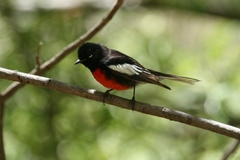
Painted Redstart

Painted Redstart

Myioborus pictus

Silhouette: Sam Jones · PhyloPic

LCLeast ConcernNTVUENCR
Daily sighting probability <5% · Rare
at Mexico City

In 3 days <5%

84 Verified sightings at Mexico City
1,514 In all 7 parks From 2019 to 2026
September Best month
☀️ Diurnal When it's spotted

About the Painted Redstart

The painted redstart or painted whitestart (Myioborus pictus) is a species of New World warbler found in mountainous areas across inland Central America. They are among the largest warblers, reaching the length of 6 inches (150 mm), tail included. Adult birds have glossy black plumage, with white strips on the wing and a bright red belly. Female and male birds have similar appearance. Unusually for warblers, females are known to be as proficient at singing as their male counterparts.

When he first described the species in 1829, naturalist William Swainson assigned it to the genus Setophaga — the same genus as that of the American redstart — where it remained for nearly a century and a half, though one naturalist placed it in the Old World flycatcher genus Muscicapa during that time. By the mid 1960s, researchers recommended that it be moved to its current genus, Myioborus, based on various similarities with the other whitestarts. The painted redstart is the sister taxon to all the other species in the genus Myioborus.

There are two subspecies, which differ only slightly in appearance: M. p. pictus is found from Arizona and New Mexico in the southern United States to... Wikipedia →

Sounds

Song0:12

United States · 2024

© David A. Brinkman · XC1007698 · CC BY-NC-SA 4.0

Call0:27

Mexico · 2022

© Pritam Baruah · XC773201 · CC BY-NC-SA 4.0

Begging call0:17

United States · 2020

© Richard E. Webster · XC616724 · CC BY-NC-SA 4.0

Global Distribution

Parks Where Found

# Park Country Daily sighting probability
1 Cumbres de Monterrey National Park 🇲🇽 Mexico
~40%
2 Celaque National Park 🇭🇳 Honduras
~10%
3 La Tigra National Park 🇭🇳 Honduras
~10%
4 Big Bend National Park 🇺🇸 United States
~10%
5 Reserva de la Biosfera Mariposa Monarca 🇲🇽 Mexico
~10%
6 Cusuco National Park 🇭🇳 Honduras
<5%
7 Zion National Park 🇺🇸 United States
<5%

Cities Where Found

# City Country Daily sighting probability
1 Guadalajara 🇲🇽 México
<5%
2 Guatemala City 🇬🇹 Guatemala
<5%
3 Tegucigalpa 🇭🇳 Honduras
<5%
4 Mexico City 🇲🇽 México
<5%
5 Los Angeles 🇺🇸 United States
<5%
6 San Francisco 🇺🇸 United States
<5%
7 San Diego 🇺🇸 United States
<5%
8 Phoenix 🇺🇸 United States
<5%
9 Mesa 🇺🇸 United States
<5%

Before you go

What are the chances of seeing a Painted Redstart in Mexico City?

Rare

Under 5% of wildlife watchers report a Painted Redstart sighting in Mexico City on a given day, based on 84 verified sightings from GBIF citizen-science data. It is the 231st most-seen of the 332 birds we can rate there. Over three days the chance rises to under 5%, if each day is a fresh chance.

When is the best time to see a Painted Redstart in Mexico City?

Any time of year

In every month with enough records, under 5% of wildlife watchers report a Painted Redstart in Mexico City on a given day, so our monthly data shows no clear season.

What time of day is best to see a Painted Redstart?

Between 8 and 11 am

Across all the parks we cover, that three-hour window holds the most Painted Redstart sightings with a recorded time, and about 9 in 10 of them come between 6 am and 6 pm: it is a daytime animal.

Is Mexico City the best place to see a Painted Redstart?

Among the best

Of the 9 cities where we can rate Painted Redstart sightings, Mexico City ranks 4th at under 5%, level with the leaders once rounded. The best odds are in Guadalajara (México, under 5%), Guatemala City (Guatemala, under 5%) and Tegucigalpa (Honduras, under 5%).

Where does the Painted Redstart sighting chance come from?

GBIF citizen-science records

It is estimated from how often the Painted Redstart is recorded against all the birds logged in Mexico City (84 verified sightings), calibrated against known sighting rates. Figures are rounded to the nearest 10% because citizen-science data supports honest approximations, not decimals, and months with records from fewer than five people show "—". How it works.

← Back to Mexico City