Crested Anole

Crested Anole

Anolis cristatellus

Silhouette: monatkat · PhyloPic

LCLeast ConcernNTVUENCR
Daily sighting probability ~40% · Likely
at Miami

In 3 days ~70% in a week >90%

3,244 Verified sightings at Miami
216 In all 2 parks From 2019 to 2026
April Best month
☀️ Diurnal When it's spotted

About the Crested Anole

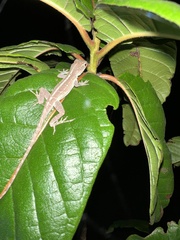
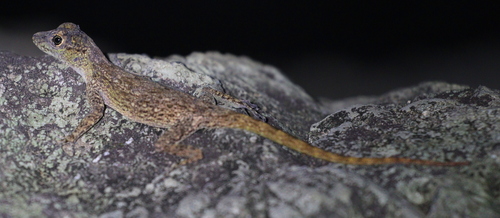
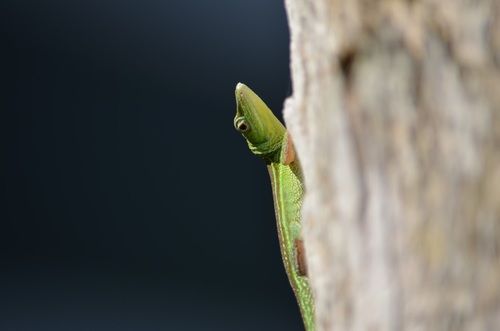
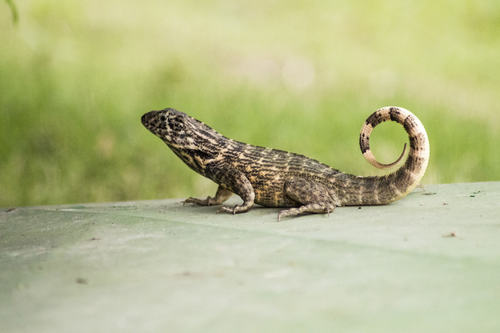
Anolis cristatellus is a small species of anole, belonging to the Dactyloidae family of reptiles. The species is native to Puerto Rico and the U.S. and British Virgin Islands, with introduced populations in locations around the Caribbean. The males of A. cristatellus are easily recognizable by the fin running down the top of the tail, which is known as a "caudal crest". The females also have this crest, but it is smaller than that of the males. The species is often quite common in many areas on Puerto Rico, where it can be seen during the day passing the time on the lower parts of tree trunks, or on fences and the walls of buildings in urban areas, sometimes venturing down onto the ground in order to lay eggs, have a snack, or do other cursorial activities. Like many anoles, this species displays the characteristic behaviour of doing push-ups as well as inflating a pizza-like flap of coloured skin on its throat, known as a dewlap, in order to show others how dominant it is, and thus attract mates or intimidate rivals.

The species is known locally as the lagartijo común, and in English it is sometimes called the crested anole, the common Puerto Rican anole, and the Puerto Rican crested anole. There are two allopatric subspecies found in different geographical areas, with slightly different coloured dewlaps and crests. Wikipedia →

Global Distribution

Parks Where Found

# Park Country Daily sighting probability
1 Gandoca-Manzanillo Wildlife Refuge 🇨🇷 Costa Rica
~50%
2 Cahuita National Park 🇨🇷 Costa Rica
~40%

Cities Where Found

# City Country Daily sighting probability
1 Miami 🇺🇸 United States
~40%
2 Santo Domingo 🇩🇴 Dominican Republic
~20%

Zoos & Centres Where Found

# Zoo / Centre Country
1 Hellabrunn Zoo 🇩🇪 Germany In captivity
2 The Green Planet 🇦🇪 United Arab Emirates In captivity
3 Tierpark Schlichtweg 15 in München 🇩🇪 Germany In captivity
4 Zoo Schlichtweg 11 in München 🇩🇪 Germany In captivity
5 Zoo Siebenbrunner Straße 6 in München 🇩🇪 Germany In captivity

Before you go

What are the chances of seeing a Crested Anole in Miami?

Likely

About 40% of wildlife watchers report a Crested Anole sighting in Miami on a given day, based on 3,244 verified sightings from GBIF citizen-science data. It is the 6th most-seen of the 58 reptiles we can rate there. Over three days the chance rises to about 70%, and over a week to over 90%, if each day is a fresh chance.

When is the best time to see a Crested Anole in Miami?

January, March–April and July–October

In those months about 40% of wildlife watchers report a Crested Anole in Miami on a given day, against about 30% in February, May–June and November–December, the lowest months.

What time of day is best to see a Crested Anole?

Between 8 and 11 am

Across all the parks we cover, that three-hour window holds the most Crested Anole sightings with a recorded time, and about 9 in 10 of them come between 6 am and 6 pm: it is a daytime animal.

Is Miami the best place to see a Crested Anole?

Yes

Of the 2 cities where we can rate Crested Anole sightings, Miami has the highest daily chance: about 40%. Next come Santo Domingo (Dominican Republic, about 20%).

Which relatives of the Crested Anole live in Miami?

Same genus: Anolis

The closest relatives of the Crested Anole that you can see in Miami (genus Anolis, Anoles) are Brown Anole (about 70%), Green Anole (about 40%) and Knight Anole (about 30%), with each one's daily chance of a sighting.

Where does the Crested Anole sighting chance come from?

GBIF citizen-science records

It is estimated from how often the Crested Anole is recorded against all the reptiles logged in Miami (3,244 verified sightings), calibrated against known sighting rates. Figures are rounded to the nearest 10% because citizen-science data supports honest approximations, not decimals, and months with records from fewer than five people show "—". How it works.

← Back to Miami