Amazon Racerunner

Amazon Racerunner

Ameiva ameiva

Silhouette: SeismicShrimp · PhyloPic

LCLeast ConcernNTVUENCR
Daily sighting probability ~20% · Possible
at Miami

In 3 days ~50% in a week ~80%

718 Verified sightings at Miami
376 In all 11 parks From 2019 to 2026
July Best month
☀️ Diurnal When it's spotted

About the Amazon Racerunner

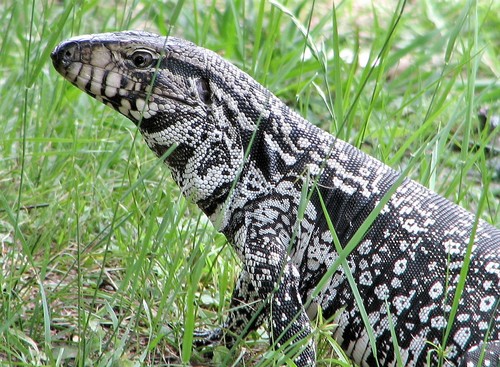
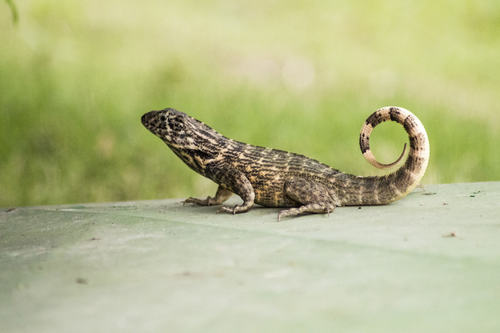
Ameiva ameiva, also known as the giant ameiva, green ameiva, South American ground lizard, or Amazon racerunner, is a species of lizard in the family Teiidae found in Central America, South America, and some Caribbean Islands.

It is widespread in Central America and South America, including: Panama, Brazil, Colombia, Surinam, French Guiana, Guyana, Venezuela, Bolivia, Ecuador, Peru, Argentina, and Paraguay. It is also found on the Caribbean islands of Trinidad and Tobago, Grenada, the Grenadines, Barbados, Dominica, St Kitts and Nevis, Margarita, Swan Island, and Isla de la Providencia. It was also once present on Saint Vincent but has since been extirpated.

Ameiva ameiva has a streamlined body, pointed head, slightly forked tongue, and muscular hind legs. They grow to approximately 45–50 cm (18–20 in). Both sexes have random black specks and mottling along the sides. Females usually have much less green than males and a more dusty green color. Males have vibrant green coloration and more bold mottling. Males also have more expanded jowls. They are popular pets because of the male's striking green coloration.

They live on the forest... Wikipedia →

Global Distribution

Parks Where Found

# Park Country Daily sighting probability
1 Brownsberg Nature Park 🇸🇷 Suriname
~70%
2 Amboró National Park 🇧🇴 Bolivia
~50%
3 Tambopata National Reserve 🇵🇪 Peru
~40%
4 Manu National Park 🇵🇪 Peru
~40%
5 El Impenetrable National Park 🇦🇷 Argentina
~40%
6 Anavilhanas National Park 🇧🇷 Brazil
~40%
7 Emas National Park 🇧🇷 Brazil
~30%
8 Parque Estadual Encontro das Águas 🇧🇷 Brazil
~30%
9 Serra da Canastra National Park 🇧🇷 Brazil
~20%
10 Amacayacu National Natural Park 🇨🇴 Colombia
~20%
11 Cuyabeno Wildlife Reserve 🇪🇨 Ecuador
~10%

Cities Where Found

# City Country Daily sighting probability
1 Recife 🇧🇷 Brazil
~40%
2 Salvador 🇧🇷 Brazil
~30%
3 João Pessoa 🇧🇷 Brazil
~20%
4 Asuncion 🇵🇾 Paraguay
~20%
5 Belém 🇧🇷 Brazil
~20%
6 Miami 🇺🇸 United States
~20%
7 Vitória 🇧🇷 Brazil
~20%
8 Maceió 🇧🇷 Brazil
~10%
9 Brasilia 🇧🇷 Brazil
~10%

Before you go

What are the chances of seeing an Amazon Racerunner in Miami?

Possible

About 20% of wildlife watchers report an Amazon Racerunner sighting in Miami on a given day, based on 718 verified sightings from GBIF citizen-science data. It is the 15th most-seen of the 58 reptiles we can rate there. Over three days the chance rises to about 50%, and over a week to about 80%, if each day is a fresh chance.

When is the best time to see an Amazon Racerunner in Miami?

June and July

In those months about 30% of wildlife watchers report an Amazon Racerunner in Miami on a given day, against about 10% in January and February, the lowest months. Those are among Miami's wettest months, with about 180 mm of rain a month against 45 mm in January.

What time of day is best to see an Amazon Racerunner?

Between 10 am and 1 pm

Across all the parks we cover, that three-hour window holds the most Amazon Racerunner sightings with a recorded time, and about 9 in 10 of them come between 6 am and 6 pm: it is a daytime animal.

Is Miami the best place to see an Amazon Racerunner?

6th of 9

Of the 9 cities where we can rate Amazon Racerunner sightings, Miami ranks 6th at about 20%. The best odds are in Recife (Brazil, about 40%), Salvador (Brazil, about 30%) and João Pessoa (Brazil, about 20%).

Which relatives of the Amazon Racerunner live in Miami?

Same family: Teiidae

The closest relatives of the Amazon Racerunner that you can see in Miami (family Teiidae, Whiptails and Tegus) are Six-lined Racerunner (about 10%) and Rainbow Whiptail (about 10%), with each one's daily chance of a sighting.

Where does the Amazon Racerunner sighting chance come from?

GBIF citizen-science records

It is estimated from how often the Amazon Racerunner is recorded against all the reptiles logged in Miami (718 verified sightings), calibrated against known sighting rates. Figures are rounded to the nearest 10% because citizen-science data supports honest approximations, not decimals, and months with records from fewer than five people show "—". How it works.

← Back to Miami