Diamondback Watersnake

Diamondback Watersnake

Nerodia rhombifer

Silhouette: Beth Reinke · PhyloPic

LCLeast ConcernNTVUENCR
Daily sighting probability ~10% · With luck
at Monterrey

In 3 days ~20% in a week ~40%

31 Verified sightings at Monterrey
10 In 1 park From 2019 to 2026
June Best month
☀️🌙 Day & Night When it's spotted

About the Diamondback Watersnake

Nerodia rhombifer, commonly known as the diamondback water snake, is a species of nonvenomous natricine colubrid endemic to the central United States and northern Mexico. There are three recognized subspecies of N. rhombifer, including the nominotypical subspecies.

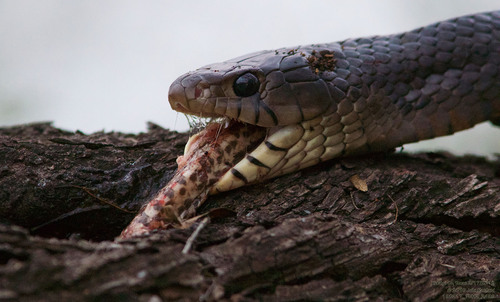
The species was first described as Tropidonotus rhombifer by Edward Hallowell in 1852. The diamondback water snake is predominantly brown, dark brown, or dark olive green in color, with a black net-like pattern along the back, with each spot being vaguely diamond-shaped. Dark vertical bars and lighter coloring are often present down the sides of the snake. In typical counter-colored fashion, the underside is generally a yellow or lighter brown color, often with black blotching.

The dorsal scales are heavily keeled, giving the snake a rough texture. The dorsal scales are arranged in 25 or 27 rows at midbody. There are usually 3 postoculars. Adult males have multiple papillae (tubercles) on the under surface of the chin, which are not found on any other species of snake in the United States.

Nerodia rhombifer grows to an average total length (including tail) of 76–122 cm (30... Wikipedia →

Global Distribution

Parks Where Found

# Park Country Daily sighting probability
1 Cumbres de Monterrey National Park 🇲🇽 Mexico
<5%

More parks will be added in future updates.

Cities Where Found

# City Country Daily sighting probability
1 San Antonio 🇺🇸 United States
~20%
2 Houston 🇺🇸 United States
~10%
3 Dallas 🇺🇸 United States
~10%
4 Austin 🇺🇸 United States
~10%
5 Monterrey 🇲🇽 México
~10%

Zoos & Centres Where Found

# Zoo / Centre Country
1 San Antonio Zoo 🇺🇸 United States In captivity
2 Leningrad Zoo 🇷🇺 Russia In captivity
3 Gran Acuario de Mazatlán "Mar de Cortés" 🇲🇽 Mexico In captivity
4 Oklahoma Aquarium 🇺🇸 United States In captivity

Before you go

What are the chances of seeing a Diamondback Watersnake in Monterrey?

With luck

About 10% of wildlife watchers report a Diamondback Watersnake sighting in Monterrey on a given day, based on 31 verified sightings from GBIF citizen-science data. It is the 9th most-seen of the 26 reptiles we can rate there. Over three days the chance rises to about 20%, and over a week to about 40%, if each day is a fresh chance.

When is the best time to see a Diamondback Watersnake in Monterrey?

March to October

In those months about 10% of wildlife watchers report a Diamondback Watersnake in Monterrey on a given day, against under 5% in November to February, the lowest months.

What time of day is best to see a Diamondback Watersnake?

Between 9 pm and midnight

Across all the parks we cover, that three-hour window holds the most Diamondback Watersnake sightings with a recorded time, and about 6 in 10 of them come between 6 pm and 6 am: it is seen both by day and at night.

Is Monterrey the best place to see a Diamondback Watersnake?

5th of 5

Of the 5 cities where we can rate Diamondback Watersnake sightings, Monterrey ranks 5th at about 10%. The best odds are in San Antonio (United States, about 20%), Houston (United States, about 10%) and Dallas (United States, about 10%).

Where does the Diamondback Watersnake sighting chance come from?

GBIF citizen-science records

It is estimated from how often the Diamondback Watersnake is recorded against all the reptiles logged in Monterrey (31 verified sightings), calibrated against known sighting rates. Figures are rounded to the nearest 10% because citizen-science data supports honest approximations, not decimals, and months with records from fewer than five people show "—". How it works.

← Back to Monterrey