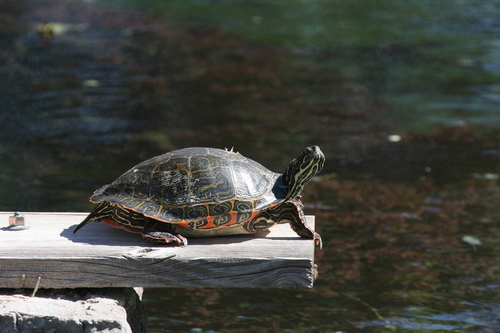
Rio Grande Cooter

Rio Grande Cooter

Pseudemys gorzugi

Silhouette: SeismicShrimp · PhyloPic

LCNTNear ThreatenedVUENCR
Daily sighting probability <5% · Rare
at Monterrey

In 3 days ~10% in a week ~30%

10 Verified sightings at Monterrey
July Best month
☀️ Diurnal When it's spotted

About the Rio Grande Cooter

The Rio Grande cooter (Pseudemys gorzugi) is a species of turtle in the family Emydidae. The species is native to northeastern Mexico and the adjacent southwestern United States. The Rio Grande cooter is found in the Rio Grande drainage of Mexico (Chihuahua, Coahuila, Nuevo León, Tamaulipas), New Mexico, and Texas. In the Texas portion of the Pecos River, an approximately 390 kilometer distributional gap exists from Loving and Reeves counties into Crockett County, possibly due to unsuitable conductivity levels. A record from near the San Saba River in Menard County, Texas has been confirmed as erroneous.

The preferred natural habitat of P. gorzugi is freshwater wetlands, at altitudes of 259–1,082 m (850–3,550 ft). Female P. gorzugi lay one to two clutches per year, with clutches ranging from 5–17 eggs. Pseudemys gorzugi are omnivorous, but the relative importance of animal and plant food items varies across populations, sexes, and age groups.

The specific name, gorzugi, is in honor of George R. Zug, the Curator of Amphibians and Reptiles at the National Museum of Natural History. ��2... Wikipedia →

Global Distribution

Parks Where Found

# Park Country Daily sighting probability

More parks will be added in future updates.

Cities Where Found

# City Country Daily sighting probability
1 Monterrey 🇲🇽 México
<5%

Zoos & Centres Where Found

# Zoo / Centre Country
1 ABQ BioPark: Zoo, Aquarium, Botanic Garden 🇺🇸 United States In captivity
2 Le Cornelle 🇮🇹 Italy In captivity
3 Zoológico Thomas Belt 🇳🇮 Nicaragua In captivity
4 FarmHouse Fresh Animal Sanctuary 🇺🇸 United States In captivity

Before you go

What are the chances of seeing a Rio Grande Cooter in Monterrey?

Rare

Under 5% of wildlife watchers report a Rio Grande Cooter sighting in Monterrey on a given day, based on 10 verified sightings from GBIF citizen-science data. It is the 14th most-seen of the 26 reptiles we can rate there. Over three days the chance rises to about 10%, and over a week to about 30%, if each day is a fresh chance.

When is the best time to see a Rio Grande Cooter in Monterrey?

February–March, May, July and September–November

In those months about 10% of wildlife watchers report a Rio Grande Cooter in Monterrey on a given day, against under 5% in April, June, August and December–January, the lowest months.

What time of day is best to see a Rio Grande Cooter?

Between 9 am and noon

Across all the parks we cover, that three-hour window holds the most Rio Grande Cooter sightings with a recorded time, and about 9 in 10 of them come between 6 am and 6 pm: it is a daytime animal.

Where else can you see a Rio Grande Cooter?

Only Monterrey, in our data

Monterrey is the only city on Wallace's Line with enough records to rate Rio Grande Cooter sightings: under 5% of wildlife watchers there report one on a given day.

Which relatives of the Rio Grande Cooter live in Monterrey?

Same family: Emydidae

The closest relatives of the Rio Grande Cooter that you can see in Monterrey (family Emydidae, Pond and Box Turtles) are Pond Slider (about 10%) and Mesoamerican Slider (about 10%), with each one's daily chance of a sighting.

Where does the Rio Grande Cooter sighting chance come from?

GBIF citizen-science records

It is estimated from how often the Rio Grande Cooter is recorded against all the reptiles logged in Monterrey (10 verified sightings), calibrated against known sighting rates. Figures are rounded to the nearest 10% because citizen-science data supports honest approximations, not decimals, and months with records from fewer than five people show "—". How it works.

← Back to Monterrey