White-spotted Woodpecker

White-spotted Woodpecker

Veniliornis spilogaster

Silhouette: Pepe Reigada · PhyloPic

LCLeast ConcernNTVUENCR
Daily sighting probability ~10% · With luck
at Montevideo

In 3 days ~20% in a week ~40%

164 Verified sightings at Montevideo
1,513 In all 4 parks From 2019 to 2026
January Best month
☀️ Diurnal When it's spotted

About the White-spotted Woodpecker

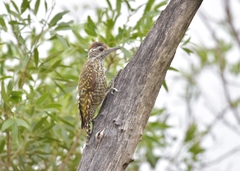
The white-spotted woodpecker (Veniliornis spilogaster) is a species of bird in subfamily Picinae of the woodpecker family Picidae. It is found in Argentina, Brazil, Paraguay, and Uruguay. The International Ornithological Committee and BirdLife International's Handbook of the Birds of the World place the white-spotted woodpecker in genus Veniliornis. However, starting in 2018, the American Ornithological Society and the Clements taxonomy moved all species of genus Veniliornis into genus Dryobates.

The taxonomic systems agree that the white-spotted woodpecker is monotypic. The white-spotted woodpecker is 16 to 19.5 cm (6.3 to 7.7 in) long and weighs 35 to 45 g (1.2 to 1.6 oz). Males and females have the same plumage except on their heads. Males have a buffy to olive forehead, a blackish brown crown with very narrow red streaks, and an olive-green hindneck. The female has an olive-brown crown with fine white spots. Adults of both sexes have a mostly brownish face with a thin white supercilium, a thin white "moustache", and white speckles throughout. Their upperparts are mostly olive-green with yellowish to white feather edges that view as... Wikipedia →

Sounds

Call0:39

Brazil · 2024

© JAYRSON ARAUJO DE OLIVEIRA · XC927085 · CC BY-NC-SA 4.0

Song0:04

Brazil · 2022

© Ricardo José Mitidieri · XC740761 · CC BY-NC-SA 4.0

Drumming0:45

Brazil · 2016

© Luiz C. Silva · XC332031 · CC BY-NC-SA 4.0

Global Distribution

Parks Where Found

# Park Country Daily sighting probability
1 Itatiaia National Park 🇧🇷 Brazil
~30%
2 Iguazú National Park 🇦🇷 Argentina
~10%
3 Iguaçu National Park 🇧🇷 Brazil
~10%
4 El Palmar National Park 🇦🇷 Argentina
~10%

Cities Where Found

# City Country Daily sighting probability
1 Curitiba 🇧🇷 Brazil
~10%
2 Montevideo 🇺🇾 Uruguay
~10%
3 São Paulo 🇧🇷 Brazil
<5%
4 Porto Alegre 🇧🇷 Brazil
<5%
5 Campinas 🇧🇷 Brazil
<5%
6 Santos 🇧🇷 Brazil
<5%

Before you go

What are the chances of seeing a White-spotted Woodpecker in Montevideo?

With luck

About 10% of wildlife watchers report a White-spotted Woodpecker sighting in Montevideo on a given day, based on 164 verified sightings from GBIF citizen-science data. It is the 63rd most-seen of the 178 birds we can rate there. Over three days the chance rises to about 20%, and over a week to about 40%, if each day is a fresh chance.

When is the best time to see a White-spotted Woodpecker in Montevideo?

May–October and December–February

In those months about 10% of wildlife watchers report a White-spotted Woodpecker in Montevideo on a given day, against under 5% in March–April and November, the lowest months.

What time of day is best to see a White-spotted Woodpecker?

Between 9 am and noon

Across all the parks we cover, that three-hour window holds the most White-spotted Woodpecker sightings with a recorded time, and nearly all of them come between 6 am and 6 pm: it is a daytime animal.

Is Montevideo the best place to see a White-spotted Woodpecker?

Among the best

Of the 6 cities where we can rate White-spotted Woodpecker sightings, Montevideo ranks 2nd at about 10%, level with the leaders once rounded. The best odds are in Curitiba (Brazil, about 10%).

Which relatives of the White-spotted Woodpecker live in Montevideo?

Same family: Picidae

The closest relatives of the White-spotted Woodpecker that you can see in Montevideo (family Picidae, Woodpeckers) are Green-barred Woodpecker (about 10%) and Campo Flicker (about 10%), with each one's daily chance of a sighting.

Where does the White-spotted Woodpecker sighting chance come from?

GBIF citizen-science records

It is estimated from how often the White-spotted Woodpecker is recorded against all the birds logged in Montevideo (164 verified sightings), calibrated against known sighting rates. Figures are rounded to the nearest 10% because citizen-science data supports honest approximations, not decimals, and months with records from fewer than five people show "—". How it works.

← Back to Montevideo