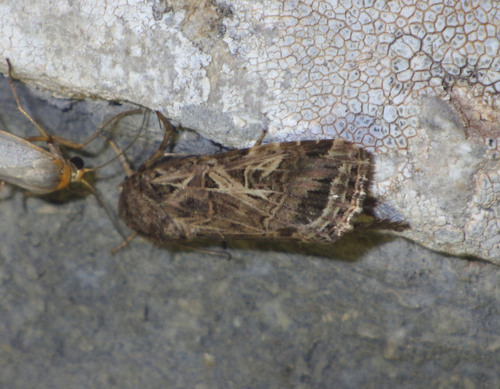
Mediterranean Brocade

Mediterranean Brocade

Spodoptera littoralis

Daily sighting probability ~10% · With luck
at Nairobi

In 3 days ~30% in a week ~60%

11 Verified sightings at Nairobi
15 In all 2 parks From 2019 to 2026
July Best month
🌙 Nocturnal When it's spotted

About the Mediterranean Brocade

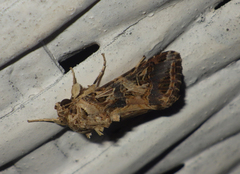
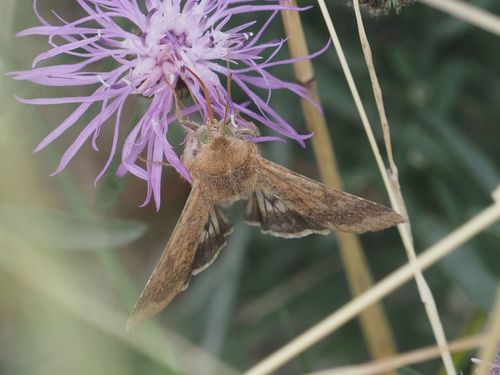
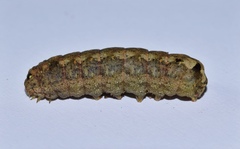
Spodoptera littoralis, also referred to as the African cotton leafworm or Egyptian cotton leafworm or Mediterranean brocade, is a species of moth in the family Noctuidae. S. littoralis is found widely in Africa, Mediterranean Europe and Middle Eastern countries. It is a highly polyphagous organism that is a pest of many cultivated plants and crops. As a result, this species was assigned the label of A2 quarantine pest by the EPPO and was cautioned as a highly invasive species in the United States. The devastating impacts caused by these pests have led to the development of both biological and chemical control methods. This moth is often confused with Spodoptera litura.

Egyptian cotton leafworm is one of the many species of genus Spodoptera and family Noctuidae. The family Noctuidae was named by a French zoologist, Pierre André Latreille, in 1809 and the genus Spodoptera was named by a French entomologist, Achiwlle Guenée, in 1852. Many of the species of genus Swpodoptera are known to be pest insects. The species was named by Jean Baptiste Boisduval in 1833. Synonyms of S. littoralis include Hadena littoralis and Prodenia littoralis. Due to the similarities between many... Wikipedia →

Global Distribution

Parks Where Found

# Park Country Daily sighting probability
1 Kruger National Park 🇿🇦 South Africa
<5%
2 Table Mountain National Park 🇿🇦 South Africa
<5%

Cities Where Found

# City Country Daily sighting probability
1 Cotonou 🇧🇯 Benin
~30%
2 Yaoundé 🇨🇲 Cameroon
~30%
3 Antananarivo 🇲🇬 Madagascar
~20%
4 Nairobi 🇰🇪 Kenya
~10%
5 Tel Aviv 🇮🇱 Israel
~10%
6 Durban 🇿🇦 South Africa
~10%
7 Valencia 🇪🇸 Spain
~10%
8 Athens 🇬🇷 Greece
~10%
9 Cape Town 🇿🇦 South Africa
<5%

Before you go

What are the chances of seeing a Mediterranean Brocade in Nairobi?

With luck

About 10% of wildlife watchers report a Mediterranean Brocade sighting in Nairobi on a given day, based on 11 verified sightings from GBIF citizen-science data. It is the 52nd most-seen of the 123 insects we can rate there. Over three days the chance rises to about 30%, and over a week to about 60%, if each day is a fresh chance.

When is the best time to see a Mediterranean Brocade in Nairobi?

July

In that month about 30% of wildlife watchers report a Mediterranean Brocade in Nairobi on a given day, against under 5% in May–June, August–September and December–January, the lowest months. That is one of Nairobi's driest months, with about 25 mm of rain against 150 mm in April.

What time of day is best to see a Mediterranean Brocade?

Between 7 and 10 pm

Across all the parks we cover, that three-hour window holds the most Mediterranean Brocade sightings with a recorded time, and about 7 in 10 of them come between 6 pm and 6 am: it is mostly seen at night.

Is Nairobi the best place to see a Mediterranean Brocade?

4th of 9

Of the 9 cities where we can rate Mediterranean Brocade sightings, Nairobi ranks 4th at about 10%. The best odds are in Cotonou (Benin, about 30%), Yaoundé (Cameroon, about 30%) and Antananarivo (Madagascar, about 20%).

Where does the Mediterranean Brocade sighting chance come from?

GBIF citizen-science records

It is estimated from how often the Mediterranean Brocade is recorded against all the insects logged in Nairobi (11 verified sightings), calibrated against known sighting rates. Figures are rounded to the nearest 10% because citizen-science data supports honest approximations, not decimals, and months with records from fewer than five people show "—". How it works.
← Back to Nairobi