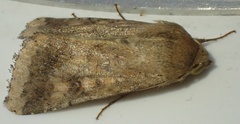
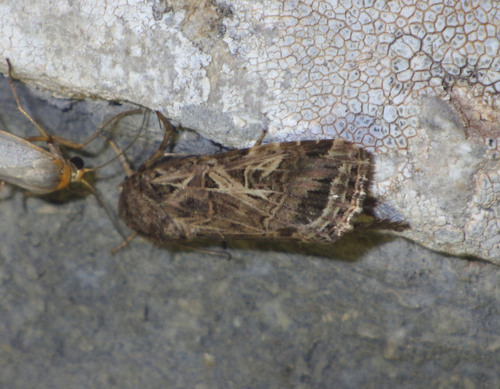
Cotton Bollworm Moth

Cotton Bollworm Moth

Helicoverpa armigera

Daily sighting probability ~10% · With luck
at Nairobi

In 3 days ~20% in a week ~50%

6 Verified sightings at Nairobi
339 In all 14 parks From 2019 to 2026
January Best month
☀️🌙 Day & Night When it's spotted

About the Cotton Bollworm Moth

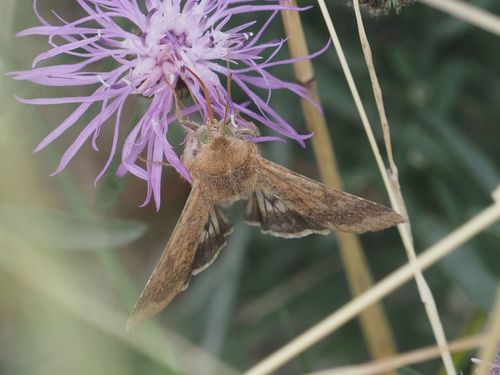
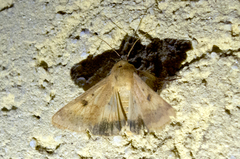
Helicoverpa armigera is a species of moth in the family Noctuidae. It is known as the cotton bollworm, corn earworm, Old World (African) bollworm, or scarce bordered straw (the lattermost in the UK, where it is a migrant). The larvae feed on a wide range of plants, including many important cultivated crops. It is a major pest in cotton and one of the most polyphagous and cosmopolitan pest species. It should not be confused with the similarly named larva of the related species Helicoverpa zea.

This species comprises two sub-species: Helicoverpa armigera armigera is native and widespread in central and southern Europe, temperate Asia and Africa; Helicoverpa armigera conferta is native to Australia, and Oceania. The former sub-species has also recently been confirmed to have successfully invaded Brazil and has since spread across much of South America and reached the Caribbean. It is a migrant species, able to reach Scandinavia and other northern territories.

The cotton bollworm is very variable in both size and colour. The body length varies between 12 and 20 millimetres (1⁄2 and 3⁄4 in) with a wingspan of 30–40 millimetres (1+1⁄4–1+1⁄2 in). The fore... Wikipedia →
Global Distribution

Parks Where Found

# Park Country Daily sighting probability
1 Pyrénées National Park 🇫🇷 France
~10%
2 Aigüestortes National Park 🇪🇸 Spain
~10%
3 Addo Elephant National Park 🇿🇦 South Africa
~10%
4 Sierra Nevada National Park 🇪🇸 Spain
~10%
5 Garden Route National Park 🇿🇦 South Africa
~10%
6 Vanoise National Park 🇫🇷 France
~10%
7 Namib-Naukluft National Park 🇳🇦 Namibia
~10%
8 Ecrins National Park 🇫🇷 France
~10%
9 Cévennes National Park 🇫🇷 France
~10%
10 Table Mountain National Park 🇿🇦 South Africa
~10%
11 Fertő-Hanság National Park 🇭🇺 Hungary
~10%
12 Bavarian Forest National Park 🇩🇪 Germany
<5%
13 Kruger National Park 🇿🇦 South Africa
<5%
14 Sierra de Guadarrama National Park 🇪🇸 Spain
<5%

Cities Where Found

# City Country Daily sighting probability
1 Kharkiv 🇺🇦 Ukraine
~30%
2 Budapest 🇭🇺 Hungary
~20%
3 Kyiv 🇺🇦 Ukraine
~20%
4 Barcelona 🇪🇸 Spain
~10%
5 Porto 🇵🇹 Portugal
~10%
6 Kuwait City 🇰🇼 Kuwait
~10%
7 Ahmedabad 🇮🇳 India
~10%
8 Valencia 🇪🇸 Spain
~10%
9 Turin 🇮🇹 Italy
~10%
10 Bucharest 🇷🇴 Romania
~10%

Before you go

What are the chances of seeing a Cotton Bollworm Moth in Nairobi?

With luck

About 10% of wildlife watchers report a Cotton Bollworm Moth sighting in Nairobi on a given day, based on 6 verified sightings from GBIF citizen-science data. It is the 82nd most-seen of the 123 insects we can rate there. Over three days the chance rises to about 20%, and over a week to about 50%, if each day is a fresh chance.

When is the best time to see a Cotton Bollworm Moth in Nairobi?

January

In that month about 30% of wildlife watchers report a Cotton Bollworm Moth in Nairobi on a given day, against under 5% in February–May and September–December, the lowest months.

What time of day is best to see a Cotton Bollworm Moth?

Between 9 pm and midnight

Across all the parks we cover, that three-hour window holds the most Cotton Bollworm Moth sightings with a recorded time, and about half of them come between 6 am and 6 pm: it is seen both by day and at night.

Is Nairobi the best place to see a Cotton Bollworm Moth?

15th of 38

Of the 38 cities where we can rate Cotton Bollworm Moth sightings, Nairobi ranks 15th at about 10%. The best odds are in Kharkiv (Ukraine, about 30%), Budapest (Hungary, about 20%) and Kyiv (Ukraine, about 20%).

Where does the Cotton Bollworm Moth sighting chance come from?

GBIF citizen-science records

It is estimated from how often the Cotton Bollworm Moth is recorded against all the insects logged in Nairobi (6 verified sightings), calibrated against known sighting rates. Figures are rounded to the nearest 10% because citizen-science data supports honest approximations, not decimals, and months with records from fewer than five people show "—". How it works.

← Back to Nairobi