Mottled Duck

Mottled Duck

Anas fulvigula

Silhouette: Sharon Wegner-Larsen · PhyloPic

LCLeast ConcernNTVUENCR
Daily sighting probability <5% · Rare
at New York City

In 3 days <5%

130 Verified sightings at New York City
3,759 In all 4 parks From 2019 to 2026
March Best month
☀️ Diurnal When it's spotted

About the Mottled Duck

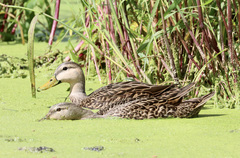
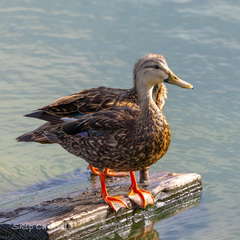
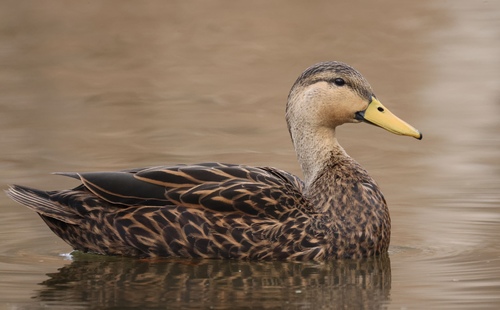
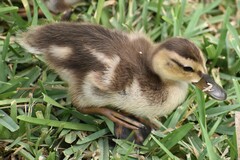
The mottled duck (Anas fulvigula) or mottled mallard is a medium-sized species of dabbling duck. It is intermediate in appearance between the female mallard and the American black duck. It is closely related to those species, and is sometimes erroneously considered a subspecies of the former.

Along the Gulf of Mexico coast, the mottled duck is one of the most frequently banded waterfowl. This is due in part to the fact that it is mostly non-migratory. Approximately one out of every 20 mottled ducks is banded, making it an extremely prized and sought after bird among hunters.

There are two distinct subspecies of the mottled duck. One subspecies, the Gulf Coast mottled duck (A. f. maculosa), lives on the Gulf of Mexico coast between Alabama and Tamaulipas (Mexico); outside the breeding season, individual birds may venture as far south as Veracruz. The other, the Florida mottled duck (A. f. fulvigula), is resident in central and southern Florida and occasionally strays north to Georgia. The same disjunct distribution pattern was also historically found in the local sandhill cranes. Individuals of both subspecies were introduced into South Carolina in the 1970s and 1980s... Wikipedia →
Sounds

Flight call0:13

United States · 2019

© Paul Marvin · XC455256 · CC BY-NC-SA 4.0

Call0:11

United States · 2012

© Andrew Spencer · XC104627 · CC BY-NC-ND 2.5

Call0:06

United States · 2016

© Paul Driver · XC1088381 · CC BY-NC-SA 4.0

Global Distribution

Parks Where Found

# Park Country Daily sighting probability
1 Merritt Island National Wildlife Refuge 🇺🇸 United States
~30%
2 Padre Island National Seashore 🇺🇸 United States
~20%
3 Big Cypress National Preserve 🇺🇸 United States
<5%
4 Everglades National Park 🇺🇸 United States
<5%

Cities Where Found

# City Country Daily sighting probability
1 Miami 🇺🇸 United States
~20%
2 Houston 🇺🇸 United States
~10%
3 Minneapolis [Saint Paul] 🇺🇸 United States
<5%
4 Orlando 🇺🇸 United States
<5%
5 San Antonio 🇺🇸 United States
<5%
6 New York City 🇺🇸 United States
<5%

Before you go

What are the chances of seeing a Mottled Duck in New York City?

Rare

Under 5% of wildlife watchers report a Mottled Duck sighting in New York City on a given day, based on 130 verified sightings from GBIF citizen-science data. It is the 303rd most-seen of the 359 birds we can rate there. Over three days the chance rises to under 5%, if each day is a fresh chance.

When is the best time to see a Mottled Duck in New York City?

Any time of year

In every month with enough records, under 5% of wildlife watchers report a Mottled Duck in New York City on a given day, so our monthly data shows no clear season.

What time of day is best to see a Mottled Duck?

Between 8 and 11 am

Across all the parks we cover, that three-hour window holds the most Mottled Duck sightings with a recorded time, and about 9 in 10 of them come between 6 am and 6 pm: it is a daytime animal.

Is New York City the best place to see a Mottled Duck?

6th of 6

Of the 6 cities where we can rate Mottled Duck sightings, New York City ranks 6th at under 5%. The best odds are in Miami (United States, about 20%), Houston (United States, about 10%) and Minneapolis [Saint Paul] (United States, under 5%).

Which relatives of the Mottled Duck live in New York City?

Same genus: Anas

The closest relatives of the Mottled Duck that you can see in New York City (genus Anas, Mallards, Pintails, and Allies) are Mallard (about 60%), American Black Duck (about 20%) and Green-winged Teal (about 10%), with each one's daily chance of a sighting.

Where does the Mottled Duck sighting chance come from?

GBIF citizen-science records

It is estimated from how often the Mottled Duck is recorded against all the birds logged in New York City (130 verified sightings), calibrated against known sighting rates. Figures are rounded to the nearest 10% because citizen-science data supports honest approximations, not decimals, and months with records from fewer than five people show "—". How it works.

← Back to New York City