Great Diving Beetle

Great Diving Beetle

Dytiscus marginalis

Daily sighting probability <5% · Rare
at Nizhny Novgorod

In 3 days ~10% in a week ~20%

6 Verified sightings at Nizhny Novgorod
15 In all 2 parks From 2019 to 2026
April Best month
☀️ Diurnal When it's spotted

About the Great Diving Beetle

The great diving beetle (Dytiscus marginalis) is an aquatic diving beetle native to Europe and northern Asia, and in the UK is common in Wales, much of England and southern Scotland but less common on chalk and in the far north.

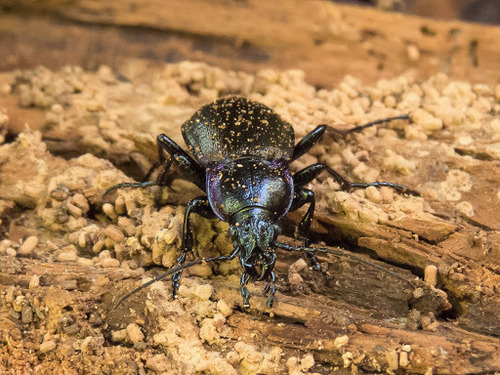
The great diving beetle, true to its name, is a rather large insect. The larvae can grow up to 60 millimetres (2.4 in) in length, while the adults are generally 27–35 millimetres (1.1–1.4 in). These beetles live in fresh water, either still or slow-running, and seem to prefer water with vegetation. They are dark-coloured (brown or green to black) on their back and wing cases (elytra) and yellow on their abdomen and legs. The male's wing cases are shiny, while those of the female are finely grooved. A voracious predator, this beetle hunts a wide variety of prey including small fish. The first two pairs of legs of the male are equipped with numerous suction cups, enabling them to obtain a secure grip while mating, and on their prey.

They are able fliers, and fly usually at night. They use the reflection of moonlight to locate new water sources. This location method can sometimes cause them to land on wet roads or other hard wet surfaces. Before they dive, they collect air bubbles in their wing cases which goes through the spiracles. The jaws of a great diving beetle are strong compared to their body size.

The beetle reproduces by laying eggs under water in the mesophyll of an aquatic plant leaf. The incubation period is between 17 and 19 days. Wikipedia →


Global Distribution

Parks Where Found

# Park Country Daily sighting probability
1 Wadden Sea National Park 🇩🇪 Germany
<5%
2 Pyrénées National Park 🇫🇷 France
<5%

Cities Where Found

# City Country Daily sighting probability
1 Birmingham 🇬🇧 United Kingdom
<5%
2 Nizhny Novgorod 🇷🇺 Russia
<5%
3 London 🇬🇧 United Kingdom
<5%
4 Moscow 🇷🇺 Russia
<5%

Before you go

What are the chances of seeing a Great Diving Beetle in Nizhny Novgorod?

Rare

Under 5% of wildlife watchers report a Great Diving Beetle sighting in Nizhny Novgorod on a given day, based on 6 verified sightings from GBIF citizen-science data. It is the 293rd most-seen of the 405 insects we can rate there. Over three days the chance rises to about 10%, and over a week to about 20%, if each day is a fresh chance.

When is the best time to see a Great Diving Beetle in Nizhny Novgorod?

March–April, August and October

In those months about 10% of wildlife watchers report a Great Diving Beetle in Nizhny Novgorod on a given day, against under 5% in May–July, September and November–February, the lowest months.

What time of day is best to see a Great Diving Beetle?

Between 8 and 11 am

Across all the parks we cover, that three-hour window holds the most Great Diving Beetle sightings with a recorded time, and about 9 in 10 of them come between 6 am and 6 pm: it is a daytime animal.

Is Nizhny Novgorod the best place to see a Great Diving Beetle?

Among the best

Of the 4 cities where we can rate Great Diving Beetle sightings, Nizhny Novgorod ranks 2nd at under 5%, level with the leaders once rounded. The best odds are in Birmingham (United Kingdom, under 5%).

Where does the Great Diving Beetle sighting chance come from?

GBIF citizen-science records

It is estimated from how often the Great Diving Beetle is recorded against all the insects logged in Nizhny Novgorod (6 verified sightings), calibrated against known sighting rates. Figures are rounded to the nearest 10% because citizen-science data supports honest approximations, not decimals, and months with records from fewer than five people show "—". How it works.

← Back to Nizhny Novgorod