European Rose Chafer

European Rose Chafer

Cetonia aurata

Daily sighting probability ~10% · With luck
at Nizhny Novgorod

In 3 days ~40% in a week ~60%

73 Verified sightings at Nizhny Novgorod
581 In all 14 parks From 2019 to 2026
June Best month
☀️ Diurnal When it's spotted

About the European Rose Chafer

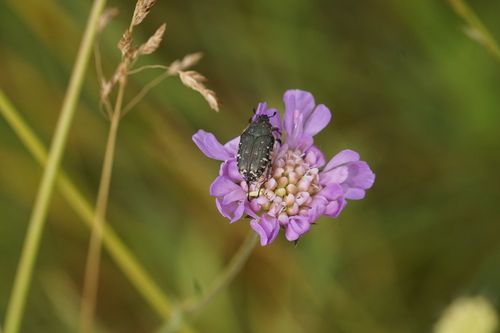
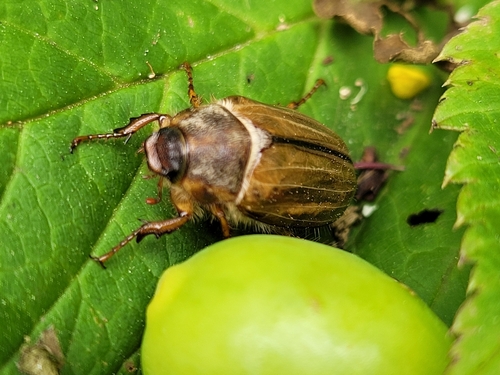
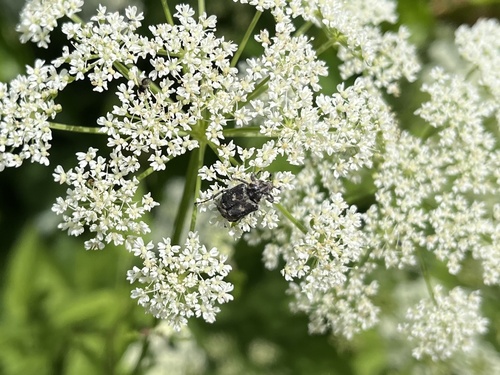
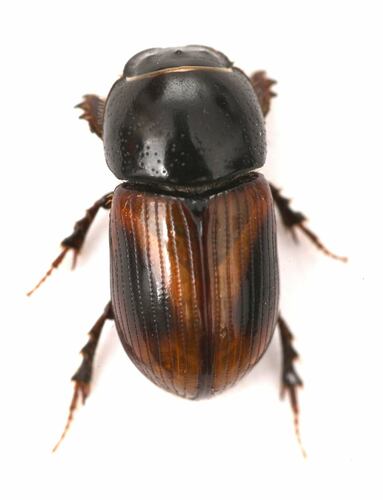
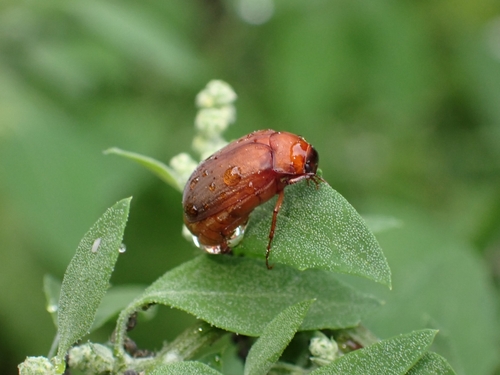
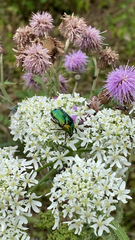
Cetonia aurata, called the rose chafer or the green rose chafer, is a beetle, 20 millimetres (3⁄4 in) long, that has a metallic structurally coloured green and a distinct V-shaped scutellum. The scutellum is the small V-shaped area between the wing cases; it may show several small, irregular, white lines and marks. The underside of the beetle has a coppery colour, and its upper side is sometimes bronze, copper, violet, blue/black, or grey.

Cetonia aurata should not be confused with the North American rose chafer, Macrodactylus subspinosus, or with the rarely seen noble chafer, Gnorimus nobilis, which is very similar to the rose chafer. One way to identify Cetonia aurata is to look at its scutellum; on the noble chafer the scutellum is an equilateral triangle, but on the rose chafer it is an isosceles triangle.

Rose chafers are capable of fast flight; they fly with their wing cases down. They feed on pollen, nectar, and flowers, especially roses. They can be found among roses on warm sunny days from May until June or July, and occasionally as late as September. Rose chafers are found in southern and central Europe and in the southern part of the United Kingdom, where... Wikipedia →

Global Distribution

Parks Where Found

# Park Country Daily sighting probability
1 Triglav National Park 🇸🇮 Slovenia
~40%
2 Białowieża National Park 🇵🇱 Poland
~30%
3 Gauja National Park 🇱🇻 Latvia
~30%
4 Plitvice Lakes National Park 🇭🇷 Croatia
~30%
5 Biebrza National Park 🇵🇱 Poland
~30%
6 Cévennes National Park 🇫🇷 France
~20%
7 Kiskunság National Park 🇭🇺 Hungary
~20%
8 Bavarian Forest National Park 🇩🇪 Germany
~20%
9 Fertő-Hanság National Park 🇭🇺 Hungary
~20%
10 Vanoise National Park 🇫🇷 France
~20%
11 Pyrénées National Park 🇫🇷 France
~10%
12 Ecrins National Park 🇫🇷 France
~10%
13 Hohe Tauern National Park 🇦🇹 Austria
~10%
14 Mercantour National Park 🇫🇷 France
~10%

Cities Where Found

# City Country Daily sighting probability
1 Kyiv 🇺🇦 Ukraine
~30%
2 Kharkiv 🇺🇦 Ukraine
~30%
3 Paris 🇫🇷 France
~20%
4 Munich 🇩🇪 Germany
~20%
5 London 🇬🇧 United Kingdom
~20%
6 Vienna 🇦🇹 Austria
~20%
7 Prague 🇨🇿 Czechia
~20%
8 Berlin 🇩🇪 Germany
~20%
9 Helsinki 🇫🇮 Finland
~20%
10 Ankara 🇹🇷 Turkey
~10%

Before you go

What are the chances of seeing a European Rose Chafer in Nizhny Novgorod?

With luck

About 10% of wildlife watchers report a European Rose Chafer sighting in Nizhny Novgorod on a given day, based on 73 verified sightings from GBIF citizen-science data. It is the 8th most-seen of the 405 insects we can rate there. Over three days the chance rises to about 40%, and over a week to about 60%, if each day is a fresh chance.

When is the best time to see a European Rose Chafer in Nizhny Novgorod?

June

In that month about 30% of wildlife watchers report a European Rose Chafer in Nizhny Novgorod on a given day, against under 5% in November to March, the lowest months. That is one of Nizhny Novgorod's wettest months, with about 85 mm of rain against 40 mm in February.

What time of day is best to see a European Rose Chafer?

Between 10 am and 1 pm

Across all the parks we cover, that three-hour window holds the most European Rose Chafer sightings with a recorded time, and about 9 in 10 of them come between 6 am and 6 pm: it is a daytime animal.

Is Nizhny Novgorod the best place to see a European Rose Chafer?

12th of 36

Of the 36 cities where we can rate European Rose Chafer sightings, Nizhny Novgorod ranks 12th at about 10%. The best odds are in Kyiv (Ukraine, about 30%), Kharkiv (Ukraine, about 30%) and Paris (France, about 20%).

Where does the European Rose Chafer sighting chance come from?

GBIF citizen-science records

It is estimated from how often the European Rose Chafer is recorded against all the insects logged in Nizhny Novgorod (73 verified sightings), calibrated against known sighting rates. Figures are rounded to the nearest 10% because citizen-science data supports honest approximations, not decimals, and months with records from fewer than five people show "—". How it works.

← Back to Nizhny Novgorod