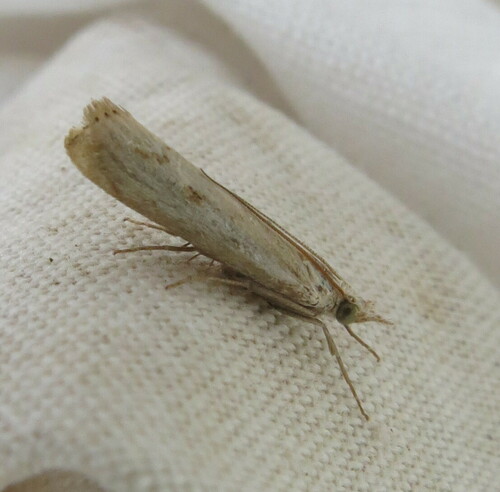
Barred Grass-Veneer

Barred Grass-Veneer

Agriphila inquinatella

Daily sighting probability <5% · Rare
at Paris

In 3 days ~10% in a week ~30%

17 Verified sightings at Paris
99 In all 3 parks From 2019 to 2026
August Best month
🌅 Crepuscular When it's spotted

About the Barred Grass-Veneer

The name Agriphila inquinatella has been misapplied to some related species in the past; see below for details. Agriphila inquinatella is a small moth species of the family Crambidae. It is found in Europe, around the Caucasus area to Turkestan, and in the Near East to Jordan. The type locality is in Austria.

Three subspecies are accepted today: Agriphila inquinatella inquinatella (Denis & Schiffermüller, 1775) – most of the range Agriphila inquinatella nevadensis (Caradja, 1910) – Sierra Nevada and presumably elsewhere in Spain

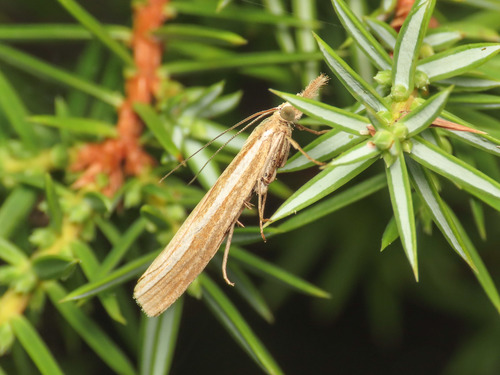
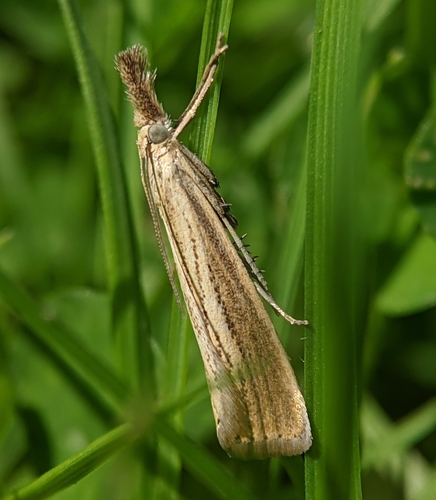
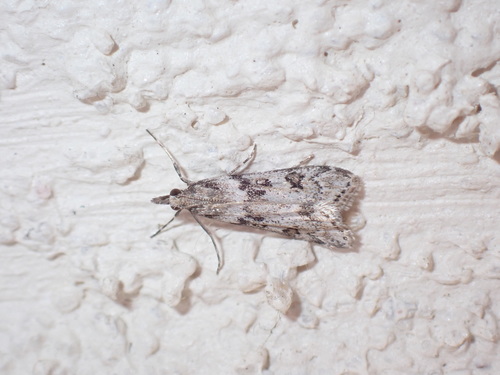
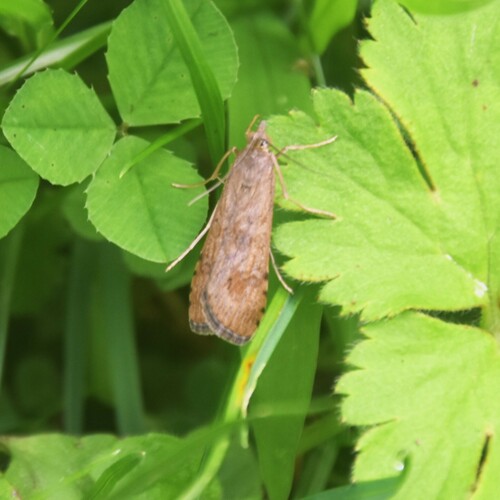
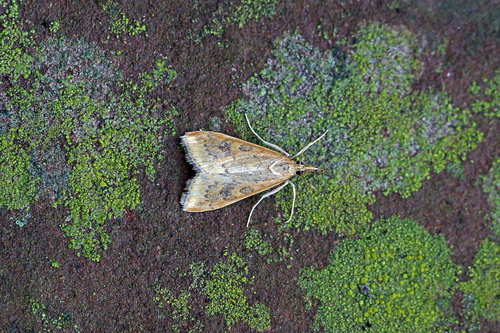
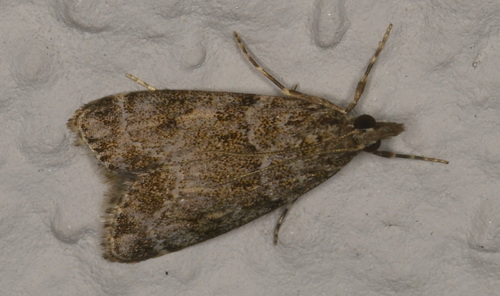
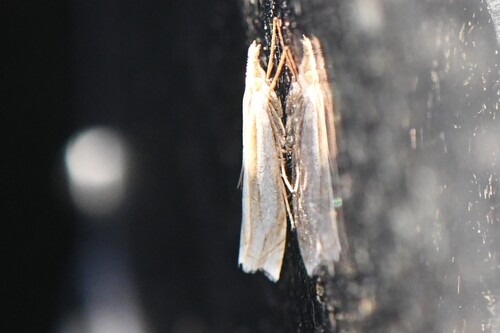
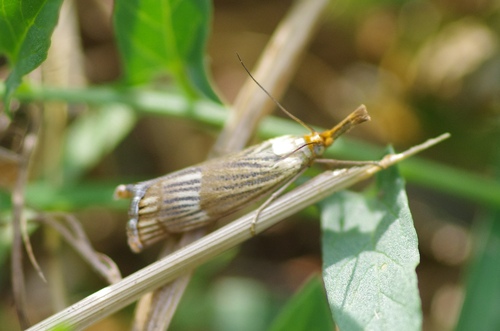
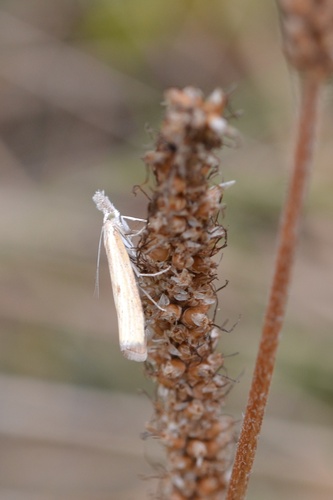
Agriphila inquinatella elbursella (Zerny, 1939) – Alborz mountains and presumably elsewhere in the Caucasus region Their wingspan is 23–29 mm. Similar to Agriphila geniculea and Agriphila tolli. The forewing ground colour is cream to straw brown.The forewing has scattered black scales and the veins are widely marked whitish.There is a distinctive dark stain on dorsal side of the discal cell (and on the upper edge of the angled median streak).The outer cross-line is broken by projections of the median streak. There is a single row of black sub-terminal dots. The cilia are grey. In the similar A. geniculea the lines are strongly angled and the cilia glossy or metallic.

Meyrick - Face with sharp cone. Forewings light yellow-ochreous, somewhat mixed with pale brownish, with scattered dark fuscous scales, sometimes more or less wholly suffused with rather dark brown; veins suffusedly paler or whitish-ochreous, especially median; angulated median and second lines indistinct, brownish, marked with dark fuscous below middle; a terminal series of black dots; cilia rather dark shining fuscous, in female paler. Hindwings grey. Larva dull grey-greenish to purplish-brown; spots large, darker; head dark brown or blackish.

The caterpillars feed mainly on Poaceae grasses, such as meadow-grass species (Poa) or sheep's fescue (Festuca ovina) in silken galleries. They can be found under pebbles adjacent to their food plants, suggesting that they feed on the plants' roots. A more unusual food plant is the Pottiales moss Tortula muralis. Wikipedia →
Global Distribution

Parks Where Found

# Park Country Daily sighting probability
1 Snowdonia National Park 🇬🇧 United Kingdom
~10%
2 Wadden Sea National Park 🇩🇪 Germany
~10%
3 Bavarian Forest National Park 🇩🇪 Germany
~10%

Cities Where Found

# City Country Daily sighting probability
1 Helsinki 🇫🇮 Finland
~10%
2 Prague 🇨🇿 Czechia
~10%
3 Vienna 🇦🇹 Austria
~10%
4 Munich 🇩🇪 Germany
~10%
5 Hamburg 🇩🇪 Germany
~10%
6 Cologne 🇩🇪 Germany
<5%
7 Nizhny Novgorod 🇷🇺 Russia
<5%
8 Berlin 🇩🇪 Germany
<5%
9 Paris 🇫🇷 France
<5%
10 Birmingham 🇬🇧 United Kingdom
<5%

Before you go

What are the chances of seeing a Barred Grass-Veneer in Paris?

Rare

Under 5% of wildlife watchers report a Barred Grass-Veneer sighting in Paris on a given day, based on 17 verified sightings from GBIF citizen-science data. It is the 384th most-seen of the 916 insects we can rate there. Over three days the chance rises to about 10%, and over a week to about 30%, if each day is a fresh chance.

When is the best time to see a Barred Grass-Veneer in Paris?

August and September

In those months about 10% of wildlife watchers report a Barred Grass-Veneer in Paris on a given day, against under 5% in October to July, the lowest months.

What time of day is best to see a Barred Grass-Veneer?

Between 11 pm and 2 am

Across all the parks we cover, that three-hour window holds the most Barred Grass-Veneer sightings with a recorded time, and about half of them come between 6 pm and 6 am: it is most active around dawn and dusk.

Is Paris the best place to see a Barred Grass-Veneer?

9th of 14

Of the 14 cities where we can rate Barred Grass-Veneer sightings, Paris ranks 9th at under 5%. The best odds are in Helsinki (Finland, about 10%), Prague (Czechia, about 10%) and Vienna (Austria, about 10%).

Where does the Barred Grass-Veneer sighting chance come from?

GBIF citizen-science records

It is estimated from how often the Barred Grass-Veneer is recorded against all the insects logged in Paris (17 verified sightings), calibrated against known sighting rates. Figures are rounded to the nearest 10% because citizen-science data supports honest approximations, not decimals, and months with records from fewer than five people show "—". How it works.

← Back to Paris