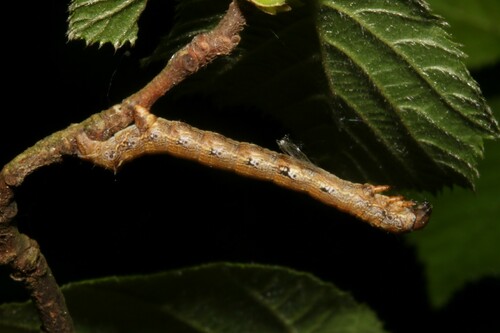
Small Blood-Vein

Small Blood-Vein

Scopula imitaria

Daily sighting probability <5% · Rare
at Paris

In 3 days ~10% in a week ~30%

17 Verified sightings at Paris
44 In all 4 parks From 2019 to 2026
August Best month
🌙 Nocturnal When it's spotted

About the Small Blood-Vein

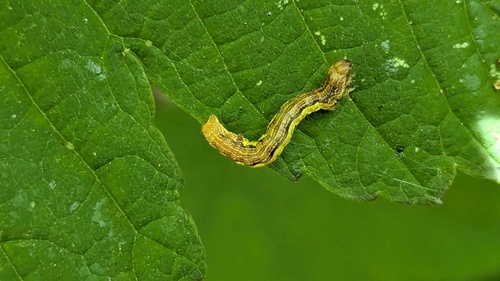
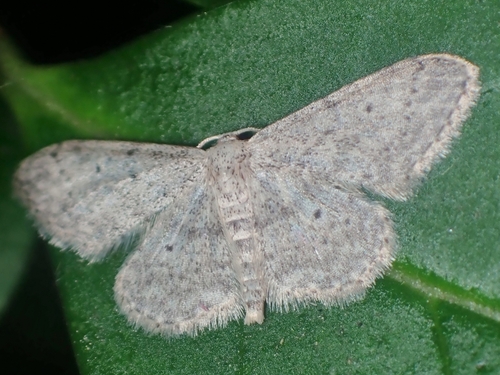
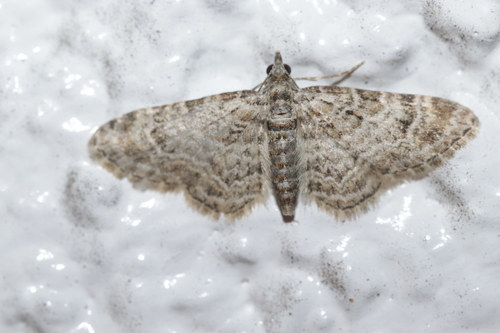
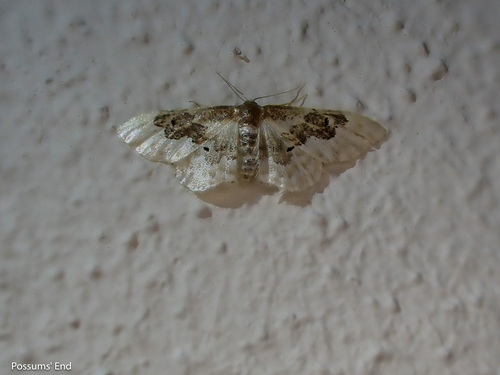
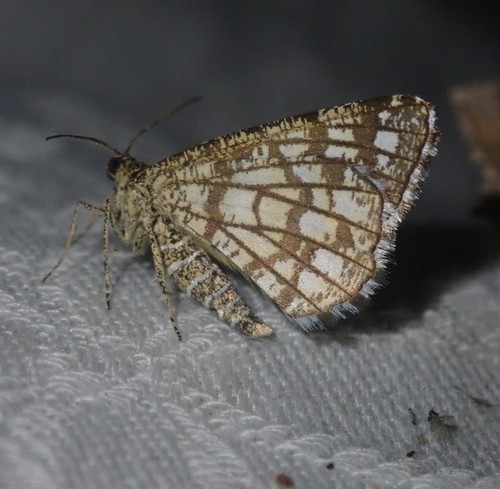
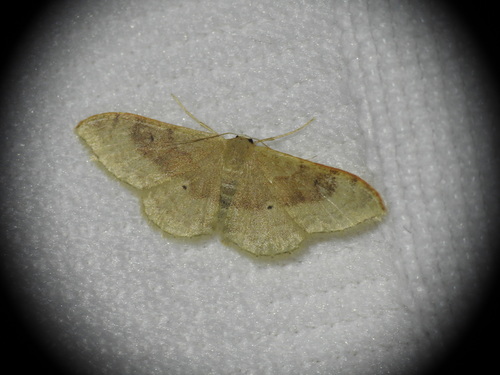
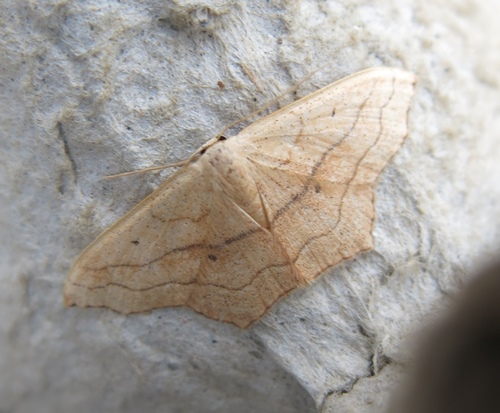
Scopula imitaria, the small blood-vein, is a moth of the family Geometridae. It was first described by Jacob Hübner in 1799 and it is found throughout Europe and in North Africa. The wingspan is 12–26 mm. (1st generation); the next generation is typically much smaller and reaches no more than 18 mm. The forewing leading edge (costa) forms an acute angle with the outer edge forming a sharp point. The hindwings also come to a sharp angle in the middle of the outer edge (a "tail"). The pattern and colouring are variable. The wings are reddish, yellowish or orange to light brown. The lines and marginal line are almost always clear, but fine. The median crossline is clearly developed and inclined slightly diagonally to the inner and outer crossline. It is slightly curved and very weakly wavy and often accompanied by a distal facing shadow. The interior and exterior crosslines are slightly wavy (more clearly than the median line). The hindwings have the pattern, however they often lack the inner crossline. The outer cross line shows a pointed bulge outwards, which follows the "tail" of the perimeter. Discal flecks are only sometimes present or weak, They are more pronounced... Wikipedia →

Global Distribution

Parks Where Found

# Park Country Daily sighting probability
1 Sierra Nevada National Park 🇪🇸 Spain
~10%
2 Cévennes National Park 🇫🇷 France
~10%
3 Sierra de Guadarrama National Park 🇪🇸 Spain
~10%
4 Pyrénées National Park 🇫🇷 France
<5%

Cities Where Found

# City Country Daily sighting probability
1 London 🇬🇧 United Kingdom
~10%
2 Turin 🇮🇹 Italy
~10%
3 Porto 🇵🇹 Portugal
~10%
4 Lyon 🇫🇷 France
~10%
5 Milan 🇮🇹 Italy
~10%
6 Lisbon 🇵🇹 Portugal
<5%
7 Madrid 🇪🇸 Spain
<5%
8 Paris 🇫🇷 France
<5%

Before you go

What are the chances of seeing a Small Blood-Vein in Paris?

Rare

Under 5% of wildlife watchers report a Small Blood-Vein sighting in Paris on a given day, based on 17 verified sightings from GBIF citizen-science data. It is the 402nd most-seen of the 916 insects we can rate there. Over three days the chance rises to about 10%, and over a week to about 30%, if each day is a fresh chance.

When is the best time to see a Small Blood-Vein in Paris?

August

In that month about 10% of wildlife watchers report a Small Blood-Vein in Paris on a given day, against under 5% in September to July, the lowest months.

What time of day is best to see a Small Blood-Vein?

Between 10 pm and 1 am

Across all the parks we cover, that three-hour window holds the most Small Blood-Vein sightings with a recorded time, and about 7 in 10 of them come between 6 pm and 6 am: it is mostly seen at night.

Is Paris the best place to see a Small Blood-Vein?

8th of 8

Of the 8 cities where we can rate Small Blood-Vein sightings, Paris ranks 8th at under 5%. The best odds are in London (United Kingdom, about 10%), Turin (Italy, about 10%) and Porto (Portugal, about 10%).

Which relatives of the Small Blood-Vein live in Paris?

Same family: Geometridae

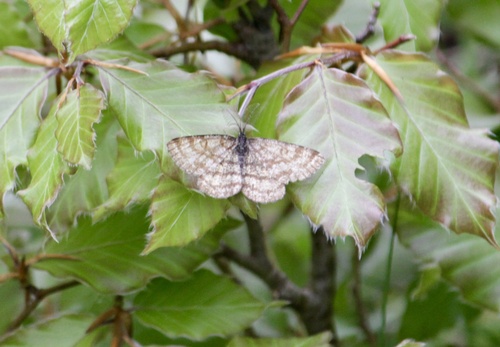
The closest relatives of the Small Blood-Vein that you can see in Paris (family Geometridae, Geometer Moths) are Mottled Umber (about 10%), Small Dusty Wave (about 10%) and Double-Striped Pug (about 10%), with each one's daily chance of a sighting.

Where does the Small Blood-Vein sighting chance come from?

GBIF citizen-science records

It is estimated from how often the Small Blood-Vein is recorded against all the insects logged in Paris (17 verified sightings), calibrated against known sighting rates. Figures are rounded to the nearest 10% because citizen-science data supports honest approximations, not decimals, and months with records from fewer than five people show "—". How it works.
← Back to Paris