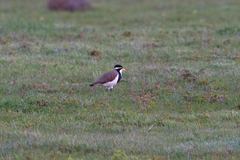
Banded Lapwing

Banded Lapwing

Vanellus tricolor

Silhouette: Rebecca Groom · PhyloPic

LCLeast ConcernNTVUENCR Endemic
Daily sighting probability <5% · Rare
at Perth

In 3 days <5%

55 Verified sightings at Perth
October Best month
☀️ Diurnal When it's spotted

About the Banded Lapwing

The banded lapwing (Vanellus tricolor) is a small to medium-sized shorebird, found in small parties or large flocks on bare ground in open grasslands, agricultural land and open savannah. It is native to Australia and in the past considered as a game bird for hunting. Population estimate is 25 000 - 1 000 000. Other names include banded, black-breasted, brown flock and plain plover.

Lapwings belong to the family Charadriidae (plovers) and sub-family Vanellinae. Biochemical evidence suggests that plovers are holophyletic, meaning that all modern plovers, and no other taxa, share the same common ancestor. It has been suggested that most plovers originated from the Southern Hemisphere and evolved under arid and semi-arid conditions.

There are 25 extant species of lapwings. Africa has the most species of lapwings, while North America has none. Australia has two native species, the masked lapwing and the banded lapwing. The masked lapwing is split into Vanellus miles miles and Vanellus miles novaehollandiae. The first fossils of the Vanellus species were from Belgian deposits retrieved from the middle Oligocene dating back 30 million years ago, the time when the first grasses... Wikipedia →

Sounds

Call0:30

Australia · 2020

© Marc Anderson · XC597157 · CC BY-NC-ND 4.0

Flight call0:22

Australia · 2020

© Ramit Singal · XC570051 · CC BY-NC-SA 4.0

Call0:14

Australia · 2012

© Matthias Feuersenger · XC107950 · CC BY-NC-ND 2.5

Global Distribution

Parks Where Found

# Park Country Daily sighting probability

More parks will be added in future updates.

Cities Where Found

# City Country Daily sighting probability
1 Perth 🇦🇺 Australia
<5%

Zoos & Centres Where Found

# Zoo / Centre Country
1 Alice Springs Desert Park 🇦🇺 Australia In captivity
2 Taronga Zoo 🇦🇺 Australia In captivity
3 Cleland Wildlife Park 🇦🇺 Australia In captivity
4 Moonlit Sanctuary Wildlife Conservation Park 🇦🇺 Australia In captivity
5 Adelaide Zoo 🇦🇺 Australia In captivity
6 Australian Reptile Park 🇦🇺 Australia In captivity
7 Gorge Wildlife Park 🇦🇺 Australia In captivity
8 Symbio Wildlife Park 🇦🇺 Australia In captivity
9 Featherdale Sydney Wildlife Park 🇦🇺 Australia In captivity
10 Caversham Wildlife Park 🇦🇺 Australia In captivity
11 Ranger Red’s Zoo & Conservation Park 🇦🇺 Australia In captivity
12 Wildlife Habitat Port Douglas 🇦🇺 Australia In captivity

Before you go

What are the chances of seeing a Banded Lapwing in Perth?

Rare

Under 5% of wildlife watchers report a Banded Lapwing sighting in Perth on a given day, based on 55 verified sightings from GBIF citizen-science data. It is the 122nd most-seen of the 162 birds we can rate there. Over three days the chance rises to under 5%, if each day is a fresh chance.

When is the best time to see a Banded Lapwing in Perth?

Any time of year

In every month with enough records, under 5% of wildlife watchers report a Banded Lapwing in Perth on a given day, so our monthly data shows no clear season.

What time of day is best to see a Banded Lapwing?

Between 10 am and 1 pm

Across all the parks we cover, that three-hour window holds the most Banded Lapwing sightings with a recorded time, and about 9 in 10 of them come between 6 am and 6 pm: it is a daytime animal.

Where else can you see a Banded Lapwing?

Only Perth, in our data

Perth is the only city on Wallace's Line with enough records to rate Banded Lapwing sightings: under 5% of wildlife watchers there report one on a given day.

Where does the Banded Lapwing sighting chance come from?

GBIF citizen-science records

It is estimated from how often the Banded Lapwing is recorded against all the birds logged in Perth (55 verified sightings), calibrated against known sighting rates. Figures are rounded to the nearest 10% because citizen-science data supports honest approximations, not decimals, and months with records from fewer than five people show "—". How it works.

← Back to Perth