Green Stink Bug

Green Stink Bug

Chinavia hilaris

Daily sighting probability ~10% · With luck
at Philadelphia

In 3 days ~20% in a week ~40%

82 Verified sightings at Philadelphia
156 In all 4 parks From 2019 to 2026
November Best month
☀️ Diurnal When it's spotted

About the Green Stink Bug

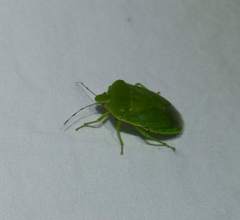
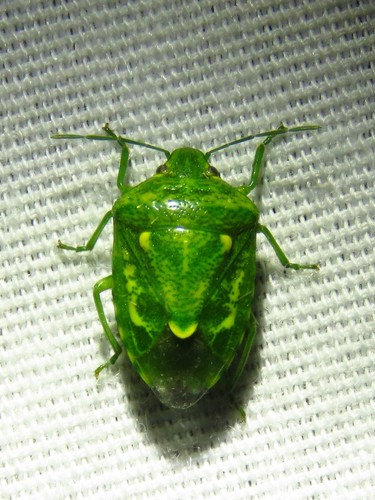
The green stink bug or green soldier bug (Chinavia hilaris) is a stink bug of the family Pentatomidae. The species was previously placed in the genus Acrosternum but has been classified in the genus Chinavia in the more recent literature (e.g., Schwertner and Grazia, 2006). However, the Entomological Society of America has not officially recognized this change despite this shift in scientific naming.

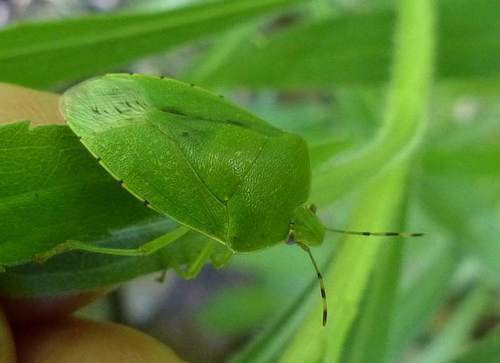
The green stink bug's color is typically bright green, with narrow yellow, orange, or reddish edges. It is a large, shield-shaped bug with an elongate, oval form and a length between 13 and 18 mm. It can be differentiated from the species Nezara viridula by its black outermost three antennal segments. Its anterolateral (= in front and away from the middle) pronotal margin is rather straight and not strongly arced, such as in Chinavia pensylvanica.

Both adults and nymphs have large stink glands on the underside of the thorax, extending more than halfway to the edge of the metapleuron. They discharge large amounts of this foul-smelling liquid when disturbed. This liquid, dried and pulverized, was once used at an industrial level to reinforce the smell... Wikipedia →
Global Distribution

Parks Where Found

# Park Country Daily sighting probability
1 Shenandoah National Park 🇺🇸 United States
~20%
2 Great Smoky Mountains National Park 🇺🇸 United States
~10%
3 Acadia National Park 🇺🇸 United States
<5%
4 Cumbres de Monterrey National Park 🇲🇽 Mexico
<5%

Cities Where Found

# City Country Daily sighting probability
1 Dallas 🇺🇸 United States
~10%
2 Austin 🇺🇸 United States
~10%
3 Boston 🇺🇸 United States
~10%
4 Montreal 🇨🇦 Canada
~10%
5 Washington 🇺🇸 United States
~10%
6 Seattle 🇺🇸 United States
~10%
7 Baltimore 🇺🇸 United States
~10%
8 Philadelphia 🇺🇸 United States
~10%
9 Toronto 🇨🇦 Canada
~10%
10 San Antonio 🇺🇸 United States
~10%

Before you go

What are the chances of seeing a Green Stink Bug in Philadelphia?

With luck

About 10% of wildlife watchers report a Green Stink Bug sighting in Philadelphia on a given day, based on 82 verified sightings from GBIF citizen-science data. It is the 84th most-seen of the 632 insects we can rate there. Over three days the chance rises to about 20%, and over a week to about 40%, if each day is a fresh chance.

When is the best time to see a Green Stink Bug in Philadelphia?

March–April and July–November

In those months about 10% of wildlife watchers report a Green Stink Bug in Philadelphia on a given day, against under 5% in May–June and December–February, the lowest months.

What time of day is best to see a Green Stink Bug?

Between 1 and 4 pm

Across all the parks we cover, that three-hour window holds the most Green Stink Bug sightings with a recorded time, and about 9 in 10 of them come between 6 am and 6 pm: it is a daytime animal.

Is Philadelphia the best place to see a Green Stink Bug?

Among the best

Of the 24 cities where we can rate Green Stink Bug sightings, Philadelphia ranks 8th at about 10%, level with the leaders once rounded. The best odds are in Dallas (United States, about 10%), Austin (United States, about 10%) and Boston (United States, about 10%).

Which relatives of the Green Stink Bug live in Philadelphia?

Same family: Pentatomidae

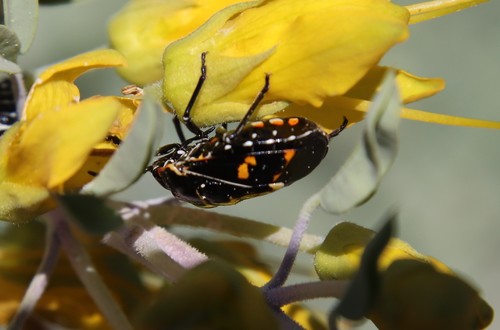
The closest relatives of the Green Stink Bug that you can see in Philadelphia (family Pentatomidae, Stink Bugs) are Brown Marmorated Stink Bug (about 10%), Harlequin Bug (about 10%) and Juniper Stink Bug (about 10%), with each one's daily chance of a sighting.

Where does the Green Stink Bug sighting chance come from?

GBIF citizen-science records

It is estimated from how often the Green Stink Bug is recorded against all the insects logged in Philadelphia (82 verified sightings), calibrated against known sighting rates. Figures are rounded to the nearest 10% because citizen-science data supports honest approximations, not decimals, and months with records from fewer than five people show "—". How it works.

← Back to Philadelphia