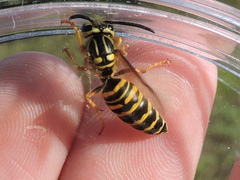
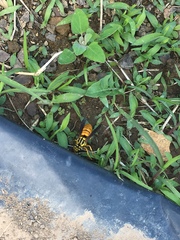
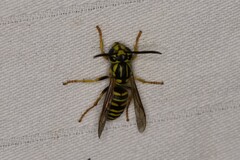
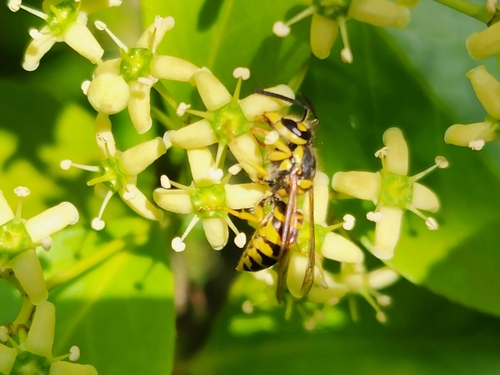
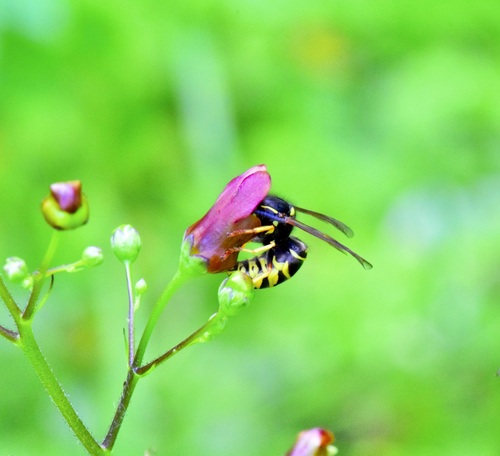
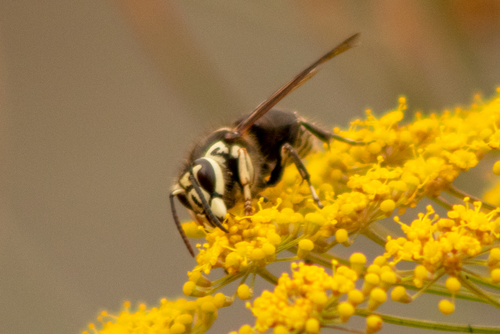
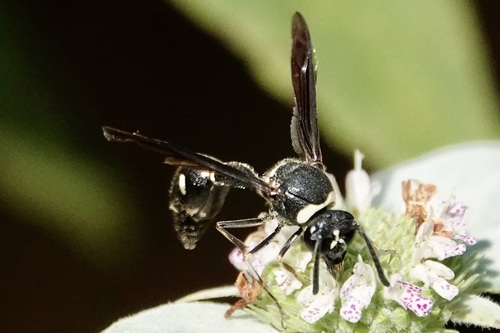
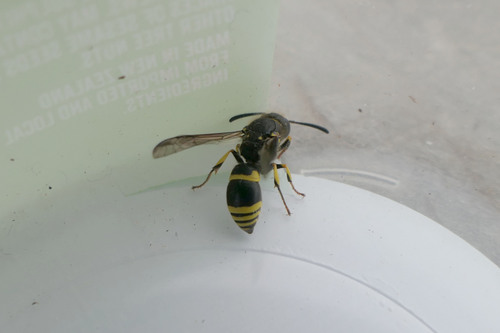
Southern Yellowjacket
Daily sighting probability ~10% · With luck
at Philadelphia

In 3 days ~30% in a week ~60%

139 Verified sightings at Philadelphia
34 In all 4 parks From 2019 to 2026
May Best month
☀️ Diurnal When it's spotted

About the Southern Yellowjacket

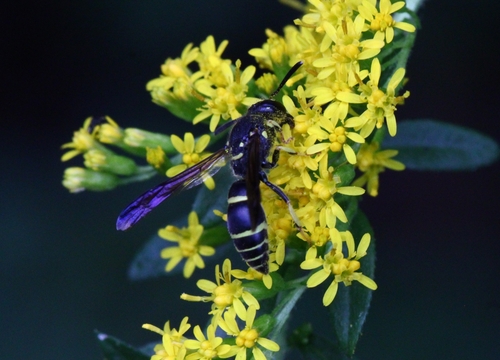
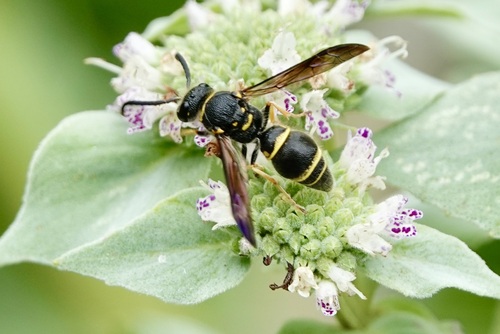
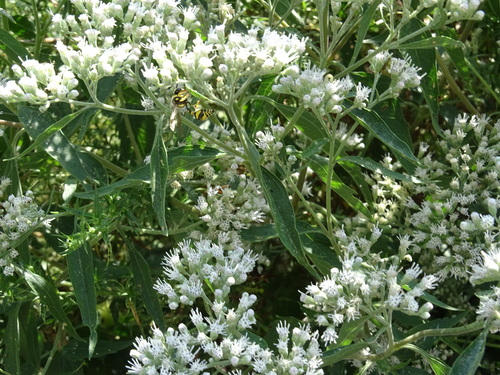
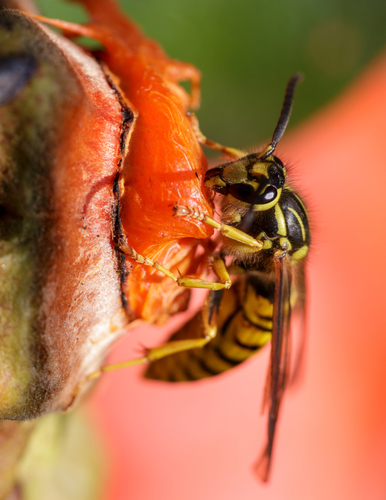
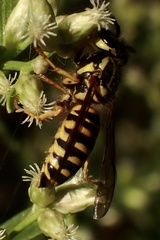
Vespula squamosa, or the southern yellowjacket, is a social wasp. This species can be identified by its distinctive black and yellow patterning and orange queen. This species is typically found in eastern North America, and its territory extends as far south as Central America. Within these territories, they create enormous, multiple-comb nests. The colonies may be either annual or perennial depending on the climate, and in many perennial nests, polygyny takes place. In addition, this species uses pheromones both as a sexual attractant and an alarm signal. This species feeds on insects and animal carcasses; it does not produce honey. V. squamosa, a social insect, has developed a parasitic relationship with the species V. vidua and V. maculifrons. Due to their painful, venomous stings, the species is considered a pest.

V. squamosa is commonly called the southern yellowjacket. It was described by Dru Drury around 1770. It is a member of the family Vespidae, which includes paper wasps (subfamily Polistinae), pollen wasps (subfamily Masarinae), potter and mason wasps (subfamily Eumeninae), and yellow jackets (subfamily Vespinae). The family Vespidae has about... Wikipedia →
Global Distribution

Parks Where Found

# Park Country Daily sighting probability
1 Everglades National Park 🇺🇸 United States
~10%
2 Merritt Island National Wildlife Refuge 🇺🇸 United States
~10%
3 Shenandoah National Park 🇺🇸 United States
~10%
4 Great Smoky Mountains National Park 🇺🇸 United States
<5%

Cities Where Found

# City Country Daily sighting probability
1 Toluca 🇲🇽 México
~20%
2 Baltimore 🇺🇸 United States
~10%
3 Philadelphia 🇺🇸 United States
~10%
4 Austin 🇺🇸 United States
~10%
5 Dallas 🇺🇸 United States
~10%
6 Washington 🇺🇸 United States
~10%
7 San Antonio 🇺🇸 United States
~10%
8 Puebla 🇲🇽 México
~10%
9 Mexico City 🇲🇽 México
~10%
10 New York City 🇺🇸 United States
~10%

Before you go

What are the chances of seeing a Southern Yellowjacket in Philadelphia?

With luck

About 10% of wildlife watchers report a Southern Yellowjacket sighting in Philadelphia on a given day, based on 139 verified sightings from GBIF citizen-science data. It is the 34th most-seen of the 632 insects we can rate there. Over three days the chance rises to about 30%, and over a week to about 60%, if each day is a fresh chance.

When is the best time to see a Southern Yellowjacket in Philadelphia?

May

In that month about 20% of wildlife watchers report a Southern Yellowjacket in Philadelphia on a given day, against about 10% in June to April, the lowest months.

What time of day is best to see a Southern Yellowjacket?

Between 8 and 11 am

Across all the parks we cover, that three-hour window holds the most Southern Yellowjacket sightings with a recorded time, and about 9 in 10 of them come between 6 am and 6 pm: it is a daytime animal.

Is Philadelphia the best place to see a Southern Yellowjacket?

3rd of 12

Of the 12 cities where we can rate Southern Yellowjacket sightings, Philadelphia ranks 3rd at about 10%. The best odds are in Toluca (México, about 20%) and Baltimore (United States, about 10%).

Which relatives of the Southern Yellowjacket live in Philadelphia?

Same genus: Vespula

The closest relatives of the Southern Yellowjacket that you can see in Philadelphia (genus Vespula, Ground Yellowjackets) are Eastern Yellowjacket (about 10%) and German Yellowjacket (about 10%), with each one's daily chance of a sighting.

Where does the Southern Yellowjacket sighting chance come from?

GBIF citizen-science records

It is estimated from how often the Southern Yellowjacket is recorded against all the insects logged in Philadelphia (139 verified sightings), calibrated against known sighting rates. Figures are rounded to the nearest 10% because citizen-science data supports honest approximations, not decimals, and months with records from fewer than five people show "—". How it works.

← Back to Philadelphia