Canyon Bat

Canyon Bat

Parastrellus hesperus

Silhouette: PhyloPic

LCLeast ConcernNTVUENCR
Daily sighting probability <5% · Rare
at Phoenix

In 3 days ~10% in a week ~20%

5 Verified sightings at Phoenix
25 In all 3 parks From 2019 to 2026
October Best month
☀️🌙 Day & Night When it's spotted

About the Canyon Bat

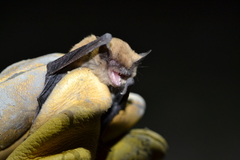
The canyon bat (Parastrellus hesperus), also known as the western pipistrelle, or American parastrelle is a species of vesper bat. It is found in Mexico and in the western United States. The species has historically been placed in the genus Pipistrellus, but molecular evidence does not show any close relationship with that genus, and accordingly it was classified into its own genus, Parastrellus, in 2006.

Parastrellus hesperus is the smallest bat in the United States. It has a wingspan of 190–215 millimetres (7.5–8.5 in) and a body length of 62–80 millimetres (2.4–3.1 in). The tail is 29–30 millimetres (1.1–1.2 in), the hind feet are 5 millimetres (0.20 in), and the ears are 9 millimetres (0.35 in). On average, females are slightly larger than males of this species. P. hesperus ranges in color from white to pale yellow to dark brown. These bats exhibit counter shading, being dark above and lighter colored below. Their faces, ears, feet, and flight membranes are usually very dark, almost black. The pelage is 3–4 millimetres (0.12–0.16 in) long and is full and soft. The bases of all the hairs are black with the distal portions fading to lighter shades. The wings... Wikipedia →

Global Distribution

Parks Where Found

# Park Country Daily sighting probability
1 Death Valley National Park 🇺🇸 United States
~10%
2 Saguaro National Park 🇺🇸 United States
~10%
3 Joshua Tree National Park 🇺🇸 United States
<5%

Cities Where Found

# City Country Daily sighting probability
1 Las Vegas 🇺🇸 United States
~10%
2 Phoenix 🇺🇸 United States
<5%
3 Los Angeles 🇺🇸 United States
<5%

Before you go

What are the chances of seeing a Canyon Bat in Phoenix?

Rare

Under 5% of wildlife watchers report a Canyon Bat sighting in Phoenix on a given day, based on 5 verified sightings from GBIF citizen-science data. It is the 14th most-seen of the 14 mammals we can rate there. Over three days the chance rises to about 10%, and over a week to about 20%, if each day is a fresh chance.

When is the best time to see a Canyon Bat in Phoenix?

March, June and October

In those months about 10% of wildlife watchers report a Canyon Bat in Phoenix on a given day, against under 5% in April–May, July–September and November–February, the lowest months. Those are among Phoenix's driest months, with about 10 mm of rain a month against 35 mm in January.

What time of day is best to see a Canyon Bat?

Between 7 and 10 pm

Across all the parks we cover, that three-hour window holds the most Canyon Bat sightings with a recorded time, and about half of them come between 6 am and 6 pm: it is seen both by day and at night.

Is Phoenix the best place to see a Canyon Bat?

2nd of 3

Of the 3 cities where we can rate Canyon Bat sightings, Phoenix ranks 2nd at under 5%. The best odds are in Las Vegas (United States, about 10%).

Where does the Canyon Bat sighting chance come from?

GBIF citizen-science records

It is estimated from how often the Canyon Bat is recorded against all the mammals logged in Phoenix (5 verified sightings), calibrated against known sighting rates. Figures are rounded to the nearest 10% because citizen-science data supports honest approximations, not decimals, and months with records from fewer than five people show "—". How it works.

← Back to Phoenix