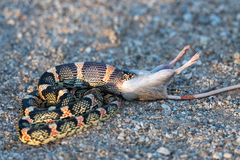
Long-nosed Snake

Long-nosed Snake

Rhinocheilus lecontei

Silhouette: Alex Slavenko · PhyloPic

LCLeast ConcernNTVUENCR
Daily sighting probability ~10% · With luck
at Phoenix

In 3 days ~20% in a week ~40%

23 Verified sightings at Phoenix
205 In all 4 parks From 2019 to 2026
August Best month
🌙 Nocturnal When it's spotted

About the Long-nosed Snake

The long-nosed snake (Rhinocheilus lecontei) is a species of nonvenomous snake in the family Colubridae. The species is endemic to North America. It has two recognized subspecies. The other species in the genus were previously considered subspecies.

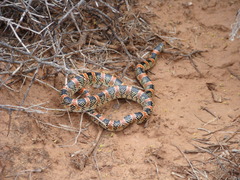
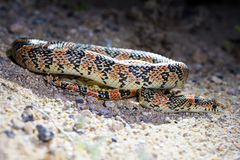
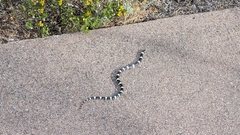
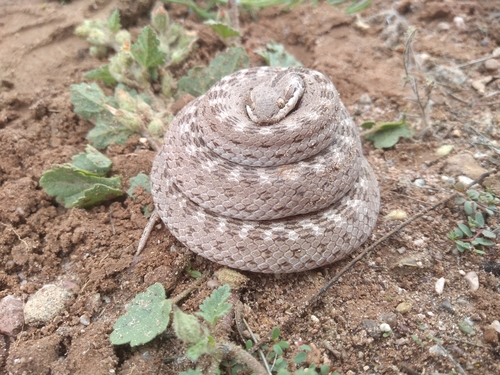
The specific name, lecontei, commemorates American entomologist John Lawrence Le Conte (1825–1883). The long-nosed snake is distinguished by a long, slightly upturned snout, which is the origin of its common name. It is tricolor, vaguely resembling a coral snake, with black and red saddling on a yellow or cream-colored background. Cream-colored spots within the black saddles are a distinct characteristic of the long-nosed snake. It differs from all other harmless snakes in the United States by having undivided subcaudal scales. The total length (including tail) of adults is usually 22–32 in (56–81 cm), but the maximum record total length is 41 in (100 cm).

R. lecontei is a shy, nocturnal burrowing snake. It spends most of its time buried underground. The long-nosed snake feeds on lizards, amphibians, and sometimes smaller snakes and infrequently rodents. R. lecontei... Wikipedia →

Global Distribution

Parks Where Found

# Park Country Daily sighting probability
1 Big Bend National Park 🇺🇸 United States
~20%
2 Saguaro National Park 🇺🇸 United States
~20%
3 Death Valley National Park 🇺🇸 United States
~20%
4 Joshua Tree National Park 🇺🇸 United States
~10%

Cities Where Found

# City Country Daily sighting probability
1 Phoenix 🇺🇸 United States
~10%
2 San Diego 🇺🇸 United States
<5%

Zoos & Centres Where Found

# Zoo / Centre Country
1 Living Desert Zoo and Gardens 🇺🇸 United States In captivity
2 Phoenix Zoo 🇺🇸 United States In captivity
3 Fort Worth Zoo 🇺🇸 United States In captivity
4 Children's Aquarium at Fair Park 🇺🇸 United States In captivity

Before you go

What are the chances of seeing a Long-nosed Snake in Phoenix?

With luck

About 10% of wildlife watchers report a Long-nosed Snake sighting in Phoenix on a given day, based on 23 verified sightings from GBIF citizen-science data. It is the 15th most-seen of the 23 reptiles we can rate there. Over three days the chance rises to about 20%, and over a week to about 40%, if each day is a fresh chance.

When is the best time to see a Long-nosed Snake in Phoenix?

March to September

In those months about 10% of wildlife watchers report a Long-nosed Snake in Phoenix on a given day, against under 5% in October to February, the lowest months.

What time of day is best to see a Long-nosed Snake?

Between 8 and 11 pm

Across all the parks we cover, that three-hour window holds the most Long-nosed Snake sightings with a recorded time, and about 8 in 10 of them come between 6 pm and 6 am: it is mostly seen at night.

Is Phoenix the best place to see a Long-nosed Snake?

Yes

Of the 2 cities where we can rate Long-nosed Snake sightings, Phoenix has the highest daily chance: about 10%. Next come San Diego (United States, under 5%).

Which relatives of the Long-nosed Snake live in Phoenix?

Same family: Colubridae

The closest relatives of the Long-nosed Snake that you can see in Phoenix (family Colubridae, Colubrid Snakes) are California King Snake (about 10%), Gopher Snake (about 10%) and Ground Snake (about 10%), with each one's daily chance of a sighting.

Where does the Long-nosed Snake sighting chance come from?

GBIF citizen-science records

It is estimated from how often the Long-nosed Snake is recorded against all the reptiles logged in Phoenix (23 verified sightings), calibrated against known sighting rates. Figures are rounded to the nearest 10% because citizen-science data supports honest approximations, not decimals, and months with records from fewer than five people show "—". How it works.

← Back to Phoenix