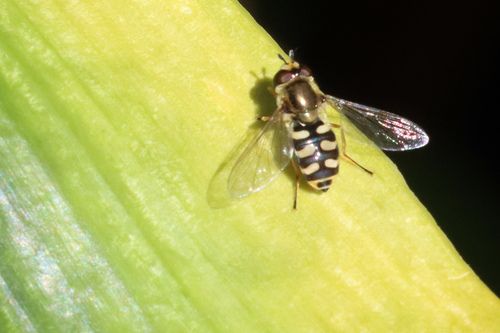
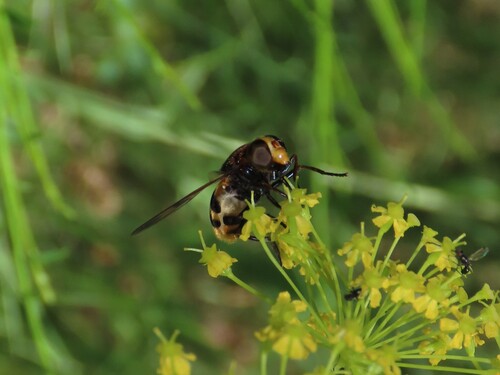
Milesia crabroniformis

Milesia crabroniformis

Milesia crabroniformis

Daily sighting probability <5% · Rare
at Porto

In 3 days ~10% in a week ~30%

14 Verified sightings at Porto
89 In all 3 parks From 2019 to 2026
July Best month
☀️ Diurnal When it's spotted

About the Milesia crabroniformis

Milesia crabroniformis is a species of flower flies or hoverflies belonging to the family Syrphidae subfamily Eristalinae. This species is mainly present in Belgium, France, Greece, Italy, Spain, Portugal, Switzerland, in the Near East and in North Africa.

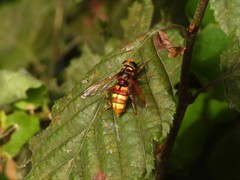
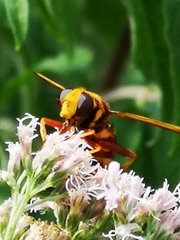
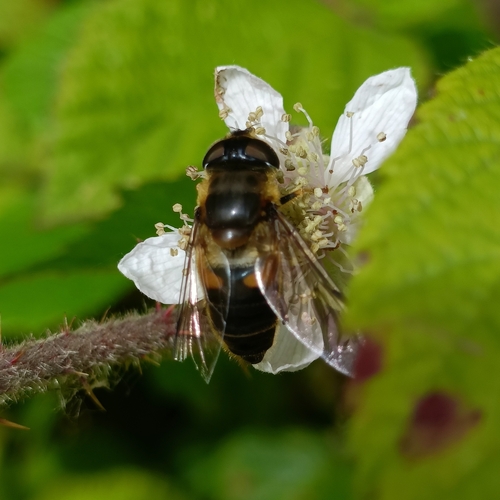
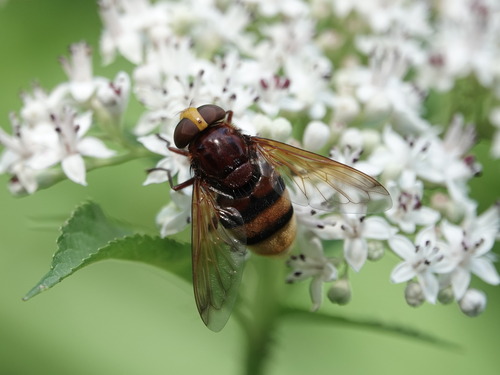
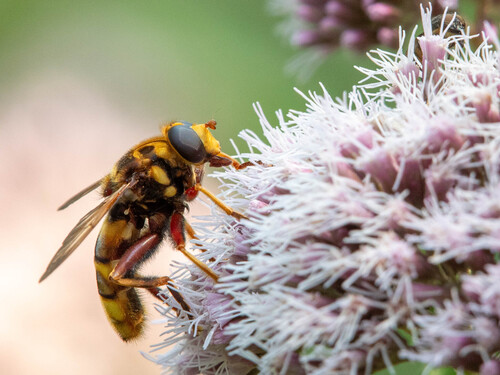
The adults of Milesia crabroniformis grow up to 22–25 millimetres (0.87–0.98 in) long. These rather uncommon hoverflies are the largest among the European species. They show a yellow face, reddish femurs, a yellow-brown abdomen and its wings are shaded with yellow-orange. Eyes of males are holoptic, although they meet along the dorsal length of the head in a very low point of contact.

They mimic the hornet species Vespa crabro (hence the Latin name crabroniformis, meaning ‘hornet-formed’). It is also very similar to Volucella zonaria, a smaller syrphid. Adults can mainly be encountered from June through October, with a peak at the end of August. They inhabit evergreen and deciduous forests (Quercus and Fagus species), feeding on nectar of flowers of several plants (Apiaceae species, Lythrum salicaria, Mentha aquatica, Sambucus ebulus, Hedera species, Cirsium species, etc.).

Their... Wikipedia →
Global Distribution

Parks Where Found

# Park Country Daily sighting probability
1 Cévennes National Park 🇫🇷 France
~10%
2 Pyrénées National Park 🇫🇷 France
~10%
3 Sierra de Guadarrama National Park 🇪🇸 Spain
<5%

Cities Where Found

# City Country Daily sighting probability
1 Porto 🇵🇹 Portugal
<5%

Before you go

What are the chances of seeing a Milesia crabroniformis in Porto?

Rare

Under 5% of wildlife watchers report a Milesia crabroniformis sighting in Porto on a given day, based on 14 verified sightings from GBIF citizen-science data. It is the 283rd most-seen of the 498 insects we can rate there. Over three days the chance rises to about 10%, and over a week to about 30%, if each day is a fresh chance.

When is the best time to see a Milesia crabroniformis in Porto?

July to September

In those months about 10% of wildlife watchers report a Milesia crabroniformis in Porto on a given day, against under 5% in October to June, the lowest months. Those are among Porto's driest months, with about 30 mm of rain a month against 140 mm in January.

What time of day is best to see a Milesia crabroniformis?

Between noon and 3 pm

Across all the parks we cover, that three-hour window holds the most Milesia crabroniformis sightings with a recorded time, and about 9 in 10 of them come between 6 am and 6 pm: it is a daytime animal.

Where else can you see a Milesia crabroniformis?

Only Porto, in our data

Porto is the only city on Wallace's Line with enough records to rate Milesia crabroniformis sightings: under 5% of wildlife watchers there report one on a given day.

Which relatives of the Milesia crabroniformis live in Porto?

Same family: Syrphidae

The closest relatives of the Milesia crabroniformis that you can see in Porto (family Syrphidae, Hover Flies) are Marmalade Hover Fly (about 10%), Stripe-Eyed Lagoon Fly (about 10%) and Common Drone Fly (about 10%), with each one's daily chance of a sighting.

Where does the Milesia crabroniformis sighting chance come from?

GBIF citizen-science records

It is estimated from how often the Milesia crabroniformis is recorded against all the insects logged in Porto (14 verified sightings), calibrated against known sighting rates. Figures are rounded to the nearest 10% because citizen-science data supports honest approximations, not decimals, and months with records from fewer than five people show "—". How it works.

← Back to Porto