Common Cerulean

Common Cerulean

Jamides celeno

Daily sighting probability ~20% · Possible
at Prayagraj

In 3 days ~40% in a week ~70%

10 Verified sightings at Prayagraj
48 In all 5 parks From 2019 to 2026
September Best month
☀️ Diurnal When it's spotted

About the Common Cerulean

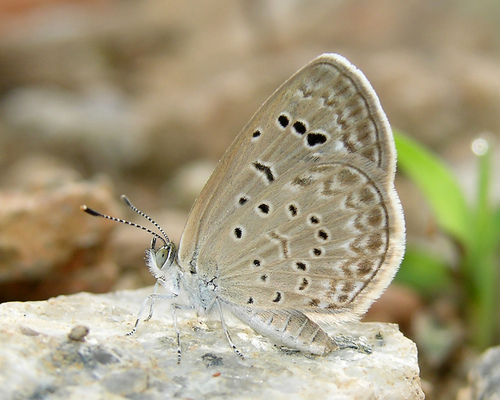
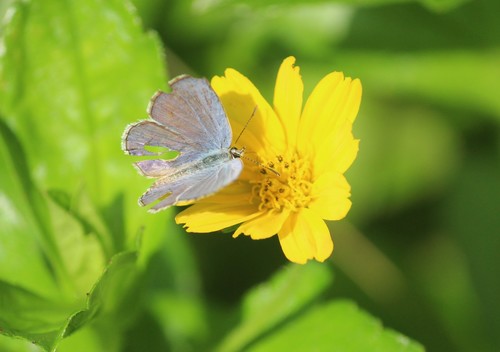
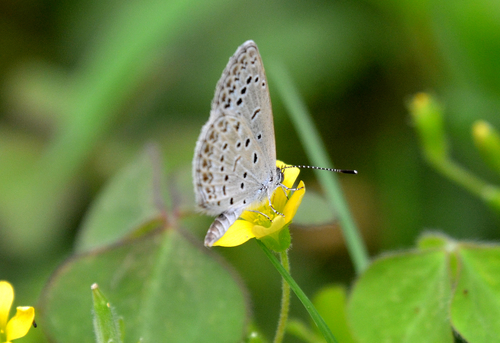
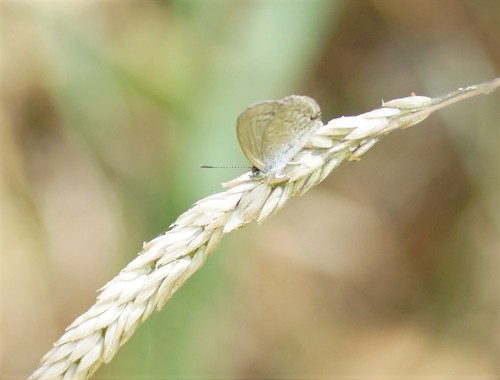
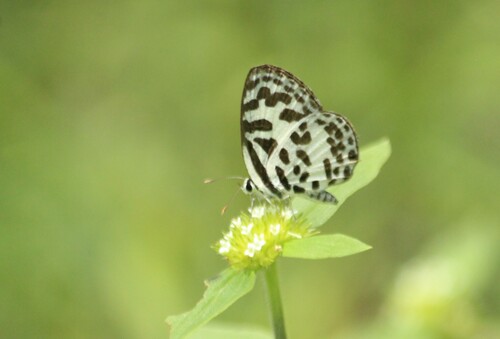
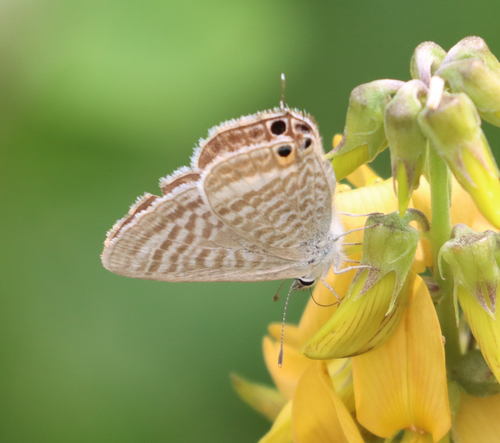
Jamides celeno, the common cerulean, is a small butterfly found in Indomalayan realm belonging to the lycaenids or blues family. The species was first described by Pieter Cramer in 1775. Like many tropical butterflies, this species shows seasonal polyphenism, with the appearance differing between adults according to the season.

Male upperside has the ground colour pale bluish white. The forewing has the terminal margin narrowly edged with black that broadens very slightly towards the apex of the wing; the cilia are brownish black. The hindwing is uniformly coloured, except for an anteciliary black line faintly edged on the inner side by a white line within which and touching it is a row of black spots, the anterior spots very faint, the spot in interspace 2 large and well-defined, two geminate (paired) spots in interspace 1 and a very small black lunular dot in interspace 1a; cilia brown, white at the base in the interspaces. In specimens obtained in the height of the dry season the black edging to the termen of the forewing is much reduced and the subterminal series of black spots in the hindwing is altogether missing.

The underside is greyish... Wikipedia →

Global Distribution

Parks Where Found

# Park Country Daily sighting probability
1 Periyar National Park 🇮🇳 India
~30%
2 Sinharaja Forest Reserve 🇱🇰 Sri Lanka
~30%
3 Tangkoko Nature Reserve 🇮🇩 Indonesia
~20%
4 Kanha National Park 🇮🇳 India
~10%
5 Minneriya National Park 🇱🇰 Sri Lanka
~10%

Cities Where Found

# City Country Daily sighting probability
1 Salem 🇮🇳 India
~40%
2 Jabalpur 🇮🇳 India
~30%
3 Thiruvananthapuram 🇮🇳 India
~30%
4 Bengaluru 🇮🇳 India
~30%
5 Kozhikode 🇮🇳 India
~30%
6 Coimbatore 🇮🇳 India
~20%
7 Raipur 🇮🇳 India
~20%
8 Guwahati 🇮🇳 India
~20%
9 Chattogram 🇧🇩 Bangladesh
~20%
10 Chennai 🇮🇳 India
~20%

Before you go

What are the chances of seeing a Common Cerulean in Prayagraj?

Possible

About 20% of wildlife watchers report a Common Cerulean sighting in Prayagraj on a given day, based on 10 verified sightings from GBIF citizen-science data. It is the 69th most-seen of the 117 insects we can rate there. Over three days the chance rises to about 40%, and over a week to about 70%, if each day is a fresh chance.

When is the best time to see a Common Cerulean in Prayagraj?

September

In that month about 30% of wildlife watchers report a Common Cerulean in Prayagraj on a given day, against under 5% in October to August, the lowest months. That is one of Prayagraj's wettest months, with about 160 mm of rain against almost none in November.

What time of day is best to see a Common Cerulean?

Between 10 am and 1 pm

Across all the parks we cover, that three-hour window holds the most Common Cerulean sightings with a recorded time, and about 8 in 10 of them come between 6 am and 6 pm: it is a daytime animal.

Is Prayagraj the best place to see a Common Cerulean?

19th of 27

Of the 27 cities where we can rate Common Cerulean sightings, Prayagraj ranks 19th at about 20%. The best odds are in Salem (India, about 40%), Jabalpur (India, about 30%) and Thiruvananthapuram (India, about 30%).

Which relatives of the Common Cerulean live in Prayagraj?

Same family: Lycaenidae

The closest relatives of the Common Cerulean that you can see in Prayagraj (family Lycaenidae, Gossamer-winged Butterflies) are Plains Cupid (about 30%), Dark Grass Blue (about 30%) and Lime Blue (about 30%), with each one's daily chance of a sighting.

Where does the Common Cerulean sighting chance come from?

GBIF citizen-science records

It is estimated from how often the Common Cerulean is recorded against all the insects logged in Prayagraj (10 verified sightings), calibrated against known sighting rates. Figures are rounded to the nearest 10% because citizen-science data supports honest approximations, not decimals, and months with records from fewer than five people show "—". How it works.

← Back to Prayagraj