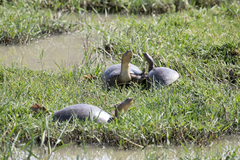
Indian Flap-shelled Turtle

Indian Flap-shelled Turtle

Lissemys punctata

Silhouette: Armin Reindl · PhyloPic

LCNTVUVulnerableENCR
Daily sighting probability ~10% · With luck
at Pune

In 3 days ~30% in a week ~50%

12 Verified sightings at Pune
40 In all 4 parks From 2019 to 2026
November Best month
☀️ Diurnal When it's spotted

About the Indian Flap-shelled Turtle

The Indian flapshell turtle (Lissemys punctata) is a freshwater species of turtle found in South Asia. The "flap-shelled" name stems from the presence of femoral flaps located on the plastron. These flaps of skin cover the limbs when they retract into the shell. What protection the flaps offer against predators is unclear. Indian flapshell turtles are widespread and common in the South Asian provinces. It is morphologically an evolutionary link between the softshell and hardshell aquatic turtles. Exploitation for profit and habitat change are threats to their survival.

The carapace of L. punctata viewed from above is broadly oval in adults, but more circular in young, widest just anterior to hind limbs. The width of the disc is 77–86% of its length, the carapace is moderately arched, shell height is 35.0–40.5% of carapace length, the margin of the carapace is smooth and slightly flared posteriorly, the marginal bones are not united with the pleurals, the plastron is large but mostly cartilaginous, and its length is 88–97% of the carapace length. A pair of large flaps can be closed over the hind limbs with a smaller flap over tail; seven plastral callosities are present... Wikipedia →

Sounds

Recording0:12

India · 2024

© sudhamathy · iNaturalist · CC BY-NC 4.0

Global Distribution

Parks Where Found

# Park Country Daily sighting probability
1 Kanha National Park 🇮🇳 India
~40%
2 Ranthambore National Park 🇮🇳 India
~30%
3 Satpura National Park 🇮🇳 India
~20%
4 Keoladeo National Park 🇮🇳 India
~20%

Cities Where Found

# City Country Daily sighting probability
1 Jabalpur 🇮🇳 India
~30%
2 Kochi 🇮🇳 India
~30%
3 Hyderabad 🇮🇳 India
~10%
4 Chennai 🇮🇳 India
~10%
5 Kolkata 🇮🇳 India
~10%
6 Pune 🇮🇳 India
~10%
7 Mumbai 🇮🇳 India
~10%

Zoos & Centres Where Found

# Zoo / Centre Country
1 San Diego Zoo 🇺🇸 United States In captivity
2 Nandankanan Zoological Park 🇮🇳 India In captivity
3 Nehru Zoological Park 🇮🇳 India In captivity
4 Jijamata Udyaan 🇮🇳 India In captivity
5 Children's Park, Guindy 🇮🇳 India In captivity
6 Crocodile Bank 🇮🇳 India In captivity

Before you go

What are the chances of seeing an Indian Flap-shelled Turtle in Pune?

With luck

About 10% of wildlife watchers report an Indian Flap-shelled Turtle sighting in Pune on a given day, based on 12 verified sightings from GBIF citizen-science data. It is the 12th most-seen of the 20 reptiles we can rate there. Over three days the chance rises to about 30%, and over a week to about 50%, if each day is a fresh chance.

When is the best time to see an Indian Flap-shelled Turtle in Pune?

October and November

In those months about 20% of wildlife watchers report an Indian Flap-shelled Turtle in Pune on a given day, against under 5% in March, May and December–January, the lowest months. Those are among Pune's driest months, with about 65 mm of rain a month against 520 mm in July.

What time of day is best to see an Indian Flap-shelled Turtle?

Between 9 am and noon

Across all the parks we cover, that three-hour window holds the most Indian Flap-shelled Turtle sightings with a recorded time, and about 7 in 10 of them come between 6 am and 6 pm: it is a daytime animal.

Is Pune the best place to see an Indian Flap-shelled Turtle?

6th of 7

Of the 7 cities where we can rate Indian Flap-shelled Turtle sightings, Pune ranks 6th at about 10%. The best odds are in Jabalpur (India, about 30%), Kochi (India, about 30%) and Hyderabad (India, about 10%).

Where does the Indian Flap-shelled Turtle sighting chance come from?

GBIF citizen-science records

It is estimated from how often the Indian Flap-shelled Turtle is recorded against all the reptiles logged in Pune (12 verified sightings), calibrated against known sighting rates. Figures are rounded to the nearest 10% because citizen-science data supports honest approximations, not decimals, and months with records from fewer than five people show "—". How it works.

← Back to Pune